
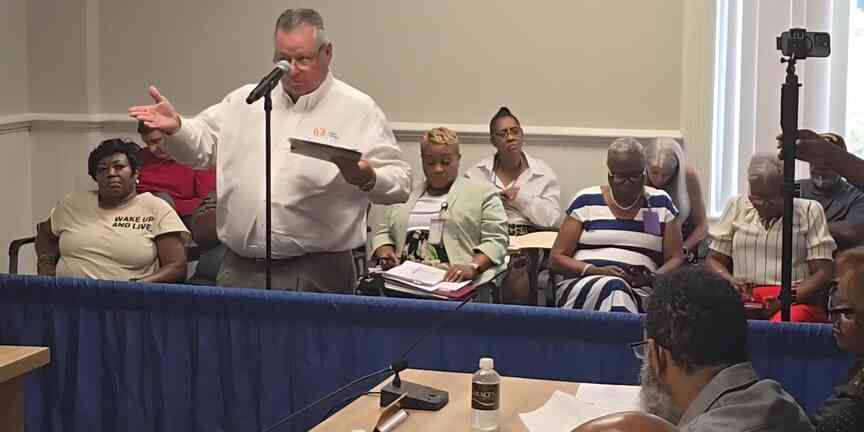
A recent meeting of the Jefferson County Quorum Court was fraught with tension and a lack of a quorum, leaving the group of elected officials unable to address pressing financial issues, particularly concerning overdue lease payments and budget disputes. The meeting, initially unable to proceed due to insufficient attendance, eventually saw some justices of the peace convene for a separate session.
The initial attempt to hold the meeting was abandoned shortly after 5:30 p.m. on Monday due to the absence of a quorum. Several justices of the peace, including Alfred Carroll, Reginald Adams, Reginald Johnson, Margarette Williams, Melanie Dumas and Brenda Bishop-Gaddy, were absent from Monday’s Jefferson County Quorum Court meeting. However, these members, along with Richard Victorino and Cedric Jackson, attended the second Quorum Court meeting called by the majority of the court.
Jimmy Fisher, Ted Harden, Roy Agee and Patricia Royal-Johnson attended the first meeting alongside Victorino and Jackson. “We need nine to have a quorum to have a meeting,” said Jefferson County Judge Gerald Robinson. “It appears that this quorum court wants to play cat and mouse and … we have business of the county that needs to be taken care of.”
A major point of contention was an overdue internal transfer of funds, needed to pay the FBT lease and lease interest, which has been pending since May 2024. Robinson emphasized the urgency. “We’re not able to do that because these individuals will not participate, will not do an internal transfer to make this so that we can make this payment,” he said.
He clarified that the request was not for new appropriations but for internal reallocation, necessitated by the layoff of 10 people to ensure sufficient cash and appropriations. Robinson warned of severe repercussions. “We are setting ourselves up for civil liability if we do not get that business taken care of,” he said. He also mentioned that FBT Bank had contacted some individuals to explain “how detrimental this would be to the county.”
Independent reporting for Pine Bluff & Jefferson County since 1879.
Scottie Ray, executive vice president of FBT Bank and Mortgage, attended the meeting and expressed his dismay. He refuted claims by a quorum court member that they were unaware of the lease situation, calling it “a bald-faced lie.”
“Ms. (Shawndra) Taggart has written checks for the last five years that come out of her office,” he said. He detailed the critical financial state, saying, “We’re 126 days late on these leases.” Ray conveyed the gravity of the situation for the bank: “Tuesday, I have to go to my board and report this … they got to go to the state with this,” he said.
He warned of potential “lawsuits … and repossessions of equipment,” which would severely impact the county’s ability to maintain roads and other essential services. Ray articulated the broader economic implications.
“Why would anybody come here and start a business? We have a railroad, we have water, we have a port, and a major interstate runs through this county. Why would anybody bring any kind of big company here if we can’t even run our county?” he said. “We’re in dangerous territory.”
The conflict also extended to the setting of meeting agendas. County Clerk Deputy Chief Tiffany Lowrey explained the procedure. “The items that need to be placed on the agenda are supposed to be sent to the county clerk’s office,” she said. “We compile the information and then we send out the agenda coming from the county clerk’s office per the procedure ordinance.”
She stated that the county judge’s office later “went in and changed up the items, moved their items first and put everything else second,” which is not following the ordinance. “The county judge sent his items to the county clerk’s office to be put on the agenda. The items were sent out, the agenda was done, and then we received a second email from the county judge’s office where they went in and changed up the items, moved their items first, and put everything else second,” she said.
Justice Melanie Dumas described this as “another stunt to personally attack us because the FBT was on the agenda to be done.”
“We do want to give him his money and we want to vote on it, but we still have to follow the law,” she said.”The procedural ordinance is the law and states that the agenda comes from the clerk’s office and this has got to stop.”
Despite the procedural disagreements, the remaining quorum court members proceeded with their meeting, chaired by Justice of the Peace Alfred Caroll. During this session, several appropriation ordinances were put to a vote, largely passing with an 8-0 vote.
One pressing ordinance included an ordinance to create one additional slot and increase various existing slots within the Juvenile Justice Education to align with surrounding school districts. It requested a supplemental appropriation of $217,886 for salaries, FICA, retirement and insurance, with retroactive pay effective January 1, 2025.
Robinson claims that there were certain quorum court members who “once we leave, he seems to be the spokesperson and know it all for the county.” Robinson described the actions of the quorum court members as “detrimental to the county” and said that “everything that comes through my office, in my opinion and the road department, they voted against and we’re not able to do any business.”
Regarding the agenda dispute, Robinson implicitly countered the claims of the justices of the peace, stating that the items on the agenda “did go through the county clerk’s office.”
“We sent it to the county clerk’s office first. We added those agenda items that came out of committee. So those were the changes. So it really was not any changes,” he said. “None of that stuff came through committee.”
He accused the justices of contradicting themselves and “being hypocritical” and trying to “usurp authority,” having “their own separate meetings, a government within a government.” He also questioned how they could “decide on 12 items and that you’re going to be a super sponsor to that without having a meeting to even know what’s on the agenda.”
Last week, he elaborated on concerns about “supersponsorship” and how it relates to items bypassing the committee process. Even with supersponsorship, the ordinance must still go through the committee, according to Robinson.
The county judge’s office has called a special quorum court meeting for Monday.