
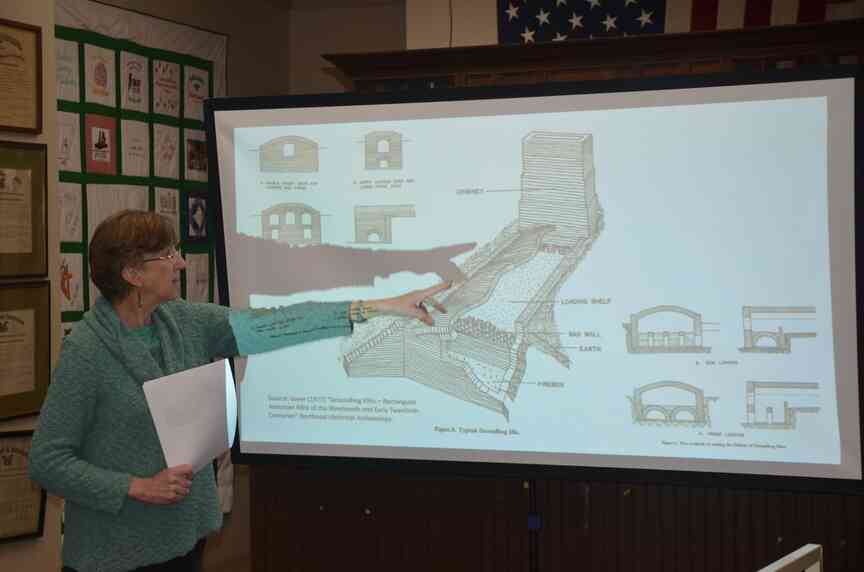
Mary Beth Trubitt, the Arkansas Archaeological Survey’s Research Station archaeologist at Henderson State University, presented a program about early pioneer craftsmanship in Dallas County.
The lecture, titled “The Nineteenth-Century Pottery Industry in Dallas County,” was presented Friday to 15 guests of the Dallas County Museum in Fordyce. This is the museum’s second year to participate in Arkansas Archaeology Month, which is sponsored every March by the archeological survey and the Arkansas Archeological Society.
“I’m happy to be back in Fordyce,” Trubitt said. “You’re always so welcoming, I need to come back more often.”
She explained how the study of regional ceramic making concerns the disciplines of both archaeology and history.
“Archaeology can tell us about the facilities and techniques and their spatial distribution across the landscape as well as the products and their uses. Historic archives and oral histories inform us who the potters and plant owners were, when they operated, what they earned and how they advertised and distributed their wares,” she said.
Independent reporting for Pine Bluff & Jefferson County since 1879.
Well within the middle-reaches of Dallas County, set squarely in the midst of undulating, woodland-covered, south-Arkansas hills, the remnants of seven once prominent ceramic kilns are found.
Trubitt explained how four are listed on the National Register of Historic Places.
“Potters working near Princeton and Tulip between 1843 and 1891 included the Bird brothers, John C. Welch, Nathanial Culberson and E.A. Nunn,” she said.
“The Bird Works was in existence by 1843, two years prior to Dallas County’s inception,” Trubitt said.
William Bird, who came from North Carolina, first established the local industry.
Bird enlisted a number of apprentices whom he trained in the skills of the trade. Most notable among them was Welch, who purchased the operation by 1858.
At some point thereafter, Welch relocated the plant to the Wave community where he continued to produce stoneware until 1891.
His was the longest running pottery works in the state.
During that earlier time, crockery was as common as plastics are today. The makers of fine pottery were vital providers of everyday utility items such as butter churns, milk jugs, shaving mugs, dinnerware and more.
The primary reason such vital household utensils were manufactured in the remote rural wilds is the fact that the vast cache of porcelain-grade gray clay required for the success of such home-spun industry could only be found there, she said.
Pottery has long been a part of the human experience, dating back to prehistoric Native Americans.
Besides often being elaborately ornate with etched swirls and animal figurines, the biggest difference between early native ceramic ware and more recent pioneer pottery was the addition of salt glazing to the latter, making the end product far more water resistant.
Trubitt said certain formulas of locally mined salts added to the kiln during high temperature firing resulted in “glazed” stoneware.
In addition to making it waterproof, it gave pioneer crockery a handsome, glossy sheen unlike the dull, flat finish of Native American production.
The importance of crockery to daily life is illustrated by the notable appearance of owner names and kiln proximity marked on a Civil War-era Dallas County military map used by Union forces for foraging soldier essentials. Stoneware fell under the heading “needful materials of war.”
The high-grade product of these family-run industries found a ready market in the nearby academic communities of Tulip and Princeton and the bustling riverside trading center of Rockport, Trubitt said.
“With the arrival of railroads to the region in the 1880’s, the fine porcelains of Dallas County began to reach markets of the wider world through the neighboring, new railroad communities of Fordyce and Malvern.”
At the same time, metal and glass kitchenware delivered from afar by the selfsame railroads began to replace crockery. This eventually ushered in the decline and demise of the utilitarian ceramics industry as it had existed for 60 years.
By the turn of the 20th century, the only two remaining ceramic makers in the region, Camark in Camden and Niloak in Benton, focused wholly on art pottery.
An offshoot of the stoneware legacy is the brick manufacturing facilities that sprang up in Hot Spring County and remain until this day.
Altogether, these family run businesses left a significant legacy of pottery making in Dallas County, Trubitt said.
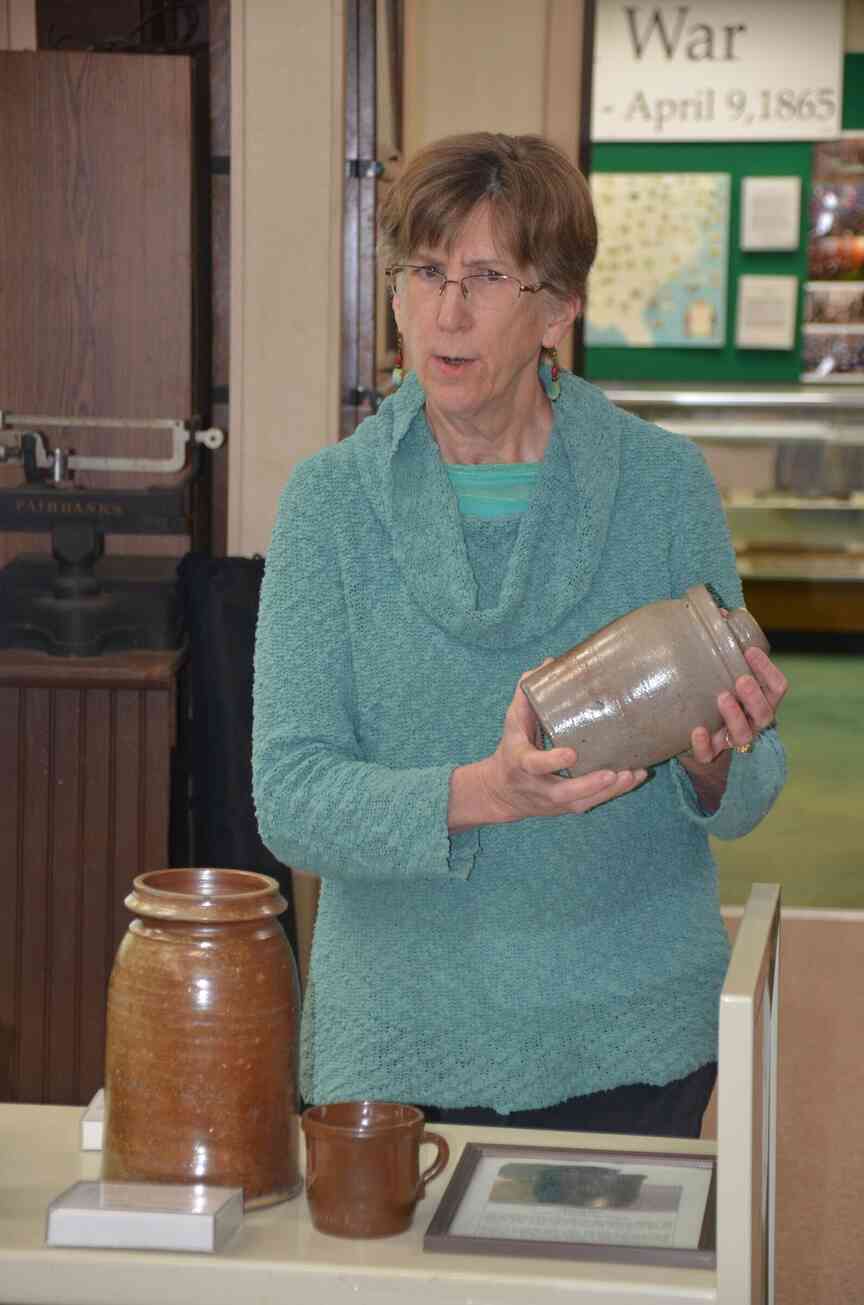 During a lecture in Fordyce, Mary Beth Trubitt explained the history of a Welch manufacturing stoneware jug that is a part of the Dallas County Museum pioneer pottery exhibit. (Special to The Commercial/Richard Ledbetter)