
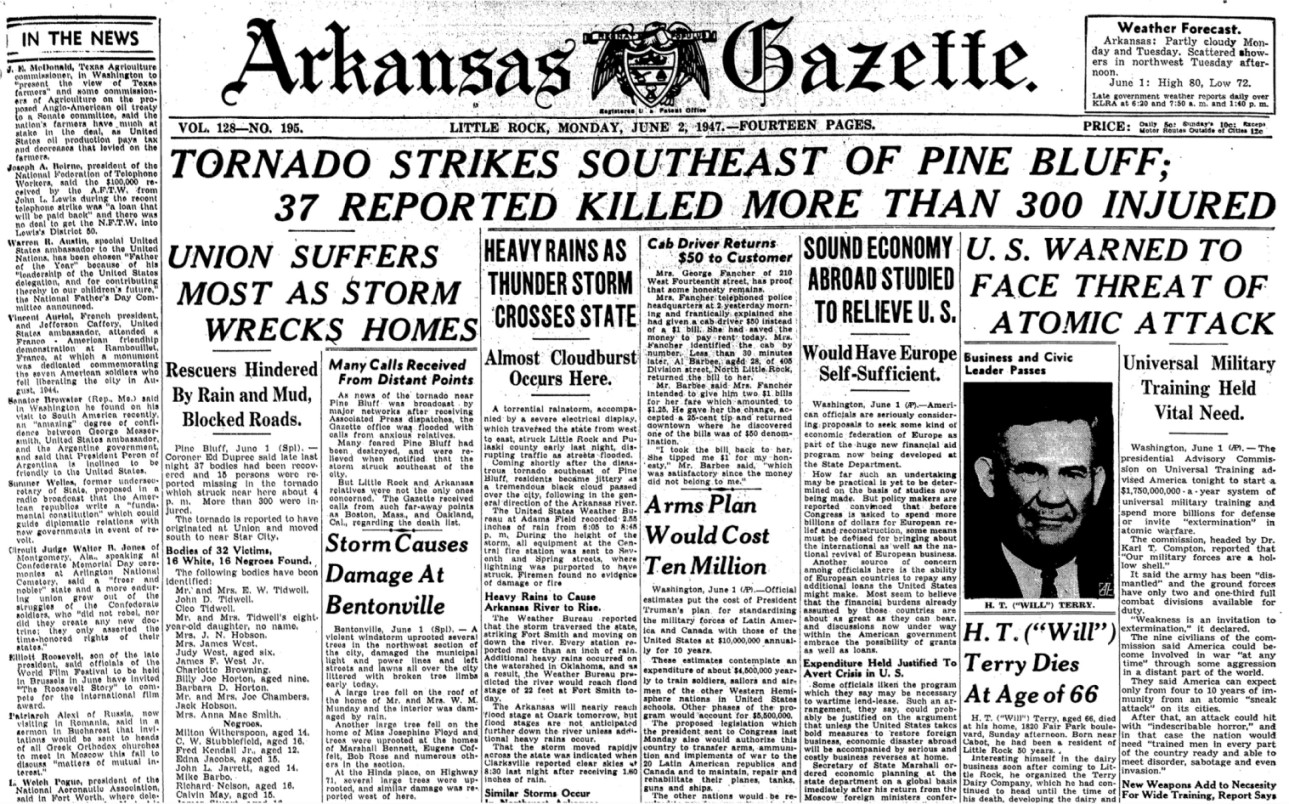
Seventy-seven years later, June 1, 1947, is still one of the most harrowing days in Pine Bluff history, as an F4 tornado swept through Pine Bluff that day. Though the city was still largely segregated, the relief efforts were fully integrated, as locals banded together to care for their hurting community.
That June 1, at roughly 4 p.m., the tornado (winds between 207 and 260 miles per hour) struck the city of Pine Bluff, Union and four other townships south of Pine Bluff without warning.
The tornado’s path was 20 miles long, varying from a few hundred yards to several miles in width. Its path stretched from Watson Chapel to Atkins Lake in Jefferson County to Ladd, and dissipated near Star City in Lincoln County. Union received the majority of the storm’s force.
Pine Bluff historian James Carter Watts compiled details from his father, Thomas Watts, a full-time railroad worker and a respected part-time photographer, whose photographs of the aftereffects have appeared in books and newspapers about the disaster. Some of the following details are excerpts from that article.
Mayor George Steed was in Oakland Park (now Dr. Martin Luther King Jr. Park) when the tornado touched down. He followed the first ambulance and was among the first on the scene. Steed later left the scene to join Alderman Guy Goodman in directing emergency response and relief efforts. Many Pine Bluff citizens from churches, veterans groups, civic organizations, and businesses gathered at city hall to lend their assistance to the rescue efforts.
Independent reporting for Pine Bluff & Jefferson County since 1879.
The Pine Bluff Commercial, several other local businesses, and First Baptist Church quickly joined together to establish a local relief fund.
Doctors, nurses, and rescue officials were rushed to the area as trucks, taxis and automobiles were turned into ambulances to transport the injured to Davis Hospital (the predecessor of Jefferson Regional Medical Center) on Cherry Street.
Local taxi companies donated the services of their cabs and drivers. Though Pine Bluff’s two cab companies were segregated, designated for white or Black passengers only, immediately after the storm it made no difference what the color of the taxis’ drivers or passengers was.
Davis Hospital also temporarily integrated their facility for Black and white patients.
Many of Pine Bluff’s injured citizens drove themselves to the hospital or received rides to the hospital from neighbors or passersby as the whole town banded together to care for the injured. All the injured citizens received preliminary care and injury analysis as they were processed based on the severity of their wounds. As a result, about 15 people listed as missing during the initial rescue operation were discovered in the hospital or by neighbors in fairly good physical condition.
The Red Cross allocated $20,000 for emergency relief efforts in the area and brought tents to house the town’s people. Temporary shelters were quickly organized at civic and community centers to house the injured and homeless citizens. Many chose to go back to their wrecked or demolished homes to be near their possessions and rebuild.
Many of the storm’s survivors chose to remain in Pine Bluff and rebuild their homes, while some re-established their lives elsewhere. For a generation or two after the storm, the community wrestled with a sense of loss and insecurity. The storm-affected area has since experienced a great deal of growth and other positive changes.
According to Wikipedia, the tornado killed 35 people in Jefferson County, including 16 in Pine Bluff. Another 300 were injured.
Times have changed since then. Currently, there are a select number of people who are known as “storm chasers” who aid in predicting and identifying tornadic activity. There are also advanced warnings from weather channels and reliable severe weather radios for the home. Most people carry cell phones, which act as warning devices.
In 2019, when an F1 tornado hit Pine Bluff, fewer properties were damaged, and no lives were lost as emergency workers from Pine Bluff, White Hall, and Jefferson County rushed to the scene to join together to assist in the rescue efforts — much like the Pine Bluff community did in 1947.
The 2024 tornado season finds the nation with around 300 confirmed tornadoes to date here in the United States.
This article is from ExplorePineBluff.com, a program of the Pine Bluff Advertising and Promotion Commission. Sources: www.nwaonline.com, www.arkansasonline.com, https://trove.nla.gov.au/newspaper/article/56783999.
Ninfa O. Barnard wrote this article for ExplorePineBluff.com.