The Pine Bluff School District has made progress from spring 2024 to spring 2025 on summative proficiency across subjects tested on the Arkansas Teaching, Learning and Assessment System (ATLAS), according to data presented during the Arkansas State Board of Education meeting.
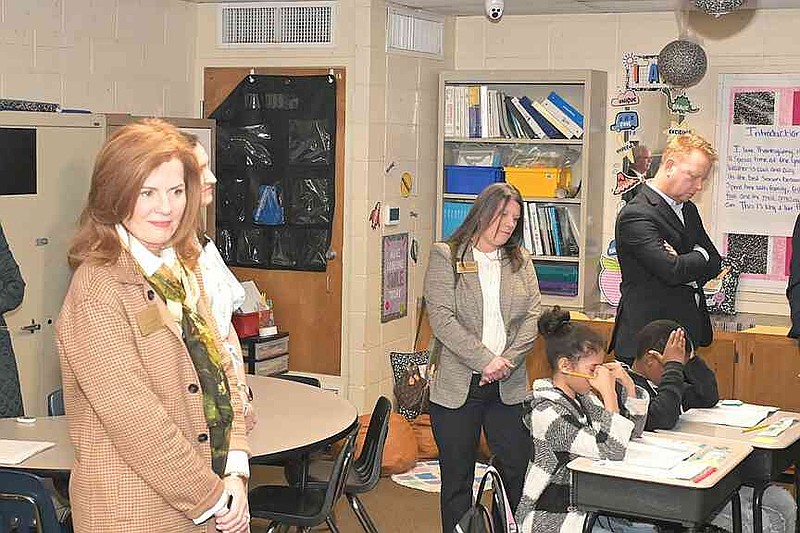
The board held its monthly conference Thursday afternoon at the Arkansas River Education Service Cooperative in Pine Bluff and toured campuses in the Pine Bluff and Watson Chapel school districts, both of which received an F grading in Arkansas’ latest school ratings released in November. Board members went into classrooms at Watson Chapel’s Coleman Elementary (grades 2-5) and Pine Bluff’s Forrest Park/Greenville Kinder Center (grades PK3-kindergarten) that morning.
Hope Worsham, who oversees public school accountability in the Arkansas Division of Elementary and Secondary Education, showed data indicating proficiency on the summative ATLAS exam administered each spring was higher across math and English language arts in the PBSD, and relatively similar points in science. She also indicated the observed proficiency across all three subjects from fall 2024 to fall 2025 was higher, and that winter 2025 to winter 2026 comparisons are not interpretable, as 2026 interim results are reported as RV, or random variable, with fewer than 10 students testing across subjects.
Academic proficiency, or achievement, is one of the four indicators in the state’s accountability grading formula.
The others are growth of all students, growth of students in the lowest quartile and percentage of all high school students, grades 9-12, being success-ready.
Independent reporting for Pine Bluff & Jefferson County since 1879.
Jennifer Barbaree outlined accomplishments in her three years as PBSD superintendent, even though the district is facing pressure from the State Board to show an immediate turnaround in its academic performance to avoid sanctions that could include another state takeover of the district.
Among some of those accomplishments:
During this school year, Southwood and James Matthews elementary schools moved from “F to D” in the accountability grades; the number of office discipline referrals have dropped by nearly 1,000 to date from last year with 1,619; 15 students from the University of Arkansas at Pine Bluff have been hired as instructional paraprofessionals; and the PBSD board received an outstanding board award.
The district in April will offer the ATLAS to students in grades 3-10 to measure their proficiency in English language arts, math and science.
Barbaree, who was hired in January 2023 after working in the state Education Department’s Office of Coordinated Support and Service, also pointed out a millage increase in the former Dollarway and Pine Bluff districts to a unified rate of 47.7 mills toward construction of a new high school and $1.9 million in back taxes paid with more than $800,000 abated in her first full school year on the job.
She also noted the hiring of a district security director, a 6% gain in proficiency with 16% of students scoring in levels 3 and 4 on the ATLAS, and having 82% of her certified staff fully licensed during the 2024-25 school year, a rise from 59% when she took over.
Barbaree added that 75 employee contracts were not renewed within her first year.
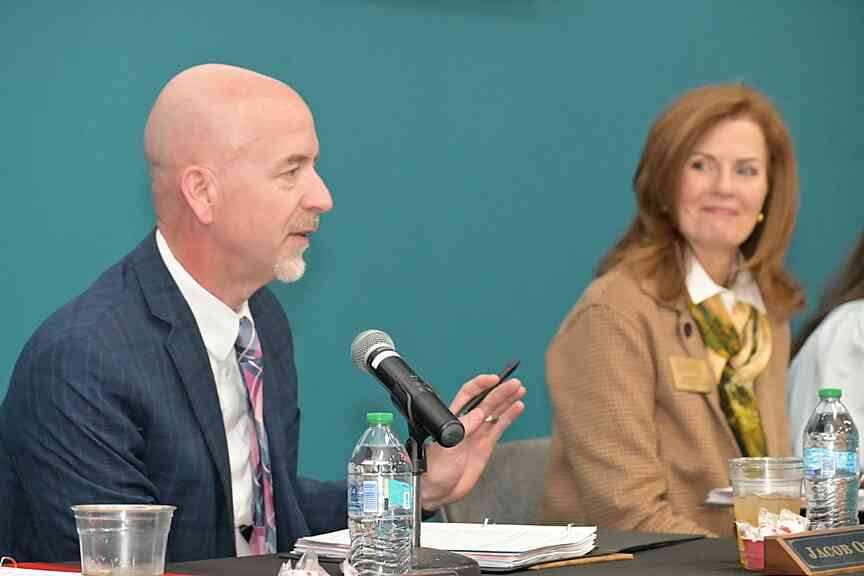
State Education Secretary Jacob Oliva, however, offered a point of sharp criticism from his visit to the local schools.
“What we find is the belief or culture that kids aren’t ready for grade-level material. Let’s just be honest,” Oliva said during the meeting.
“Those kids are hungry to be taught. If I hear parents blame students for performance, I’m going to have a fit because that’s not the problem.”
Oliva left the board meeting before the public comments.
“I would say in the visits that Secretary Oliva and the board (made) or other people who come to our district, we believe we are teaching students with the rigor,” Barbaree said. “We know the rigor can be stronger. His statement based on, ‘Are we teaching to the standard in every classroom every day?’ I can’t guarantee that across the district. I can say that is the push and the motive, that we have the rigor and we’re teaching to standard to every student every day. I would say today, when we went to the classrooms, they saw that.”
The only action item in the meeting was a vote on the consent agenda.
The board unanimously accepted it except for the Little Rock School District’s application for district conversion charter to create a “blended learning environment” at Hall High School. State Board member David Peacock voiced concerns about the long-term performance and attendance rate at such a school, and the board opted to table the vote.
Lee County School District Superintendent Micheal Stone also made his verbal plea to the board to reinstate full local control. May will mark the fifth anniversary of the district’s state takeover.
Under state law, the State Board must vote to either annex or consolidate a district taken over for five years with another district, or return it to local control.
“Returning Lee County School District to local control is not a statement of victory. It’s a statement of readiness,” Stone said.