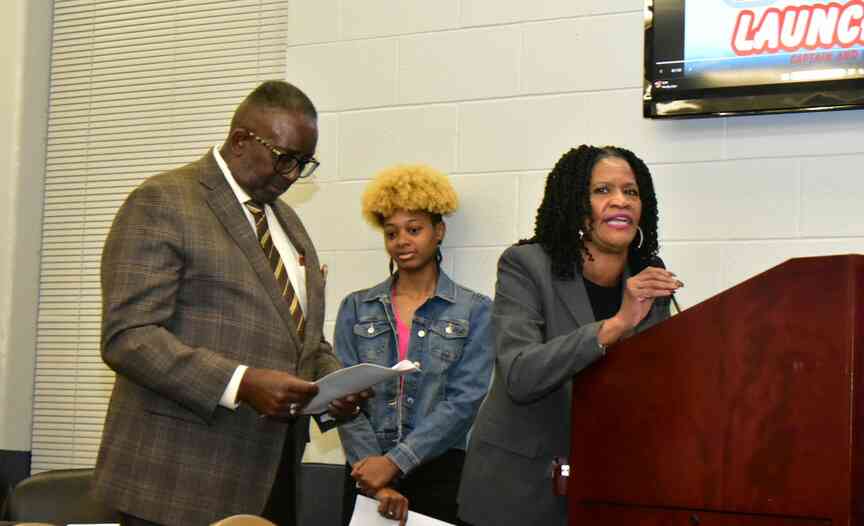
Timothy Scott said he has witnessed the successes and challenges of the Pine Bluff School District from a young age to his current role as a principal.
“Our district and city have made significant strides in academic achievement and student support,” said Scott, who leads Broadmoor Elementary. “However, we continue to face opportunities for growth in areas such as behavior and community safety. Unfortunately, these challenges sometimes overshadow the progress and positive change that is taking place every day in our schools.”
Like many connected to Jefferson County’s schools from interested stakeholders to administrators, the letter grades assigned to each campus and district alarmed Scott. Two of the three traditional school districts — Pine Bluff and Watson Chapel — and Friendship Aspire Academies of Arkansas each received an F from the Arkansas Department of Education based on its new accountability formula. Each PBSD campus scored an F except for James Matthews and Southwood elementaries, both of which received a D.
Speaking to the district board last Monday, Scott said he was disheartened that all but one local education agency scored an F. The White Hall School District was graded C.
The district grades were released Nov. 6.
Independent reporting for Pine Bluff & Jefferson County since 1879.
“While these results are factual, they do not tell the full story,” Scott said. “Our internal tracking and assessment data show meaningful growth and progress among our scholars. Several schools with similar grades demonstrated slightly higher achievement percentages, yet the letter grade outcomes remain the same. This pattern raises concern, particularly when all of the affected schools serve primarily African American populations within a high-poverty community.”
EDUCATORS SPEAK
Pine Bluff School District educators who spoke at the regular board meeting, whether they were just giving public comment or making a presentation, specified the need for parental and community support in helping all students rise to the level of proficient understanding in each subject tested in the Arkansas Teaching, Learning and Assessment System (ATLAS) summative battery offered each spring. Scores from ATLAS are largely factors in a campus’ or district’s grade based on the state’s District Accountability Formula, which takes into account the achievement, growth of all students, growth of the lowest-performing quarter of students and success-ready graduates.
“The No. 1 thing that’s our biggest thing is culture,” said Kourtney Smith, director of choral music at Pine Bluff High School and the district’s certified personnel policy committee chairman. “Our culture in our school is a reflection of the culture in our community, and we have to build sustainable barriers in our schools that combat the culture in the city. That means, when we look around at the same fights we’re having at city hall, where progress and the lack of resources, this and that, safety, things of that nature — it bleeds into our school systems. And our community is what will help us make our schools better. We need parents, we need community members to wrap around our kids, and it cannot just be on teachers or administrators.”
Aside from the halls of government, teaching kids responsibility and holding them accountable as adults are skills that are still important to Smith.
“Those skills seemingly have gone out the window because of our need to push kids forward and get them out of the system and this, that and the third, but those things still work,” Smith said. “I think what we’ve seen culturally is a lack of those key values and morals that have kept us and got us in the shape that we’re in right now.”
Pine Bluff High Principal Ronald Laurent expressed a similar viewpoint.
“When I look at our students who come, they don’t come ready or committed to do the work that’s necessary for school,” he said. “Many of them come, and the parents send us what they have, we have to take what they’ve sent us and do the best job we can with them. We’ve got to change their mindset. We’ve got to change the mindset they’ve gotten from family dynamics. They come to school sometimes angry. So, we’ve got to change that. We’ve got to let them know that we care about them and they can be whatever they want to be if they’re willing to work for it.”
OPERATION RISE
Laurent, along with special education teacher Glinda Foots and college/career coach Denesha Evans, presented an initiative called Operation RISE, the mission of which is to improve the school’s grade from F to at least a C by supporting student success through data-driven strategies. Each teacher signed a commitment to follow through with the steps when they learned about the program, Laurent said.
Among those strategies, as presented, is a focus on the growth of all students — especially those in the lowest quartile — by growing each student in their outcomes by at least 50%. The ATLAS assigns a level in each subject for each student: Level 1 for those who need further support in gaining understanding of a subject, Level 2 for those who demonstrate basic understanding, Level 3 for those who show proficiency and Level 4 for those who demonstrate advanced understanding. Evans outlined to the board the school wants to be much more data-driven by monitoring progress, creating a shared data room and restructuring WIN, or “What I Need,” time for targeted interventions with students.
“There’s a recipe for success, and it takes everyone,” said Foots, who specializes in English language arts and is a transition coordinator. “It takes the teacher. It takes the student. It takes the parent, the community coming together under one umbrella in the name of success. When one component is missing, then there is a problem. It strengthens the initiative, and when one is missing, it weakens it.”
Parents have to realize they play an important role in meeting with educators about their children, Foots said. She added educators can emphasize to the parents ensuring that students attend school regularly, conduct appropriate behavior for learning, do homework, prepare for exams and take education seriously.
“We all are a reflection of education,” Foots said. “I say that because the grade of F is not just a reflection of the school. It’s not just a reflection of the parents. It’s not just a reflection of the community. But as a whole, it’s a reflection of how we come together and emphasize the importance of academic achievement.”
To improve test scores, Laurent said, more rigor is needed in teaching, meaning teachers will need to show more depth of knowledge of a subject to their students.
“You can’t just settle for ‘yes’ or ‘no’ answers,” Laurent said. “You have to be able to explain why you think the way you think. We want students to be able to do that, and teachers have to teach them in a way they understand.”
District board member Patrick Lockett asked Laurent after his presentation: “Is this an admission that we have failed somewhere down the line?”
Laurent answered: “No. Let me tell you why: We just haven’t done enough. We were doing the work, but not enough. So, we had to refocus.”
SCHOOL CULTURE
The culture of a school is important to James Matthews Principal Tameka Wright, who said she worked on changing the mindsets of both students and teachers when she took on her current role before the 2023-24 school year.
“Next is the accountability piece,” she said. “I couldn’t have my expectations low for any of my teachers or students. I had to come in with high expectations. That’s what I did. We implemented and put systems in place, and now we’re working those systems and expectations out, and we actually went from F to a D, so we’re moving in the right direction. And we’re growing, and next year, hopefully, we’ll be a C or a B campus.”
Wright explained the systems she referred to include “simple things” like coming to work on time, greeting students at the door with a smile and having lessons already planned.
“You can’t just walk into the classroom and start teaching. You have to be intentional, be specific about what you’re giving our kids on a daily basis, and that’s my expectation,” she said.
CHARTING A NEW PATH
Phillip Carlock, the district’s assistant superintendent for student support services and curriculum and instruction, said during a visit to Southwood Elementary teachers had conversations with students in a fifth grade classroom about their test scores, how they want to improve and how they will improve.
“Before you change anything, you have to have an awareness,” Carlock said. “Sometimes, that awareness brings about direction in where you want to go. … Once students become aware, they want to have an impact on their letter grade. So, I think we can zoom out and have a greater impact by including the parents, including the community, because now the letter grade is a thing, but what are going to do to change it?
“Once we have that awareness, once we get some clear directions about next steps we want to go, then we chart that path and we head in that direction.”
Scott told the board he is confident both the data on the district and the narrative of education in Pine Bluff will be changed with a shared vision, transparency and community collaboration.
“Despite these challenges, I remain highly encouraged and optimistic the Pine Bluff School District continues to show consistent improvement each year, a testament to the dedication of our educators, scholars and parents,” Scott said. “As an instructional leader, I am committed to advancing this progress by fostering intentionality, forward-thinking mindsets, increased parental involvement and a relentless focus on student achievement.”
How soon the data will begin to favor the district remains to be seen.
“We can do it this year,” Laurent said. “We can do it, but we have to push, all hands on deck. Everyone has to be pushing the student forward. The teacher has to push. The parent has to push. The student has to have a desire to do it, and that’s what we have to change … change the mindset, the culture.”