
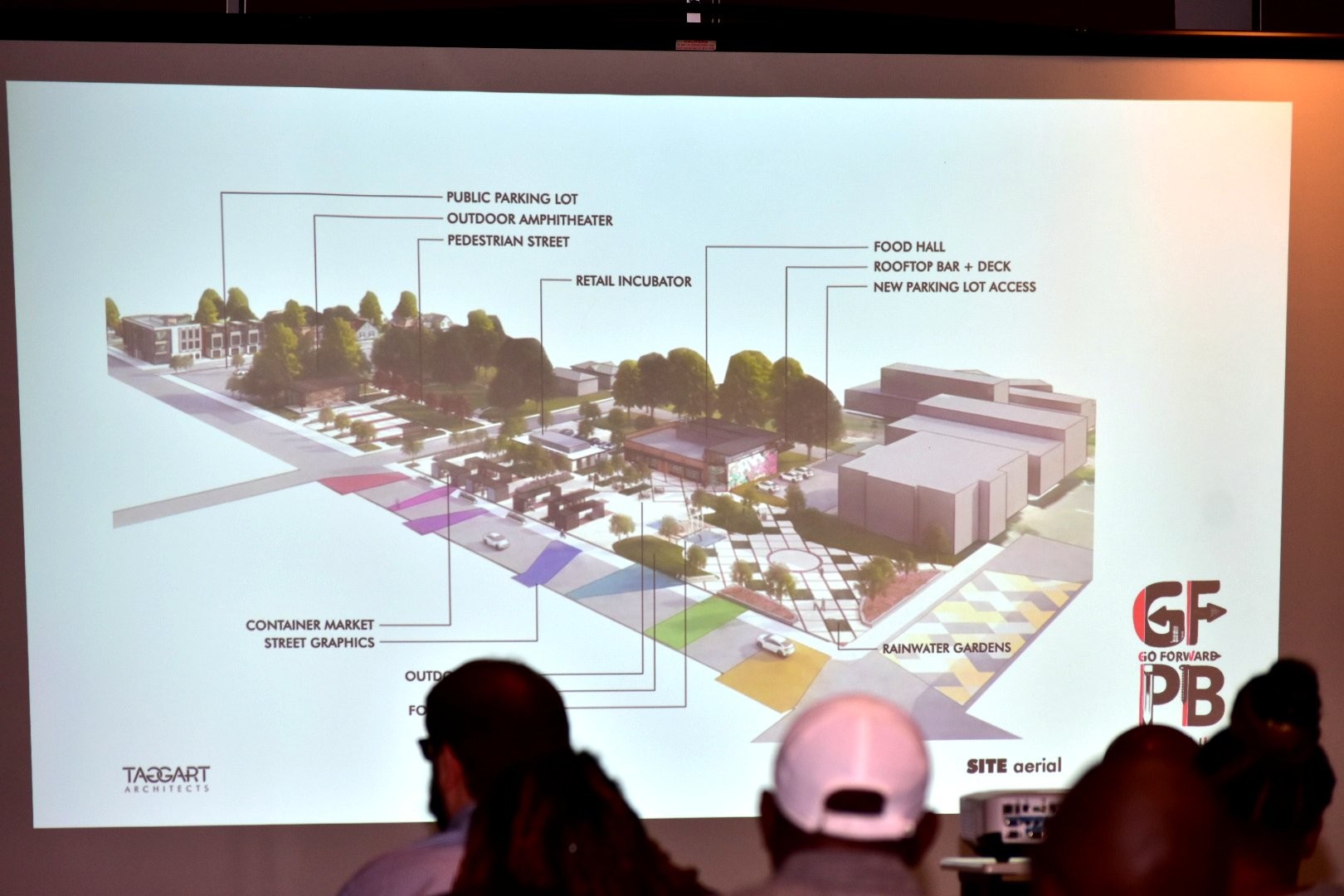
The Pine Bluff Planning and Development Committee met last week to discuss several pressing matters concerning the city’s development and future. The meeting, led by chairman and City Council member William Fells, covered various topics, including updates on the Sixth and Main Street project, the King Cotton Holiday Classic basketball tournament, go-kart track developments, and proposed ordinances for abandoned vehicles and smoke shops.
Go Forward Pine Bluff CEO Ryan Watley provided an update on the construction progress for Sixth and Main. The project is nearing completion, with plans to open in March. Watley addressed concerns about funding and assured the committee that an operating budget would be available within a week. The committee also discussed job opportunities that the project would create.
“We have about 56 opportunities we’re looking at,” said Watley. According to Watley, the estimated cost of operating the new facility for the upcoming year is roughly $150,000.
The committee also discussed the recent King Cotton Holiday Classic basketball tournament, which was hailed as a success by Watley. The event generated $145,000 in sponsorships and provided an economic boost to the city, he said.
Independent reporting for Pine Bluff & Jefferson County since 1879.
While the total cost of the tournament was not explicitly stated in the meeting, it was revealed that 40% of the funds went towards payroll, primarily for Pine Bluff citizens, and the tournament did not necessarily make a profit. The committee expressed interest in continuing the tournament in 2025 and exploring ways to cut expenses without sacrificing the quality of the event.
Watley did, however, inform the city that funding from the city would be needed for the tournament to continue. Discussions have already been had, according to Watley, to include the possibility of continuing the tournament in 2025.
Urban Renewal Executive Director Chandra Griffin provided an update on the go-kart track project, which has experienced delays due to weather and soil conditions. The Go Forward project is now under contract with DBC Commercial and is expected to be completed within 270 days with a total budget of $4 million. The funding for the project comes from the 2017 sales tax, which was used almost exclusively to fund projects pushed by Go Forward. An extension of the tax was rejected twice by voters last year, bringing the tax collection to an end in September.
According to Griffin, the initial phase involved removing an existing concrete slab, which was thought to be reusable but had to be discarded based on the final architectural drawings.
During the slab removal, the soil underneath was found to contain unsuitable elements. This necessitated a geotechnical survey and the decision to undercut and replace the existing soil with compacted dirt. The weather has further hampered progress.
Fells sponsored a proposed ordinance to address the issue of abandoned vehicles in the city. The ordinance would give code enforcement the authority to tow vehicles that have been abandoned for 72 hours. The committee discussed the need for public education on the ordinance and the importance of allowing residents to bring their vehicles into compliance before towing.
The committee also discussed a proposed ordinance to regulate smoke and vape shops in the city. The ordinance would prohibit these shops from being located within 1500 feet of a school or church. Council member Steven Mays questioned the need for the ordinance, while the city of Pine Bluff Inspection and Zoning official Lakisha Hill argued that the city has the right to regulate businesses and maintain standards.
Hill raised concerns about the potential negative impacts of these shops on residential neighborhoods, including noise, congregating people and spillage into the community. They also highlighted the potential for increased police involvement and argued that the current 300-foot distance from residential properties might not be far enough.
Mays questioned the necessity of the ordinance, suggesting that there are already enough regulations in place. However, a counterargument was made by Hill that the city has a right to prevent the city from “running down into the ground.”
The committee ultimately voted to forward the smoke and vape shop ordinance to the city council for further consideration.