
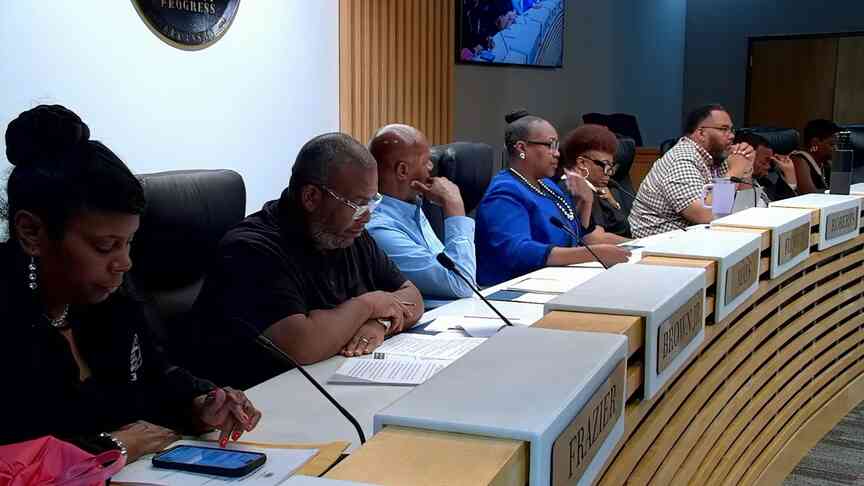
A contentious debate over garbage pickup services in Pine Bluff culminated Thursday night in a 5-4 vote by the city council, with Mayor Vivian Flowers casting the tie-breaking vote to authorize a contract with CARDS Holdings LLC. Voting in favor of the contract were council members Yvonne Denton, Bruce Lockett, Glen Brown Jr. and LaTisha Brunson. Voting against it were Steven Mays, Lloyd Holcomb Jr., William Fells and Lanette Frazier.
The decision, which passed a resolution for waste management and related services, followed lengthy public comments and a spirited discussion among council members regarding the procurement process, company qualifications and constituent concerns.
The meeting began with public comments, including Danny Walker, who expressed concerns about the consulting firm’s good faith in recommending CARDS and the potential impact on local Waste Management employees. “I understand that the city went through a consulting firm … But I have talked with several people who have concerns about whether the consulting firm was operating in good faith,” Walker said. He also emphasized the importance of ensuring current Waste Management employees are “taken care of.”
Carla Britain, senior operations specialist with Waste Management, highlighted her company’s commitment to the city and assured that it was ready to manage customer service operations if chosen.
The main agenda item, the resolution to contract with CARDS, quickly sparked discussion.
Independent reporting for Pine Bluff & Jefferson County since 1879.
Council member Lanette Frazier voiced significant concerns, starting with the integrity of the request for proposal process itself. She questioned why a request was issued if Waste Management was thought to be doing a better job previously. Frazier also argued that Waste Management was unfairly penalized for offering alternatives in their proposal, which she maintained was within their rights based on the requests language.
“If you didn’t want any alternatives in RFP, you shouldn’t have done it,” she asserted. She further highlighted Waste Management’s offer of separate billing as an option due to past issues with Liberty Utilities, suggesting it was misconstrued as an undesirable exception.
Frazier also expressed unease about the apparent unwillingness of another potential vendor to establish a local presence and her lingering concerns about potential acquisitions involving CARDS. Despite a meeting with CARDS’ officials where her questions were answered, she concluded, “They don’t want them,” referring to her constituents’ desire to keep Waste Management.
Flowers strongly defended the decision to move forward with CARDS, emphasizing the integrity of the five-month procurement process and the need for a new, improved contract. She highlighted that for 35 years, the previous contract had simply been renewed, preventing necessary changes.
“If we renew the existing contract, by law, you cannot change that contract,” Flowers stated, a point affirmed by the city attorney. She reiterated that the request for proposal process was initiated to secure a “better contract” for the city’s terms.
Flowers detailed the advantages of the CARDS proposal, including “no exceptions” to the city’s requirements for new containers, newer trucks, daily complaint reports and a 24-hour response window. She also lauded their commitment to opening a local call center and hauling station, potentially with a transfer station, and their willingness to accept fines for service failures.
Addressing the employee transition, Flowers clarified that current Waste Management employees would have the first opportunity to apply for positions with CARDS. She also addressed concerns about acquisitions, stating that CARDS clarified there were no plans for future acquisitions and that any future sale would require the city’s explicit consent.
Fells challenged the notion that rejecting the committee’s recommendation would reflect poorly on the city, asserting the council’s right to reject proposals based on legitimate concerns. He pointed to specific language in the existing Waste Management contract, arguing it allows for negotiation and modification of service levels and pricing at any time, even if the contract were extended.
“To me, that suggests that at any time we can go to Waste Management and renegotiate our level of service and our pricing,” Fells said. He questioned why complaints about CARDS’ services in other communities were not considered a legitimate reason to reject their proposal, particularly since the council and citizens only became aware of these issues after the selection was made.
City Attorney Althea Scott advised that while the existing contract’s language might allow for negotiation upon extension, doing so immediately after a competitive bidding process where another company was selected could expose the city to litigation for “detrimental reliance.” She also clarified that the committee was aware of complaints against all companies, including Waste Management, during the evaluation process.
In a final exchange, Frazier clarified that the 15-day response time she previously mentioned for Waste Management applied only to “major events” like natural disasters, not everyday trash pickup. She reiterated her concern about the transparency of the process, noting that the council received the final selection information on the day of the council meeting, despite the decision being made weeks prior.
“If we are talking about transparency, if we’re talking about doing things differently than what was done in other administrations, then we have to do things differently across the board, right?” she said.
Ultimately, the resolution passed by a narrow margin, with Flowers’ decisive vote marking a significant shift in Pine Bluff’s waste management services.
The new contract is set to start on November 1, 2025.
Under the terms of the agreement, CARDS will be responsible for the collection, transportation and disposal of waste materials from residential units, commercial and permanent industrial customers within the city limits.
For standard residential service, which includes weekly municipal solid waste collection in a 96-gallon cart and one bulk and brush collection per week, the rate will be $19.39. Residents requiring an additional 96-gallon solid waste cart will be charged $8 per month for each extra cart.
For unusual accumulation waste collection, which addresses larger volumes of waste beyond regular limits, the rate will be $125 per hour for vehicle and crew, in addition to a disposal fee of $15 per yard collected.
In the event of a declared disaster, “Disaster Management” rates will apply:
Roll-off truck and container: $175 per hour;
Grapple truck: $175 per hour;
Rear-load truck and crew: $175 per hour;
Disposal fee: $175 per ton collected.
Small commercial businesses utilizing a single 96-gallon cart with weekly collection will be charged $24.99.
For larger commercial entities using front-load containers, the rates, which are net to the contractor, vary based on container size and collection frequency.
For residential units, brush will be collected once per week on the same day as solid waste collection. However, the contractor is not obligated to collect brush that:
Contains limbs exceeding four feet in length or four inches in diameter, or debris from a commercial tree service provider.
Is not stacked at the curb in a manner allowing safe lifting into the collection vehicle.
Does not consist of more than four cubic yards of brush and bulky materials per collection.
The contract also outlines various service specifications and includes a detailed schedule of liquidated damages for noncompliance.
The city has established clear financial penalties to ensure adherence to performance standards and timely service. Key liquidated damages include:
Missed collection: $100 per missed collection over five missed collections per day.
Failure to correct a missed collection within 24 hours: $100 per occurrence per day.
Missed residential unit block: $500 per incident if three residential units on one side of a street or an entire cul-de-sac report a missed collection, and the contractor cannot provide data showing the collection vehicle traveled on the block.
Commencement of residential collection prior to 7 a.m. or operating after 7 p.m. (unless permitted): $250 per route per occurrence.
Commencement of front load collection within 500 feet of a resident prior to 7 a.m. or in other areas prior to 5 a.m. (unless permitted): $250 per route per occurrence.
Failure to complete a majority (50%) of collections on a given day: $5,000 for each incident (unless due to unsafe conditions reported by the contractor).
Failure to clean up spilled solid waste within two hours of notification: $250 per impacted address.
Failure to resolve properly reported bona fide customer complaints within one business day: $200 for each incident.
Failure to submit accurate monthly or annual reports in the specified format: $250 per report per calendar day delinquent.
Failure to submit accurate accounting (invoices, complaint reports): Nonpayment until accurate accounting is submitted.
Failure to return carts and containers to approximately the original collection location: $50 per incident for each affected address.
Failure to leave a public education notice when inappropriately prepared material is not collected: $50 for each incident.
Failure to be prepared to perform services on or after the commencement date: $3,000 per calendar day.
Failure to deliver or replace carts within five business days of notification: $50 per incident per affected address.
Failure to provide a staffed office to answer phones from 7 a.m. to 7 p.m. on regular collection days: $1,000 per day.
Flowers said these liquidated damages are designed to ensure high standards of service and minimize disruptions to residents and businesses in Pine Bluff.