
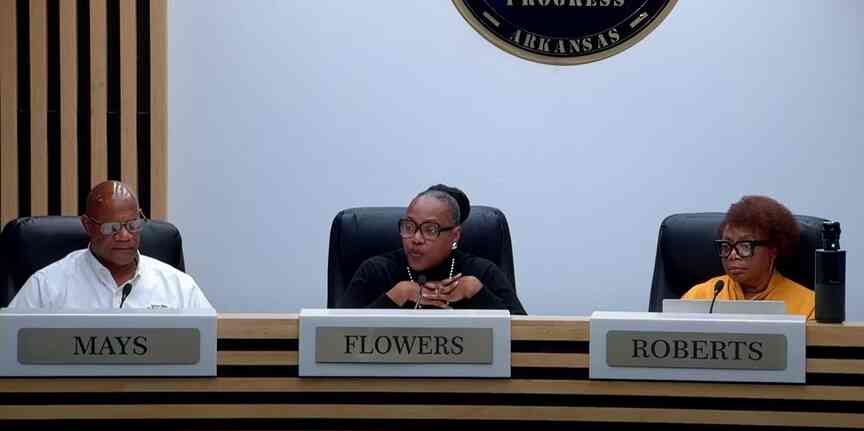
The Pine Bluff City Council convened Monday to discuss a range of topics from youth engagement in government to the modernization of city financial processes. The meeting also included a special recognition for the Pine Bluff Police Department’s advanced accreditation.
The Pine Bluff High School government class, whose seniors were present, were recognized. Their teacher, Alisa Smith (also known as Miss Purple), emphasized the importance of engaging young voters.
“I have found it to be true in these last three years that I’ve been teaching 12th graders that they’re just not engaged in government. They didn’t see the purpose for it,” Smith stated.
Smith stated the importance of their future involvement, noting, “these students will be registered voters in this county. And I need to remind them and you that they will be sending in those absentee votes. So I need them to be active about what’s going on in the city of Pine Bluff.”
A significant portion of the meeting was dedicated to a memorandum of understanding with Ambassadors for Christ Youth Ministries (AFC) for services in combating juvenile crime. The measure passed.
Independent reporting for Pine Bluff & Jefferson County since 1879.
Kanisher Caldwell, representing AFC, explained that the resolution was a reauthorization of an existing grant. “This is something we have already done and we’ve had this grant in the community, this very same grant for the nine years,” Caldwell stated, noting that a previous withdrawal was due to a change in administration and funding.
Council members raised questions regarding the specifics of the partnership, particularly concerning the involvement of the city’s Group Violence Intervention program. Mayor Vivian Flowers clarified that the memorandum outlines six bullets for GVI’s provisions, including mentoring and outreach services, and 13 items for AFC. She cited a recent instance where AFC provided housing for two homeless high school students, demonstrating their “super valuable” role in the community.
A point of contention arose around a clause in the resolution that mentioned “directly support law enforcement operations, including immigration law enforcement.” Council Member Bruce Lockett expressed direct opposition to this. “That’s some of that Trump stuff. Now, I’m not into that.”
Caldwell clarified that the AFC’s role is supportive, not enforcement. “That portion is that if the parents or someone is picked up for ICE … we’re able to provide housing if they’re separated until we can get them permanent housing or permanent situations within their families,” she explained. Council Member Steven Mays Sr. voiced support for AFC.
“I’ve been knowing her and Pastor (and GVI Director Kevin) Crumpton for years, and I’m very sure that them working together, we’ll do the right thing,” said Mays.
Another key discussion revolved around an ordinance amending the city’s code to authorize electronic payments. Council Member Lanette Frazier sought clarification, confirming that the ordinance was about “us actually working on the policy and procedures for electronics.”
Flowers explained that the ordinance, which was ultimately adopted, would allow electronic payments only after the city clerk, treasurer and finance director define the standard operating procedures. She emphasized the efficiency and security benefits, citing a recent scam alert related to paper checks.
“The system of electronic payment for companies and governments is more secure than using paper checks. It is more secure. There is more opportunity and likelihood for fraud using paper checks than electronic,” Flowers said, noting that physical checks expose routing and account numbers.
The city clerk, Janice Roberts, while supporting electronic payments, suggested a pause until the implementation of a new technology system. However, Flowers argued against delay. “We cannot wait until after Tyler (the city government’s new software program) comes fully on board to make any changes. We have to make some of these changes in concert with the transition to the new system,” she said.
Lockett expressed reservations about the ordinance’s structure, preferring an exhibit that outlines specific policies rather than assigning responsibility for developing them.
“I’ve never seen one done like this where it assigns the responsibility for developing the policy to key people,” Lockett commented. Flowers countered that not every city has the same financial structure, and the legislation had been thoroughly reviewed by various officials, including the city attorney and the municipal league. She also highlighted the ongoing investigation into over $250,000 stolen from the city through paper checks in the parks and recreation department, underscoring the urgency for change.