
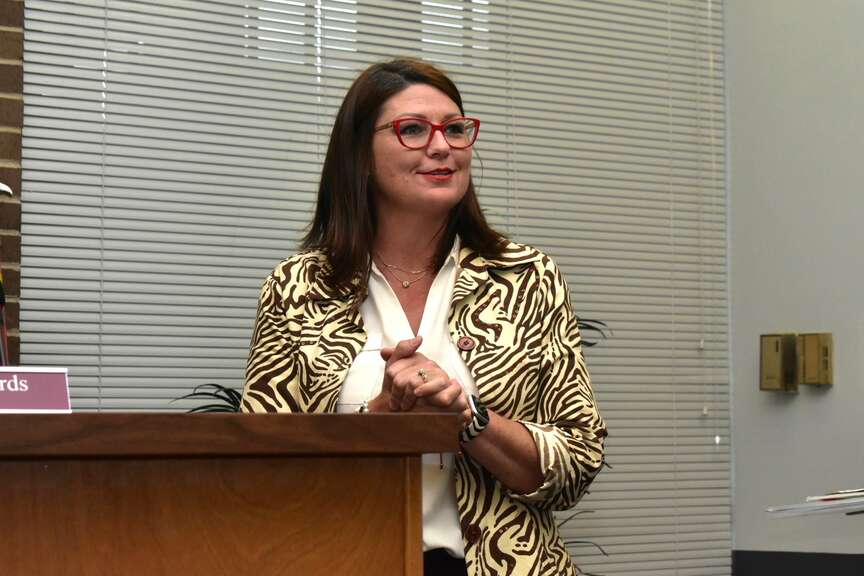
Faced with questions about the amount of testing in the Pine Bluff School District, Superintendent Jennifer Barbaree addressed the matter during Monday’s December board meeting.
Barbaree revealed the district has given 5,976 interim assessments for the Arkansas Teaching and Learning Assessment, the year-end standard battery for students in grades 3-10, between Oct. 31 and Dec. 6. The district enrolls 2,692 students this school year, according to the Arkansas Department of Education Data Center.
Students took tests in English language arts, math (grades 3-8, algebra and geometry) and science (grades 3-8, biology). Barbaree stressed grade-level standards for the current school year were tested in the interim exams after a larger percentage of students in the district scored at Level 1 or 2, meaning they demonstrated either a limited or basic understanding of the content, in the ATLAS.
Common formative assessments and classroom tests are also given at the classroom level in all grades and test grade-level standards, Barbaree said. In the District Common Formative Assessment, given on a quarterly basis, the ELA test was given in grades 2-12, and the math was given in grades 1-12.
“We are assessing it a lot, and people are complaining, we are assessing our students ‘too much, too much,'” Barbaree said. “It’s not that we’re assessing them too much. It’s, ‘What are we doing with the results?'”
Independent reporting for Pine Bluff & Jefferson County since 1879.
Barbaree outlined that plan of attack in a “one-pager” created by PBSD educational facilitators and provided to lead teachers last week. From this document, teachers must answer:
What do they want students to learn and be able to do?
How will they know if the students learned it?
What is to be done if students haven’t learned it?
And what is to be done if they already know it?
Barbaree said principals will lead training with their teachers during professional development in January, and teachers will then come up with a plan to go over with students how they performed versus the standards set for scoring at Levels 3 and 4, the proficient and advanced levels. Teachers can also access a pacing guide to know what the priority standard is for each course, Barbaree said.
Performance level descriptors for each course explain to teachers how a student can meet the standard. For example, in third-grade vocabulary, to score Level 3, a student uses Latin affixes or bases to understand the meaning of words, and for Level 4, a student uses multiple Latin affixes or bases to interpret the meaning of unknown words within word families.
Students in grades K-3 completed ATLAS literacy “screeners” to determine who was at risk of not meeting standards. Those at risk were given “testlets,” which Barbaree explained is a more diagnostic assessment.
Students in grades K-2 determined to be at risk of not meeting standards in math were given testlets as well.
“A diagnostic is just determining why a kid was at risk,” Barbaree said. “Once they were given that testlet, they were prescribed interventions they can do online through the ATLAS program, and the teacher is also aware of that so they can provide some interventions in the classroom.”