
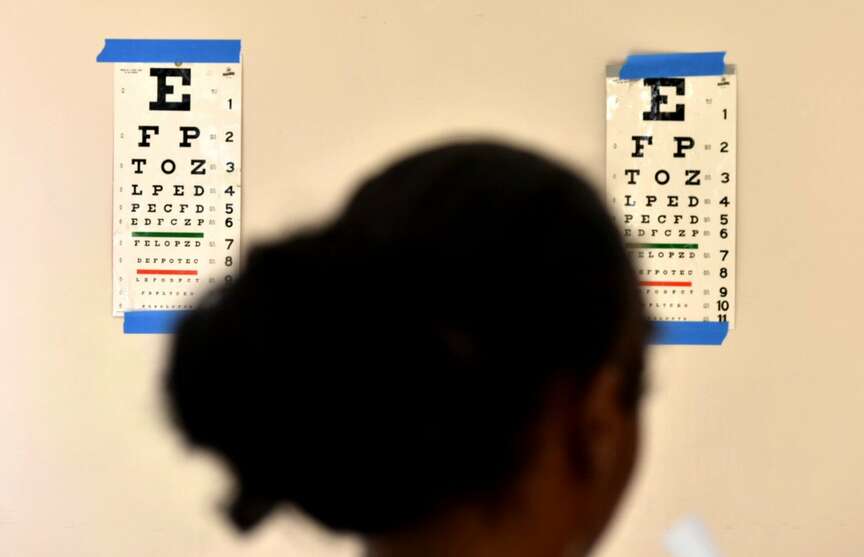
Improving a child’s vision can improve his or her student performance, self-esteem and academic outcomes.
That’s the position Pine Bluff School District leaders are taking with the rollout of their 20/20 for 2025 campaign. The district introduced the initiative Wednesday by encouraging high school seniors to have their eyesight checked and receive eyewear before they finish high school or turn 18, at which point in most cases they will not be eligible to remain on their parents’ or guardians’ health insurance.
“I came up with this initiative — 20/20 for 2020 — right before covid hit, because what I began to realize was students were using electronic devices more frequently and their vision was changing,” PBSD Board Chairman Sederick Charles Rice said. “We also know by state law, certain grade levels are also tested to make sure their vision is OK, but when they get to the high school — and they often test eighth or ninth grade — that vision is often missed.”
Rice shared that vision, so to speak, with PBSD Superintendent Jennifer Barbaree and district health director Mae Hawkins-Coleman to restart the initiative so every high school junior and senior in the district can have their vision examined by 2025. Students who fail the screening will receive a referral for a follow-up with an eye doctor of their choice.
The campaign outlines several objectives with a purpose for each grade level. The first objective is to improve vision screenings and eye exam follow-up for students in grades pre-K, 1, 2, 4, 6 and 8 with the knowledge that more comprehensive screenings and eye exams can help identify vision problems that may impact academic success.
Independent reporting for Pine Bluff & Jefferson County since 1879.
The second objective covers grades 3, 5 and 7, with knowledge that eyesight may change more rapidly at these levels in a student’s growth and development due to heavy use of different technologies. The third objective covers grades 9-12, in which students are said to not normally be screened and their eyesight may change more rapidly due to heavy use of such devices.
The remaining objectives are to seek support from local, state and congressional officials; seek grant dollars to subsidize vision screenings and eye exams for those in all grade levels, as well as new vision equipment purchases within all student populations; and partnering with local eye care businesses and offices.
“I met with the nurses and I told them about the campaign,” Hawkins-Coleman said, adding she talked two retired nurses into helping. “Everyone had buy-in. I even had two retired nurses come back to make sure this happened, so we knew how important it was to get it before they graduate from high school.”
The PBSD, Rice said, will also work on mental health, social services and dental care initiatives in the future.
“Those are services that are very, very important to our students going forward,” he said. “This is our launch. We’re talking about 2025, which means we have a plan to make sure every student at our high schools, every student in the school district, is tested by 2025, along with what the state mandates — but also to make sure those who may have fallen through the cracks are tested as well.”