
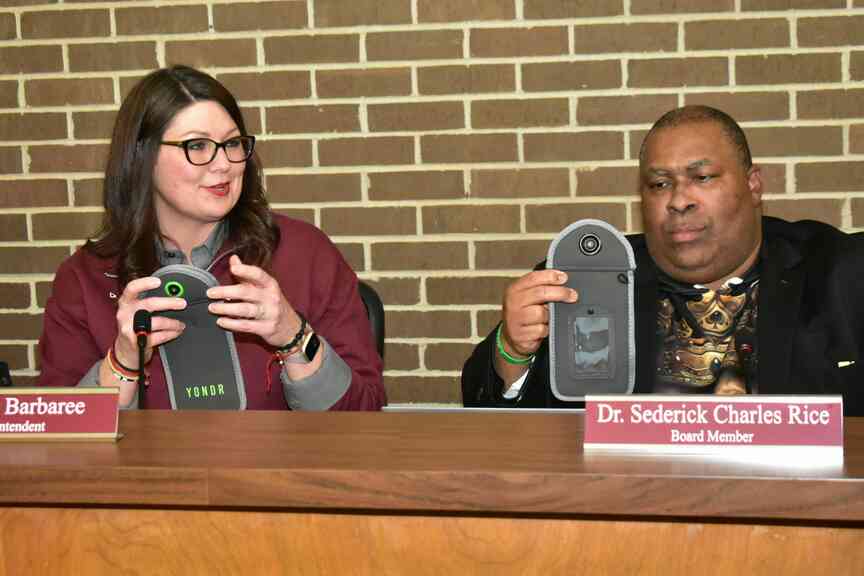
The Pine Bluff School District has taken steps toward a stronger ban on cellphones and other personal electronic devices with the purchase of locking pouches, which will be used starting next school year.
A state grant at the start of this school year allowed the School District and at least 200 other districts to purchase a Yondr-brand system that provides the storing pouches and magnetic stations to unlock the pouches at the end of the school day. Gov. Sarah Huckabee Sanders last week signed Senate Bill 142 into Act 122, now the Bell to Bell, No Cell Act, to go into effect in the 2025-26 school year. Sen. Tyler Dees, R-Siloam Springs, and Rep. Jon Eubanks, R-Paris, sponsored the bill.
Superintendent Jennifer Barbaree said the School District was “ahead of the game” on Act 122 when the district purchased Yondr pouches. Pine Bluff was expected to receive a $55,000 grant, Barbaree announced in December.
“Based on research we’ve been reading with ‘The Anxious Generation,’ which is the book the governor has been promoting — and we were reading that as a district to hear the different things that social media has caused for our students and our generation — with that in mind, we started looking at the opportunity to purchase cellphone pouches,” Barbaree said during a School Board meeting last week.
The act states, in part: “The rise of cell phone and social media use by young people is leading to unintended and, at times, harmful consequences to the academic and mental well-being of young people.” The law, which alters Section 6-18-515 of the Arkansas Code, states each public school district and open-enrollment public charter school must establish a policy and exemptions for the possession and use of “a personal electronic device during the school day” by a student. That policy must be submitted to the state Division of Elementary and Secondary Education; otherwise, it will be cited for violating accreditation standards.
Independent reporting for Pine Bluff & Jefferson County since 1879.
Exemptions are provided for health reasons and emergencies, as well as if the district or charter school provided a device to the student.
The law previously allowed a device in school “for instructional purposes at the discretion of a teacher or administrator.”
The pouches are not yet used in the district, Barbaree said, as officials are still creating procedures for use and listening to officials from other districts about their ideas. A student advisory committee will talk with School District officials about the upcoming policies.
“We also know students are very slick and parents are also concerned about this bill because they’re so used to having access to their children at all times,” Barbaree said. “Because of that, we’re thinking about how we can support parents, and they’ll be involved in our meetings and conversations.”
Each student in grades 7-12 will receive a pouch. “This is not something that we feel is a necessity at the elementary (level) at this time,” Barbaree said.
Pine Bluff High School Principal Ronald Laurent presented Yondr pouches to board members.
“We’ve had really positive interactions with our students about the no-cellphone use,” Barbaree said. “Our principals have supported it, and our parents have supported it.”
Board President Sederick Charles Rice highlighted the concerns some parents may have about reaching out to children during an emergency.
“Back in my day, you called the front office and they sent a note down,” Rice said. “I don’t know if we’re going to be able to go back to that, but we really want our parents and community leaders to know we are concerned and we hear you, but at the end of the day we have to follow the law.”
Sanders also signed into law Senate Bill 59, which allows each student in Arkansas to receive a free breakfast each school day regardless of eligibility for a federally funded free or reduced-price meal. The bill, now Act 123, went into effect immediately with an emergency clause and adds subdivision (f) to Section 6-18-722 of state code.
Under a Community Eligibility Provision by the U.S. Department of Agriculture, school districts in low-income areas may provide breakfast and lunch at no cost to all students. Schools that adopt the provision are reimbursed based on the percentage of students “categorically eligible for free meals based on their participation” in specific means-tested programs, the USDA adds.
“It’s a very good law,” Barbaree commented. “It may make it to where we don’t have to apply for CEP for breakfast in the future, (but) that it would just be automatic.”
The new law reads, in part: “If necessary to comply with the requirements of subdivision (f)(1) of this section, the department (of education) shall provide funds that have been disbursed to the department from the United States Government for purposes of funding child nutrition programs to each public school to cover the cost of providing one (1) breakfast at no cost during each school day to each public school student who is not a qualifying student under this section.”