
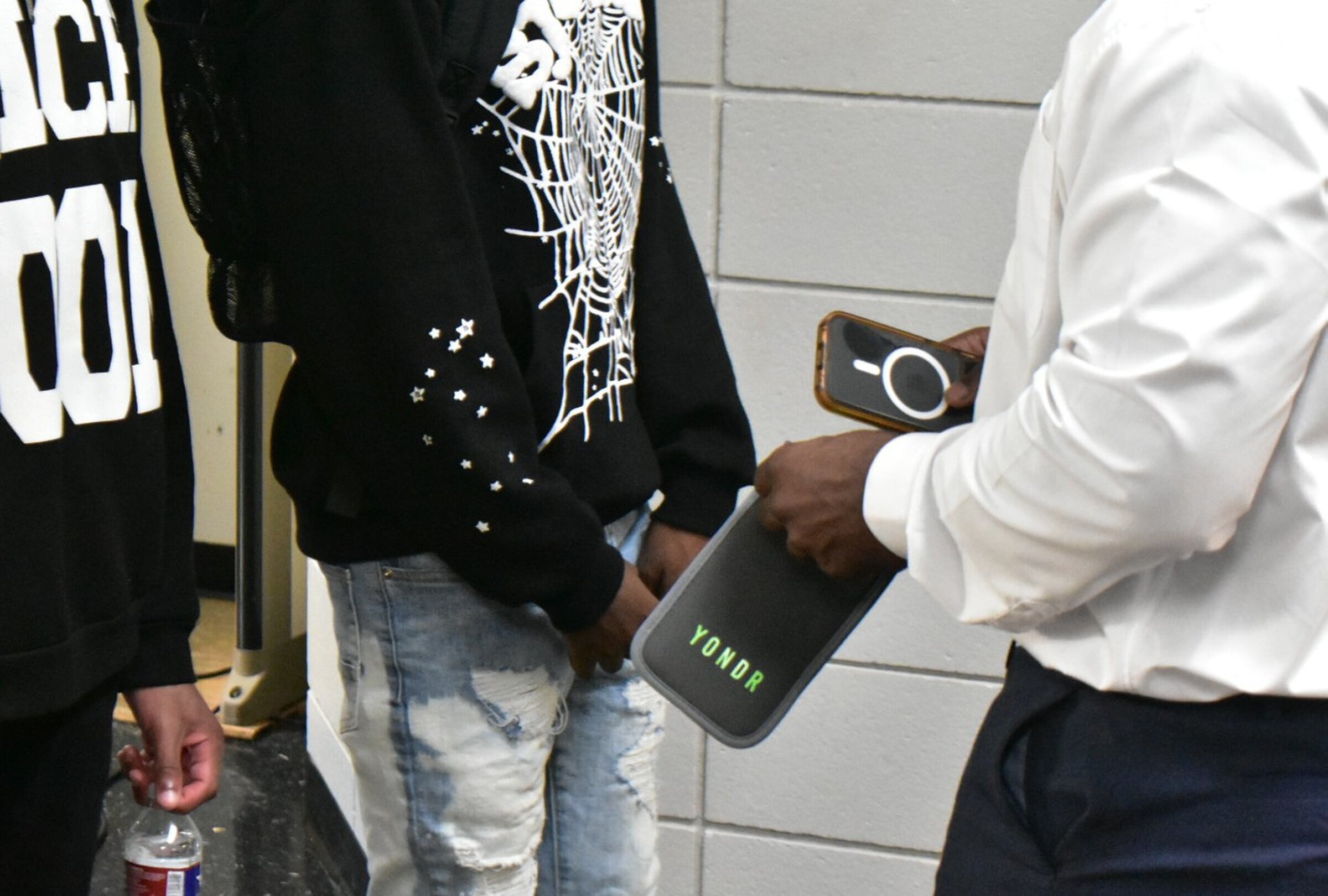
Pine Bluff High School students filed into the Jack Robey campus one by one Monday morning, saying hello to security guards and school officials while saying goodbye — temporarily — to their electronic devices on the first day of class.
It didn’t appear to be a surprise to any of the hundreds of students. Monday marked the first day the Pine Bluff School District enforced the Bell to Bell, No Cell Act the state Legislature passed earlier this year, banning the use of smartphones, headphones and other personal devices during the school day.
Senior Adam Price, executive president of PBHS’s student government, said he didn’t notice any hesitation from the students.
“The school mentioning it early, already getting it into our heads for this year — ‘OK, the phones gotta go’ and all of that — I think that gave us time to prepare mentally so there wouldn’t be any problems. I think it was very easy to hand over the phone so we could go ahead and get the day started.”
PBHS Principal Ronald Laurent reminded the students to turn off their devices before they walked to the metal detectors at the back of the campus. Each student with a device placed it in a Yondr-brand pouch. The pouch locks in the smartphone throughout the school day, and students go to a station on campus to unlock them once the final class is over.
Independent reporting for Pine Bluff & Jefferson County since 1879.
The pouches are issued at the high school and Pine Bluff Junior High School. Watson Chapel and White Hall school districts will issue the pouches when classes begin in their districts Aug. 11 and 13, respectively.
The Bell to Bell, No Cell Act, or Act 122 of 2025, was signed into law in February. Sponsors of what was previously Senate Bill 142 cited “harmful consequences to the academic and mental well-being of young people,” and the new law requires a policy enforcing consequences for the use of smartphones and other devices during class.
Superintendent Jennifer Barbaree said the district has a progressive discipline policy for the use of devices in class, beginning with taking each phone used in an offense and returning it to the student at the end of the school day.
“Right now, we’re just trying to acclimate the students to (the rule),” Barbaree said.
Smartphones in the classroom, if they were not used for instruction, proved a distraction last school year, Price said.
“Some kids, they weren’t paying attention,” he said. “They’d rather be on their phones. All we do at home is be on our phones and chill. We don’t really know when to separate work from chill. I feel like this no-phones (rule) will help us. Now, I feel (as) if kids are forced to pay attention now, because you can’t be on your phones any more. You can’t have music in your ears any more. It’ll be a big help in the classrooms.”
The lack of devices, Price believes, will also promote more friendships and one-on-one conversations among students. As executive president of student government, Price cited the need to make this school year about more engagement among peers.
“I know it will be kind of a challenge with the no-phones; they’re still taking damage from that,” he said. “At the end of the day, we can get it done and we will get it done.”
Also in the district, kindergartners have joined their pre-kindergarten peers at what is now known as Forrest Park/Greenville Kinder Center campus on West 10th Avenue. That leaves the district’s four elementary schools serving grades 1-6.
Barbaree said in April that parents of students then in the pre-K3 and pre-K4 levels wanted the district to keep their kids at the campus once the little ones reached kindergarten. Principal Marceinia Peoples said at the time that the campus also provides “developmentally appropriate material” for the kindergartners.
“With registration, through central office and also the support of our maintenance staff, custodial staff and most of all the administration, the transition has been good,” Peoples said Monday while visiting Brandy Dutton’s kindergarten class. “There were times when we had to do work orders to get things painted and floors fixed, new bulletin boards and white boards and things like that, but those things are steady coming in. Today, our cubbies come in. We’re still awaiting things like cubbies, but we have the general supplies and resources for the Day 1 to start.”
Of the 10 kindergarten classrooms, many have 22 to 23 students each, Peoples said. There are 11 pre-K3 and pre-K4 classrooms with a maximum classroom size of 20 for each.
“We still have families who are registering,” she added. “We know that’s a process, but we definitely have a few slots in for pre-K4. Those parents are getting those documents in right now.”