
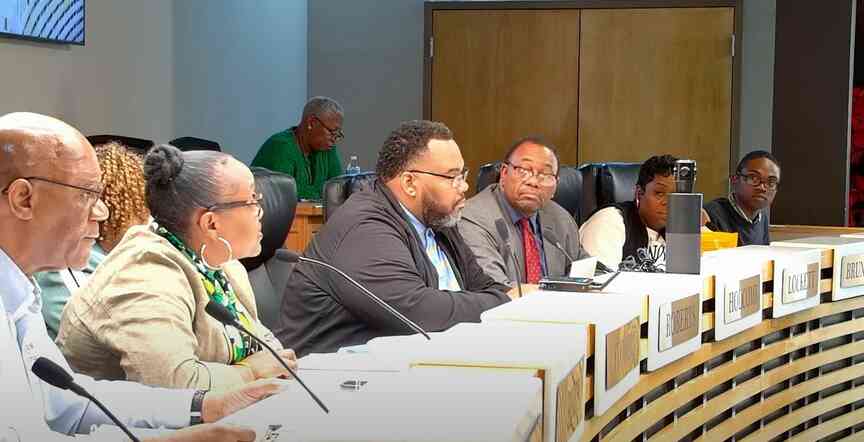
The Pine Bluff City Council met Monday, covering a range of critical issues including the transition in the treasurer’s office, proposed ordinances and resolutions, and community concerns regarding street repairs and distressed properties.
On the topic of the treasurer’s office transition, concerns were raised from city Treasurer Loretta Whitfield about the transfer of documents between her and outgoing Treasurer Greg Gustek.
“There had to be a transfer from one to another. There were some issues with technology,” stated Pine Bluff Mayor Vivian Flowers.
Flowers also noted that there were “several years of documentation that was being transferred” and that “there was a break in between the service of the last treasurer.” This led to some clarity issues “on how many years of record” were involved.
Independent reporting for Pine Bluff & Jefferson County since 1879.
To address these concerns, the council and the city attorney met with both the former and present treasurers to “provide a learning experience” and clarify the process. It was also noted by Flowers that “there is nothing documented that stipulates what the transition in any office looks like” and that the council would “resolve to make more clear for every office” the transition process in the future.
Council member Bruce Lockett expressed his concerns. “I’ve been on the council going on nine years and it’s kind of embarrassing to say but I never really known what information the treasurer was supposed to be providing to us,” said Lockett. He further added that “At one point, we got to make some policy to define what that is.”
Flowers said Whitfield got a chance to review the hard copies, but the concern was the thumb drive she never received.
Moving on to legislative matters, the council addressed several ordinances and resolutions.
The council adopted an ordinance approving the updated City of Pine Bluff Stormwater Management Plan for 2025-2029. This plan outlines measures to control and reduce water pollution from runoff.
Council member William Fells explained that the plan is a standard procedure to ensure the city complies with regulations and focuses on public outreach, construction site management and pollution prevention. The plan details various strategies, such as storm drain marking, citywide clean-up days and employee training, to improve stormwater quality and prevent pollution. This was the third and final reading and was passed.
An ordinance providing for the rezoning of 1010 N. Short Cedar was adopted on its third and final reading. The property is being rezoned from R-3 Residential to B-6.2, University Overlay District — Tier 2. This change aligns the property with the zoning regulations of the University Overlay District and is intended to support the development and expansion of university-related facilities and activities in the area.
An ordinance amending Subsection (b) in Section 26-113 of Article IV of Chapter 26 of the Code of Ordinances, addressing prohibited driving acts, was up for its second reading. This amendment aims to add a new paragraph defining and penalizing “drag racing” on public streets. The ordinance outlines fines for first, second and subsequent convictions within 12 months, ranging from $300 to $1,000. This was placed on the calendar for further consideration.
The council approved a resolution authorizing the mayor to grant an easement to the Pine Bluff Convention Center and Hotel Public Facilities Board. This easement is for the hotel project adjacent to the convention center.
Grandon Gray from The P3 Group clarified that this resolution ensures the legal title shows an easement for ingress and egress. It was emphasized that this is not about transferring any additional land.
Lockett inquired about the ownership of the parking lot, and Gray confirmed this was just for the easement.
“Legally for the title, it has to actually show an easement an ingress and egress so that the title can be fulfilled,” said Gray. “There’s no other changes, there’s no land transferring or anything like that.”
Gray said work has already begun at the hotel site.
All council members were added as co-sponsors of this resolution.
A resolution waiving competitive bidding and authorizing an agreement with Natural State Asphalt Repair Inc. for street repair and related services was adopted. The resolution cites the need for regular and frequent street maintenance due to external factors and acknowledges resident complaints about street conditions.
The agreement with Natural State Asphalt Repair comes with a one-year warranty. The resolution highlights the optimal weather conditions for commencing repairs and the Natural State’s readiness to begin work. The service agreement includes a pricing schedule of $225 per burn, covering approximately 48 square feet and a term from March 24, 2025, to Dec. 31, 2027.
A resolution declaring certain houses, buildings and structures as nuisances and ordering abatement was added to the agenda and approved. Another resolution, providing for the placement of the cost of correcting certain nuisances on tax books as a lien when taxes are collected, was added and approved. This resolution allows the city to recover costs associated with addressing nuisance properties.
Community concerns were also a significant part of the discussion. Fells provided a report for Development and Planning, highlighting the issue of vacant and distressed properties in the 3rd Ward.
“Recently I’ve been surveying the 3rd Ward and I have been documenting the vacant and distressed properties in the ward and so far 231 have been identified,” he said. “These properties range from mildly distressed to severely distressed.”
Fells further explained the different levels of distress, stating, “For mild distress, this could just be a property that may be vacant or it may have a junkyard and it looks like no one is living there. For moderate it’s houses with broken windows, broken doors, they may be boarded up, the roof is open or it shows signs of fire.”
Fells expressed concern that “Some of these projects are severely distressed and I think that they are, you know, they cause a safety risk to the public, they also diminish property values, and so I do think it should be a priority for the city to be addressing these over the next few years.”