
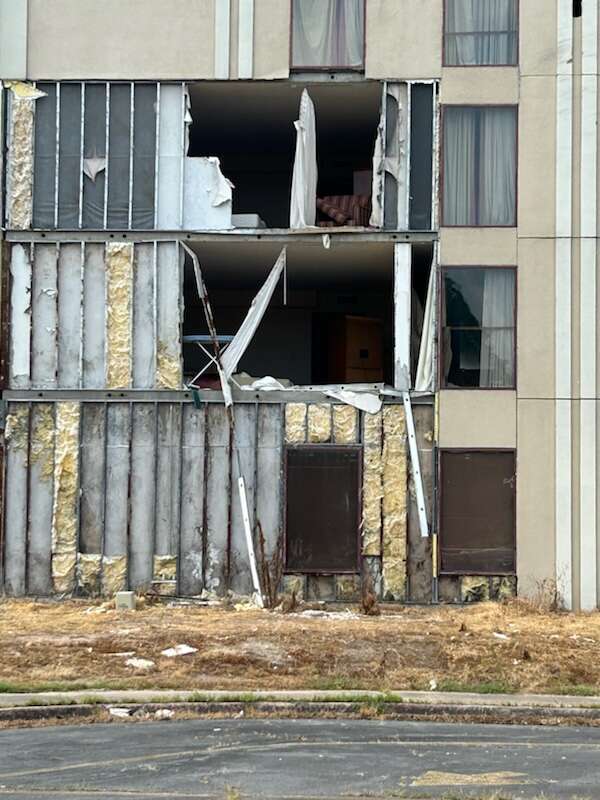
An ordinance authorizing the issuance of a promissory note to provide short-term financing under amendment 78 to acquire furniture, fixtures and equipment for the development of the Marriott Courtyard Hotel in the amount of $3 million was moved to the council with a do pass during a Joint City Council Ways and Means and Development and Planning Committee meeting on Monday.
During the meeting, Development and Planning Chair Bruce Lockett and committee member Latisha Brunson were present in person, while Steven Mays participated virtually.
Council Member Glen Brown Jr. was present for the Ways and Means Committee, along with virtual attendees Mays and Lloyd Holcomb Jr., Pine Bluff Mayor Shirley Washington, Go Forward Pine Bluff CEO Ryan Watley and P3 Group CEO Dee Brown were also in attendance.
As indicated by Brown, the hotel faced a funding gap when a three-month approval process unexpectedly extended to 18 months, necessitating additional funds. According to Brown, the delay was caused by a government shutdown and changes in the administrative personnel during the Trump administration.
“A lot of the Trump administrative people left offices, and there were a lot of vacancies within (the U.S. Department of Agriculture) and other governmental agencies,” Brown said. “What should have been a three-month process took 18 months to get approved. It is fully approved by the bank, fully approved by USDA. Everyone is on the same page.”
Independent reporting for Pine Bluff & Jefferson County since 1879.
Originally, the approval package included construction costs, furniture, fixtures and equipment, as outlined by Brown. However, after the 18-month approval period, there was an increase in construction costs.
“When we sent the package to USDA it included the furniture, but what happened was the construction cost increased,” said Brown. “There was no one working in the offices there and it just sat there. Over the last year, construction costs have increased, and so when we went back out to confirm pricing after the approval, the price had escalated over the period of time.”
Brown emphasized that seeking solutions in the city, rather than returning to the USDA for funding, was a more sensible approach. He explained that the USDA’s processing speed was beyond their control, and relying on them again would be akin to “rolling the dice again with inflation.”
To minimize costs, the city will begin the demolition process of the convention center hotel and the clearing of the land, followed by the immediate closure of the hotel deal by the first week of September. This strategic approach allows the city to save on interest and capital expenses associated with the project.
“We thought in the interest of public safety we demolish the hotel first, then close and start construction,” said Brown. “If you demolish the hotel first, the contractor that demolishes the hotel can’t be the same contractor that builds the new one under the laws we are governed by.”
The USDA has completely funded the project, and the bank that is financing the construction of the hotel will also finance the loan for the furniture and fixtures.
As per the ordinance approving the issuance of a promissory note to secure short-term financing under Amendment 78 to the Arkansas constitution for acquiring specific tangible personal property, the city plans to obtain a loan from Farmers State Bank of Alto Pass, an Illinois Banking corporation, as the primary lender.
The city intends to transfer ownership to the Public Facilities Board.
Chairman Lockett expressed reservations about the proposed ordinance, citing concerns about taxation. He was particularly frustrated by the need for additional funding, given that $2.9 million had already been allocated to support the project after city officials had promised that no tax money would be needed for the project.
In response, Brown clarified that the initial $2.9 million was essential to submit the file to the USDA. He reminded Lockett that the P3 Group had also invested $1.7 million, emphasizing the shared belief in the project’s potential.
Unfortunately, the project encountered delays in Washington, D.C., further complicating the situation, he said.
Lockett expressed his concern that the council lacked knowledge about the progress of the hotel project. He also believed that the city should not be involved in operating hotels. Additionally, he doubted that a hotel with 125 rooms would generate significant tax revenue for the city.
Council Member Brunson expressed her frustration and concern regarding the hotel located in her ward. She described the hotel as an unsightly nuisance that posed a health hazard. Brunson emphasized her desire to see the hotel demolished, stating, “I want it down.”
“We’ve been working on this for 3 years,” said Watley. “I’m glad we are taking the steps to hopefully resolve this issue.”