
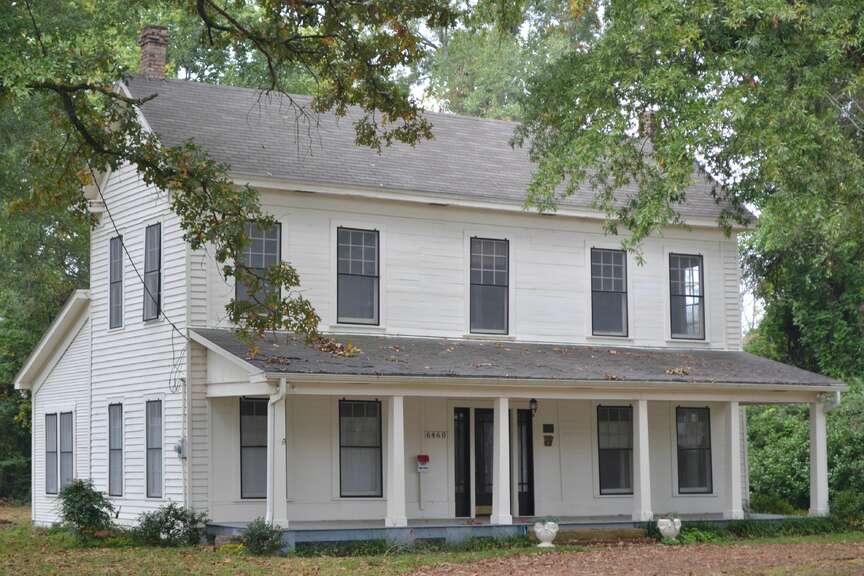
Known today as little more than a wide spot in the road, New Edinburg, like so many old farming communities of southeast Arkansas, was once a vibrant and flourishing town with a prosperous population.
The 2010 census records contain many of the same family names as were on the rolls in 1830…Marks, Smith, Davis, Crain, Washburn, McDaniel, and Hudson. Its often curious history dates back to when these staunch pioneer families first inhabited the area. As was customary in such isolated settlements, different families intermarried until almost everyone was some sort of distant kin.
The hub of the community has had several name changes and an almost equal number of locations. It was originally situated just east of its present site, established under the name of Washburn Flats. By 1848 the name changed to Eagle Post. According to a 2000 edition of the Cleveland County Herald, the name changed to Lott’s Post and back again to Eagle Post after the year 1850. Following a long-running debate, the name Edinburg was eventually decided upon.
Tradition holds how the preceding village was built one mile east of where it may be today found, until being lost to a gambling debt. The same legend states that the initial settlement with nearly all its log and frame structures burned to the ground one night while a group of its most prominent citizens were deeply involved in a high-stakes poker game. Soon thereafter, the town relocated a short distance west and adopted the moniker it bears to this day: New Edinburg.
According to Dr. Ron Moseley’s book “The Life and Times of Parnell Springs,” E.P. Marks opened a drug store in 1867, followed soon after by a general store run by J.J.T. Kendrick. In 1869, Georgia native Dr. E.H. Moses erected the first house within the town limits. That same year, E.P. Marks and W.D. Attwood opened the Drive-In Store. Members of the Masonic Hall put up the first educational institute on the ground occupied by the current U.S. Post Office. In 1896 a larger, improved school went up, opening its doors to 115 students of all ages. From there the town took off, until today’s Arkansas 8 was soon lined on either side by numerous newly built stores, homes and a couple of nice hotels.
Independent reporting for Pine Bluff & Jefferson County since 1879.
Any old timer will tell you about one of the more notable features of the town that long stood at its very heart. It was a huge spreading oak that grew in the center of the highway right in front of Attwood’s store. Breck Attwood, Pascal Parham and numerous of their cronies are said to have spent long hours idling beneath its shade, watching the many comings and goings in the town, while nearby pigs wallowed out a considerable pothole in the middle of the thoroughfare beneath the tree.
Much in the rough and rowdy tradition held by most of early Cleveland County, things weren’t always so peaceful in and around New Edinburg. Former native Bobby Erwin says, “Shootings, stabbings and fistfights were as common as all night drinking and gambling bouts.” As the name might imply, many early settlers of the area were of Scottish decent. The rugged terrain and generations of clan warfare in the highlands bred the Scots into a hardy and stubborn lot. These were traits they brought with them to the new world that helped tame the wilderness. The reality of circumstance required men and women be much tougher than what we’ve come to expect in our convenient, modern age and yes, much meaner, too.
Like any prosperous town of its former size, New Edinburg had a well-funded bank. Accordingly, it also had the occasional bank robbery. E.M. Attwood established the Bank of New Edinburg in 1904. Attwood descendant and Fordyce Chamber of Commerce Director Barbara Finley related how one long night while lying awake with a severe headache, the bank president took an early morning stroll downtown seeking some sort of relief from his discomfort. Noticing a lantern burning within his bank, he slipped in the back door and apprehended thief M.B. Moore in the act of picking the safe. As result, Attwood received a $500 reward from the Arkansas Bankers Association for interrupting the robbery of his own bank.
There were store, stagecoach and train robberies as well. And like any market town, the economy was driven by supply and demand. Perhaps then the threat of violence is why so many doctors came to set up medical practice in New Edinburg. Besides the aforementioned Dr. Egbert Moses, a short list of additional practitioners would include Dr. J.O. Vance, Dr. Dunman, Dr. William Barnett, Dr. Curtis Burke Attwood and Dr. J.L. Bachlor.
Many individuals and families in the tiny town managed to accumulate large fortunes. Besides immense landholdings, storekeeping, banking and cotton ginning provided the foundation for Attwood, Frey, Barnett and Marks prosperity.
Back when cotton was still king of the cash crops, every farmer put the bulk of his efforts into raising the valuable commodity. As result, every agri-based community had its busy cotton gin. During harvest season, cotton wagons were nearly constantly lined up to have their loads sucked up into the churning machinery that so adequately separated the fiber from the stubborn seeds.
Like so many of the old bank and store buildings, homes and hotels that make New Edinburg a time capsule microcosm, the old gin still stands right behind the Masonic Hall. However, much as many of the other antiquated structures in town, it’s a bit in disrepair. In fact, the gin is so overgrown with vines and trees, one might never know, at least for the time being, it’s still mostly standing beneath the menagerie of flora. Within the tin-covered structure buried beneath prolific shrubbery remains the two-story ginning machinery, huge blower-pipes, drive shaft and flywheels. There’s even the occasional Bank of New Edinburg canceled check lying around signed by onetime gin owner R.E. Everright.
Zach McClendon Jr. shared how in 1943, his father, Zach McClendon Sr., relocated the family from the town of Strong to Monticello, where Senior continued acquiring numerous additional small cotton gins throughout southeast Arkansas, including the New Edinburg operation. There was good money to be made ginning cotton, but even more substantial monetary gains stood to be had from milling cottonseed into valuable oil. McClendon not only owned several gins but also held considerable stock in Drew Cottonseed Oil Mill. His accumulation of small ginning facilities was driven by competition with bigger corporations such as Swift and Armor, which necessitated procuring a steady supply of the highly sought after by-product seed through owning the source from whence it came, small-town gins. Over many years of hard work and legendary Scottish frugality, McClendon eventually built a respectable fortune from the fruits of humble satellite communities such as New Edinburg.
A visit to the pre-Civil War village today reveals a place diminished but by no means done, not by a long shot. The lack of progress may even be a blessing in how unlike other cities that have torn down historic edifices in the rush to progress, New Edinburg remains frozen in time, little changed from its heyday. In its current state, it’s more a bedroom community than a center of commerce.
There’s a busy post office that provides delivery service to 402 families. Rural carrier Melody Spears states she drives a 118-mile route out of New Edinburg six days a week to post their mail.
There is a new rural fire station on Mt. Lebanon Road and a vibrant newly built community center that occasionally hosts live music and Bar-B-Q on third Saturdays of the month.
For those traveling Highway 8 between Fordyce and Warren, don’t just slow down, but take a spell to stop and soak in the old time ambience of a place as quaint as it is legendary.
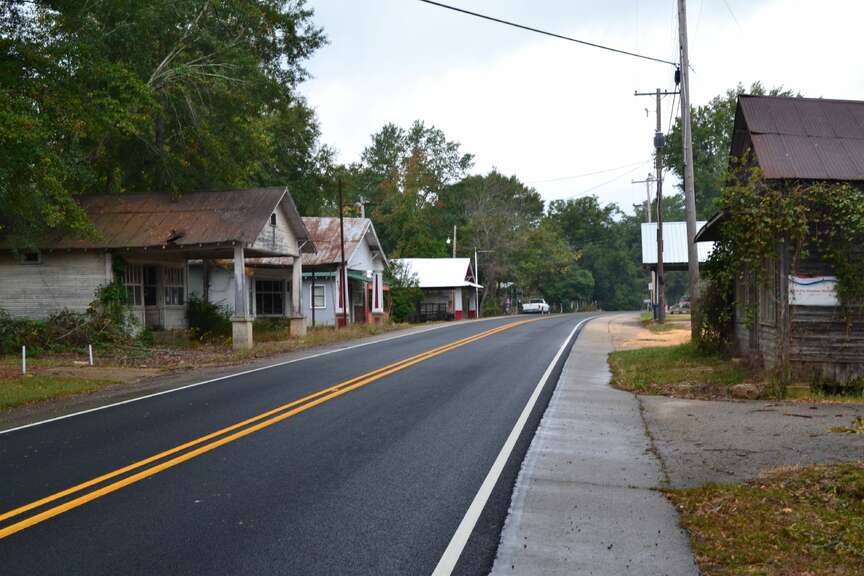 Arkansas Highway 8 is a busy, store lined thoroughfare passing through the heart of the tiny community. (Special to The Commercial/Richard Ledbetter)
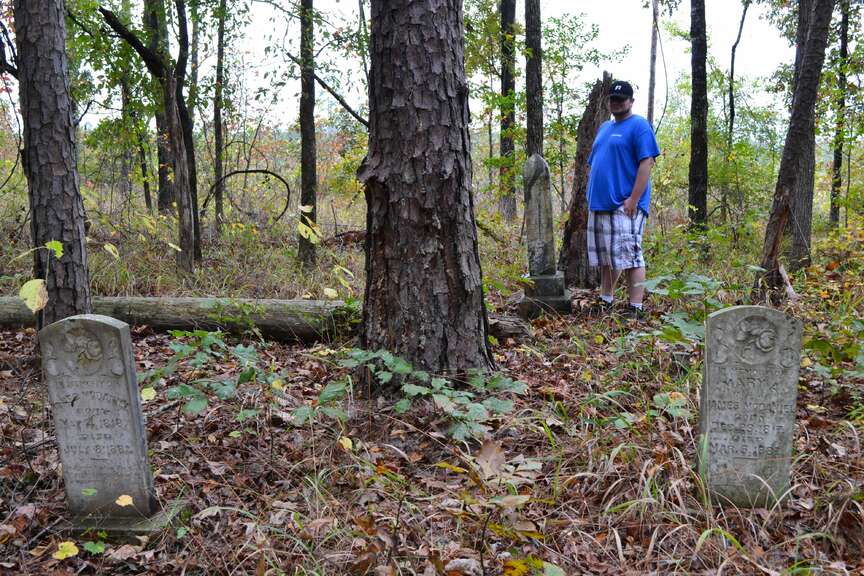 Stephen McClellan shared the hidden location of the original Edinburg cemetery that now lies overgrown in a pine flat, one mile east of the current town. (Special to The Commercial/Richard Ledbetter)