
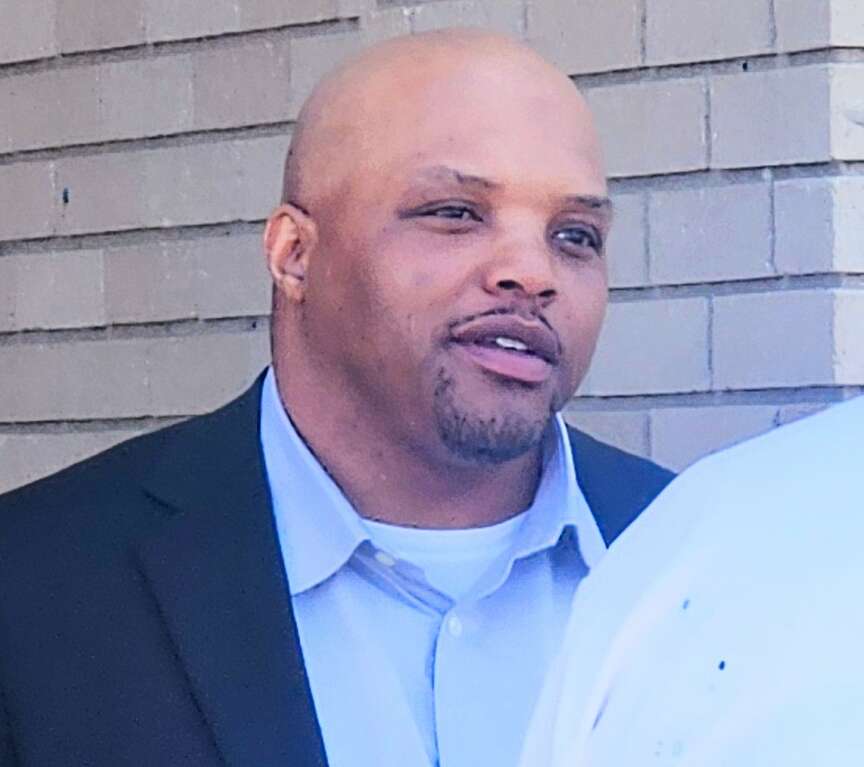
A jury in the Second Division of 11th West Circuit Court found Rodrick Morris guilty of 79 of 82 counts of accepting city funds from a now-deceased Pine Bluff Urban Renewal Agency executive director for asbestos work he did not perform.
The panel Wednesday needed 4 hours and 18 minutes to determine Morris, 44, was guilty of 41 counts of Class C second-degree forgery and all 38 counts of theft of property between 2019-23. Of the theft charges, Morris was found guilty on all seven counts of accepting payment of $25,000 or more, a Class B felony; guilty on all 29 counts of accepting at least $5,000 but less than $25,000, a Class C felony; and guilty on both counts of accepting at least $1,000 but less than $5,000, a Class D felony. In total, Morris received $667,384 in payments from Urban Renewal.
Morris declined to testify. Special Judge Robert Edwards of Searcy allowed Morris and his defense lawyers to sit through the reading of all 84 counts.
The sentencing phase will begin at 9 a.m. Thursday. Morris now faces five to 20 years for each Class B felony; three to 10 years for each Class C felony and up to six years for each Class D felony.
Independent reporting for Pine Bluff & Jefferson County since 1879.
Morris and his high school classmate, Maurice Taggart, were charged with 84 total counts — Taggart was hit with another charge of abuse of office — in June 2023. Morris was found not guilty on three second-degree forgery counts, and prosecutors withdrew two others.
Taggart, who resigned from Urban Renewal in September 2021, died Aug. 30, 2023 at age 43.
Prosecutors detailed in their case how Taggart was the only city official to enter the payments into software called New World, as well as how Morris was believed to operate a fraudulent limited liability company called RM Group that, according to testimony from a state asbestos environmental coordinator, was not licensed to do business in the state. Morris, however, was certified as a contractor and supervisor in Arkansas and Texas, where he resided at the time he was charged.
The third day of the trial began with one of the 12 jurors excused from duty after he expressed to Judge Edwards he was uncomfortable in helping render a verdict since he is involved in a ministry that visits state prisons.
“If someone is found guilty and I’m part of the process, that could be a problem,” the juror told Edwards. “… It’s just a feeling I have.”
Edwards asked: “Will it keep you from being a juror?” The juror answered in the affirmative.
Prosecutors called John Petteway, a senior vice president of branch banking for the North Texas region of Wells Fargo, who testified Morris endorsed most of the checks with the RM Group LLC stamp. Defense attorney Jimmy Morris Jr. then unsuccessfully requested Edwards direct two verdicts, or grant judgments based on lack of evidence, for all 44 second-degree forgery counts and all 38 thefts of property.
In closing arguments, deputy prosecuting attorney Joe West told the jury RM Group did no work for the city of Pine Bluff, reminding them of testimony from current Urban Renewal Executive Director Chandra Griffin, environmental project coordinator Gary Nooner and state environmental official Ronald Allen.
“That money was taken and deposited from the city of Pine Bluff into Rodrick Morris’ bank account,” West said.
As for the address of RM Group to which Taggart mailed the checks, West added: “That wasn’t an address Maurice Taggart pulled from nowhere.”
Jimmy Morris asked the jury to connect the dots in the case and told them a quote from 18th-century English jurist William Blackstone: “It is better for 10 guilty men to go free than for one person not guilty to go to prison.” The attorney suggested Arkansas State Police Investigator Mike McNeill didn’t look to see whether Rodrick Morris was a businessman, and that no one other than Taggart put the information regarding the payments into the database.
“The defendant created and pushed none of those invoices through,” Attorney Morris said, adding Taggart had everyone who knew about the payments fooled. “… They had to get the person so far removed, in Houston, that they had to throw someone under the bus.”