
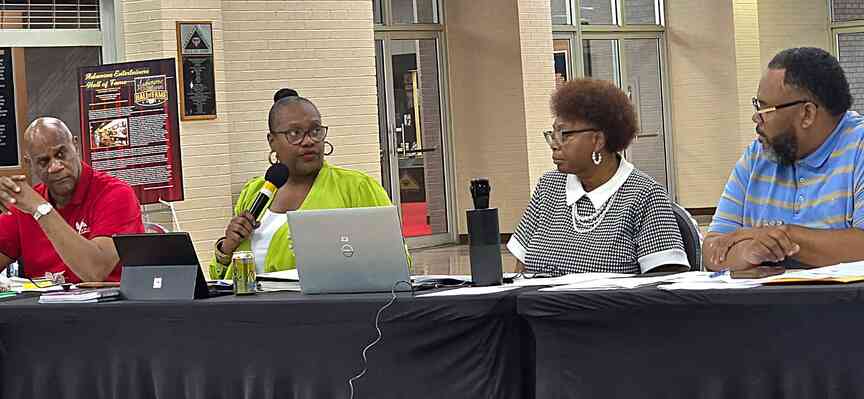
A proposed 10-year sales and use tax, intended to address critical infrastructure and economic development needs, was pulled from the Pine Bluff City Council agenda by Mayor Vivian Flowers on Tuesday.
This action followed significant public feedback and concerns from council and community members. The decision came a week after a spirited public comment voiced apprehension about the city’s fiscal management and the proposed tax’s impact.
During public comments, former mayoral candidate John Fenley, who opposed Go Forward Pine Bluff’s 2017 tax initiative, expressed strong opposition on the new tax proposal.
“I don’t know what you’re thinking. I really don’t because the city hasn’t been spending its tax money wisely,” he said. “There’s one project they’ve come forward with, completed in the last eight years … just barely for eight and a half million dollars down there on Main Street.”
Flowers acknowledged these sentiments.
Independent reporting for Pine Bluff & Jefferson County since 1879.
“I also have heard loud and clear in the last couple of weeks, especially from my colleagues on the council as well as citizens, that, while I have spoken with plenty of people who understand this need, I heard every citizen who said what we heard Mr. Fenley say, ‘I don’t know what you’re doing.’ And that’s a problem.”
Flowers emphasized the city’s urgent need for revenue, citing a dwindling population–from 41,000 in 2020 to just over 37,000 in 2025 — and a corresponding decline in the tax base.
“We cannot continue to lose population and therefore lose our tax base while we do not do anything to speak and to invest in our children, to the extent that they stay here,” she explained.
She further detailed the need to address housing, blight and infrastructure, including Wi-Fi and road repairs.
“All of that is extra and all of that costs money. Right now, we are at a balanced budget with just a little over $2 million. And we are taking in more than we spend. There is not enough belt-tightening to fully address what we need to address if we want to see jobs, if we want to attract your population, and if we want to assist small businesses,” continued Flowers.
A commitment to transparency and public understanding drove Flowers’ decision to pull the tax proposal.
“Before we do anything, I hear you. Everyone needs to understand what we’re proposing, to be excited about it, be clear about it,” she said. “It is my responsibility as mayor to work with all of these good men and women, to make sure that when they go back to the people in their wards, that they can say with confidence, whether they agree or not, this is what this is. But they can confidently vote for something to put on the ballot, not to pass it, but to give the people the choice to know what we need and to make the choice as to whether or not we are going to put skin in the game, because I always say it: no one is coming to save us. We have to save ourselves and we have the resources to do it with.”
To address the public’s concerns and ensure understanding, Flowers announced plans for town hall meetings and information sharing.
“I’m pulling it down so that we can do that so that we can have town hall meetings, and so that we can share information,” she stated. “We will begin this week by sharing a fact sheet online, and we will share it throughout the city. We will schedule town hall meetings over the next three months.”
The proposed tax included provisions for full audits every two years, a detail Flowers highlighted as part of the commitment to accountability.
Tuesday’s meeting was moved to the Convention Center from the council chambers due to electricity being turned off as a result of ongoing maintenance and repairs.