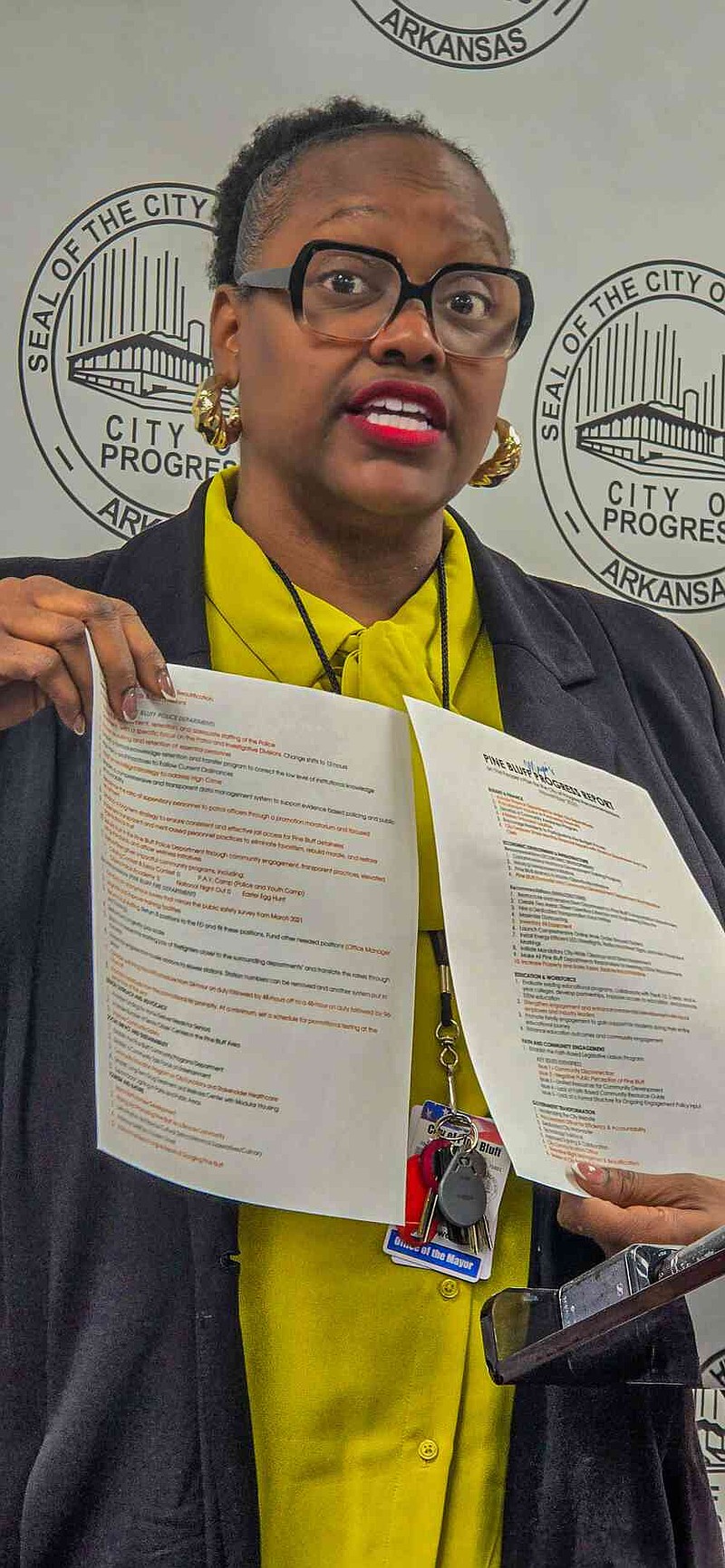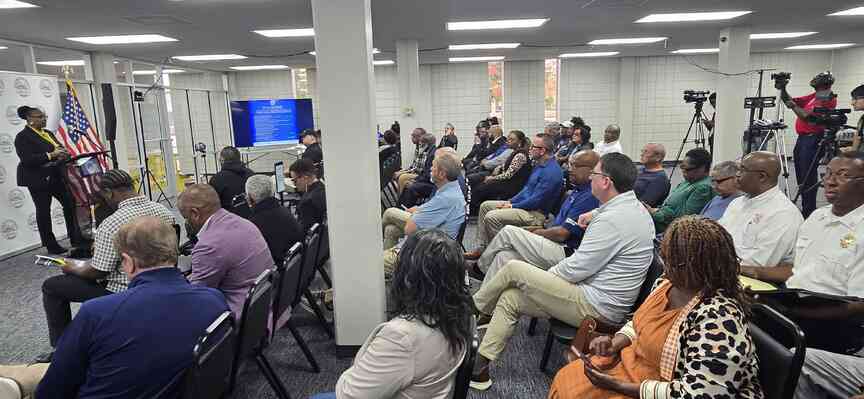
Pine Bluff Mayor Vivian Flowers is moving forward with a controversial proposal for a new one-cent, 10-year sales and use tax, dubbed the “Revitalization Economic Development Tax,” arguing the additional revenue is critical to address chronic city budget deficits and an eroding tax base. Facing skepticism rooted in the management of previous tax initiatives, Flowers is simultaneously implementing a binding transparency measure: a mandatory forensic audit every two years.
During Monday’s town hall meeting held at noon in the Detective Kevin Collins Center Conference Room, Flowers detailed the city’s precarious financial situation, citing multiple years of budget shortfalls and noting the city has operated with approximately a “$2 million deficit in the 2025 budget.”
According to Flowers, this deficit, coupled with the long-term trend of population decline — losing approximately 1,000 people a year — has led to a shrinking tax base and a strained ability to fund essential services.
Addressing a citizen’s question on how to overcome “trust issues based on what has happened with past taxes,” Flowers offered a direct message of accountability. She emphasized that citizens should judge the current administration by its actions.
Independent reporting for Pine Bluff & Jefferson County since 1879.
“I would say this year, I came in and said what I would do. And we’ve been doing it, we’re still doing it,” she said. On past financial issues, Flowers insisted on facing the problem directly. “We have gotten in there, and not only recognized areas where there was fraud, waste and abuse… we told y’all about it,” said Flowers, referencing the Parks and Recreation Department. “In order to fix it, you have to face it.”
Flowers is framing the mandatory forensic audit as a “prenup” for the city’s relationship with its residents, assuring them the new tax would be managed solely by the elected City Council and Mayor.
The audit, which is being contracted to an external firm, will cover the last two years or more of city departmental spending and, crucially, “all 7 years of the 2017 sales tax-related expenses and revenues.” That sales tax was part of a Go Forward Pine Bluff push to pay for various initiatives. Two attempts to extend the sales tax were voted down. The resolution to approve the auditing contract was placed on the city council’s current agenda, with the audit expected to take between four and nine months.
If passed, the revenue from the proposed sales tax would be dedicated to priority projects under defined categories of spending. The City of Pine Bluff, under Flowers’s leadership, released the comprehensive “Progress Report on The People’s Plan for the City of Progress Recommendations” for November 2025, detailing numerous initiatives across critical areas.
Key projects outlined by Flowers include comprehensive blight removal, full-scale renovation of the Pine Bluff Convention Center, citywide pothole repairs, downtown broadband access, and a minimum $5 million repair and expansion project for the Pine Bluff Port. Flowers also noted a significant increase in the Pine Bluff Police Department’s full-time uniformed personnel, rising from 75 to 100 officers, an improvement that requires more sustained funding.
The mayor’s report outlines a multi-faceted approach to city improvement, organized under several key pillars.
Budget & Finance and Government Transformation
Key recommendations focus on transparency and efficiency. Proposed actions include increasing procurement inclusion, developing a community awareness program on the budget, and modernizing the city website with a Dedicated City Webcaster to enhance public access to government proceedings. The report also calls for the establishment of a Procurement Officer for Efficiency & Accountability.
Economic Development & Infrastructure
Infrastructure and economic development remain top priorities. Recommendations span the creation of a two-week Street Operations Department to Pine Bluff Transportation Department, hiring a dedicated transportation grant writer, and launching a comprehensive online work order request system to improve service delivery. Economic development initiatives include a comprehensive workforce development training program and the revitalization of the Pine Bluff Economic and Community Development Department.
Public Safety: Police and Fire Departments
Public safety recommendations are extensive, aiming to address staffing, training, and community relations.
Pine Bluff Police Department: Prioritizing recruitment, retention, and adequate staffing, especially in patrol and investigative divisions. A major push is to establish a formal knowledge retention and transfer program. The report also focuses on anti-blight strategies to address high crime areas and the implementation of a comprehensive data system to support evidence-based policing and public accountability. The Police Department aims to rebuild trust through community engagement programs like the Police Department Wellness Initiative.
Pine Bluff Fire Department: Key goals are to return to full staffing, upgrade and improve training facilities, and implement a long-term strategy for recruiting and retaining firefighters through competitive pay. The report also suggests changing the work schedule from 24 hours on duty followed by 48 hours off to a 48-hour on duty followed by 96 hours off.
Education & Workforce and Community Engagement
The report emphasizes support for youth and community:
Education: Expanding educational programs from Pre-K-12, two-year, and four-year colleges, and strengthening employer partnerships for STEM education.
Faith and Community Engagement: The plan seeks to establish a Faith-Based Legislative Liaison Program to tackle issues identified, such as “Community Disconnection” and a “Negative Public Perception of Pine Bluff.”
The proposed one-cent sales and use tax, if approved by voters in March 2026, would be in effect for 10 years (2026 to 2036). Officials project this tax could generate an additional $9.1 million to $14.3 million annually.
In response to public skepticism, city officials highlight the inadequacy of current revenues. Despite an increase in tax revenue from Saracen Casino and cannabis dispensaries, the city’s overall revenue remains insufficient to meet all of its needs due to rising costs, a declining tax base, and past budget shortfalls.
Flowers’s administration emphasizes that this tax initiative is based on the People’s Plan and aims to address critical, long-standing needs. Town hall meetings are scheduled for this week, with the measure set to be considered by the City Council in December. If it is approved, the measure will go before the public as part of the March 2026 primary election.
Citizens can text PBALERTS to 91896 for more information.