
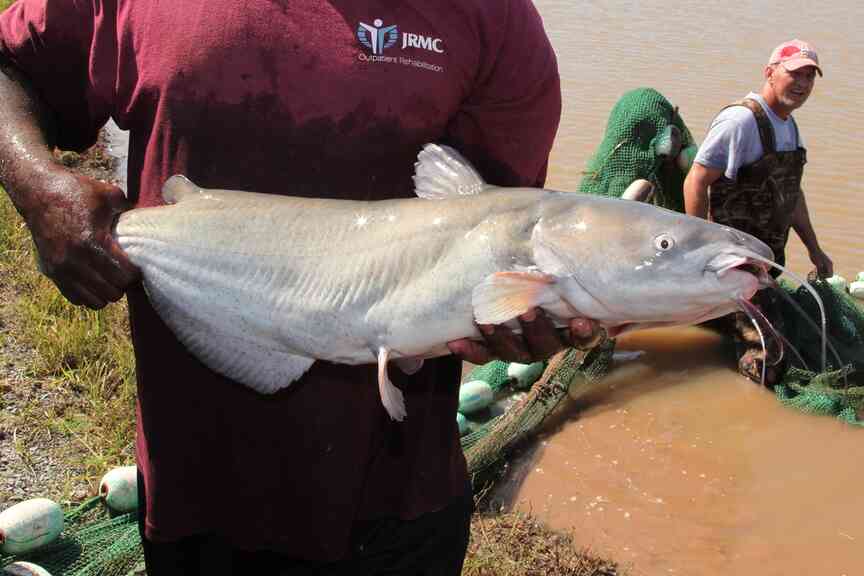
August is National Catfish Month. Catfish are one of Arkansas’ top sportfish — they can be found in most waters throughout the state, are fun to catch and taste great too, according to Scott Jones, small impoundment extension specialist for the University of Arkansas at Pine Bluff.
“The quickest way to celebrate National Catfish Month is to visit your local seafood restaurant and order a plate of catfish,” Jones said. “Consider selecting restaurants that offer local-caught or American farm-raised catfish. And for those looking for an adventure, the pursuit of fresh catfish can be fun and rewarding.”
With some understanding of habitat preference, proper gear and lure selection — all of which can be learned quickly through a myriad of online instructional videos and articles — catfish are relatively easy fish to catch, he said. They can also grow very large, so a single catch can make the trip worthwhile. Their ease to catch makes them a good fish to target for novices and children who benefit most from quick success.
“Catfish are highly regarded for their table fare, and unlike other smaller preferred food-fish such as crappie, walleye and trout, a single large catfish can provide dinner for a whole family,” he said. “Another interesting aspect of fishing for catfish is that you do not always have to do so with a rod and reel. There are some very effective ‘passive’ fishing techniques for those who do not want to hold a rod waiting for a bite.”
When it comes to equipment, a wide range of rod and reel combos are suitable for catfish. Individuals should use gear suitable for the size of catfish they are targeting.
Independent reporting for Pine Bluff & Jefferson County since 1879.
“For example, when fishing a neighborhood pond stocked by the Arkansas Game and Fish Commission’s (AGFC) Family and Community Fishing Program, you only need to prepare for up to about 3-pound fish,” Jones said. “When fishing the Arkansas River or larger reservoirs, you may encounter catfish 20, 30 to 50 pounds or more, so your gear must be beefed-up accordingly.”
There are catfish-specific rods available at several tackle shops. These are generally heavy duty and similar to surf fishing gear. However, most fishing rods and reels will suffice. Individuals fishing in areas with larger catfish may simply need to rig up stronger line on their reels.
For those interested in a different approach, volumes of catfish can be caught using passive trotlines, yo-yos, stump-lines and even jug- or float-lines carried by wind drifting over large, promising areas.
“What makes the passive approach appealing is that once the lines are baited, you do not have to actively hold a rod, set a hook or reel in the fish,” Jones said. “For drifting jug-lines and stationery yo-yos, you must stay near the gear and retrieve your fish once they are hooked. For trotlines and stump-lines, you can bait them and come back several hours later to check them for fish. Be sure not to leave this gear unchecked for long — overnight at most — as to not waste fish that may die if they stay hooked too long.”
Jones said the most important factor in catfish lures or bait is scent. Catfish scent and taste detection is far more advanced than most freshwater fish, so smelly oily bait tends to perform best. Effective options include earthworms, various “stink bait” products, chicken livers, live sunfish, live goldfish, live shiners, cut sunfish, shad or carp, corn kernels, cut hot dogs, chunks of canned meat and even Zote soap.
“While some of those options may sound a bit outlandish, they actually all work,” he said. “In fact, several scientific journal articles have demonstrated the effectiveness of Zote soap compared to conventional lures, and many state agencies have used it in catfish sampling efforts.”
When using fish as bait, individuals should only use fish caught within that body of water or fish purchased from an AGFC-certified bait shop. It is illegal to transport fish caught in one body of water for use in another.
“The type of hook matters for the fish you are targeting and the lures you are using,” Jones said. “Circle hooks tend to be a popular choice for catfish when using earthworms, live fish, cut fish and other denser lures. Circle hooks often hook catfish in the sides of the mouth, are less prone to deep-hooking and set themselves more consistently than other hook designs.”
Treble hooks are preferred when using delicate baits such as dough baits, some stink baits and chicken livers. The three points of treble hooks help keep softer lures secured and offer good hooking success for catfish.
“When using a rod and reel for catfish, you generally use a weighted rig that rests on the bottom and you maintain semi-tight line to detect bites,” Jones said. “Alternatively, you can use floating rigs near shore or in shallow areas where the float going under the surface indicates a bite.”
When a bite occurs, individuals should reel in any slack line. If they still feel the fish pulling on the end of the line, they should then firmly sweep the rod upwards and begin reeling. The hookset for catfish, especially when using circle hooks, is not the aggressive hard snap that you may see from anglers fishing for largemouth bass.
“You need only apply firm pressure to the line for the exposed hooks to set into the fish and continue reeling so that the fish does not gain slack line, which can allow them to shake the hook free,” he said. “For larger catfish, you should adjust your reel’s drag to slip slightly during hard pulls to prevent overloading and possibly breaking the line.”
WHERE TO FISH FOR CATFISH?
Individuals who want to fish at locally-stocked ponds should explore the options available on the AGFC’s Family and Community Fishing Program webpages, Jones said.
“These ponds are stocked periodically with catfish, often coinciding with public fishing derbies at the site,” he said. “For larger bodies of water, target large woody cover near deeper water, creek or river channels, for example, and pay special attention to shady areas when fishing shallow.”
On flowing streams or rivers, individuals should target current eddies just behind jetties or woody debris. Catfish are present in all larger reservoirs and rivers in Arkansas — it is just a matter of zeroing in on exactly where they are lurking.
“Finally, in the heat of summer, consider fishing at night,” Jones said. “Most fish species are more active at night this time of year, and you are more likely to capture catfish shallow near shore at night than during the day. This is especially true for trotlines – baiting them right at dark and checking the lines periodically overnight or first thing in the morning is a very effective technique.”
Jones said all anglers 16 years and older must have an Arkansas fishing license to fish public waters within the state. When fishing AGFC Family and Community Fishing Program ponds, the daily harvest limit for catfish is three.
“You can catch all you like, but you may only take home three,” he said. “The state-wide combined daily harvest limit – for channel, blue and flathead catfish — is 10. Some locations may have more restrictive limits, so check AGFC’s annual Fishing Guidebook and official signage at fishing access points and boat ramps for specific details.”
Will Hehemann is an extension specialist for communications with the University of Arkansas at Pine Bluff School of Agriculture, Fisheries and Human Sciences.