
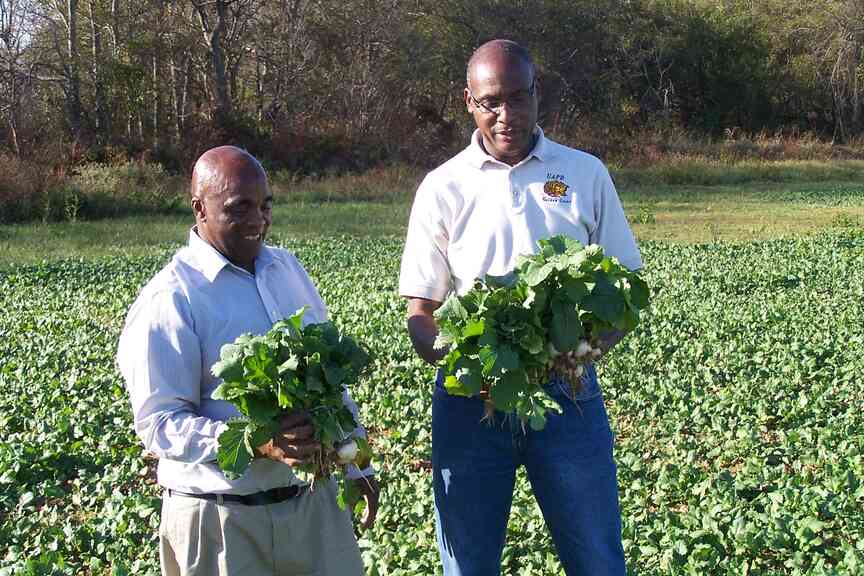
March and April are the perfect months to plant spring greens, according to Van Banks, extension associate for the University of Arkansas at Pine Bluff’s Small Farm Program.
Spring greens include crops such as turnip, mustard and collard greens.
“Spring greens should be planted whenever temperatures will be between 28 and 80 degrees Fahrenheit for the next seven to 10 weeks or during the week following the last expected winter freeze,” he said.
“For example, if the previous expected winter freeze is Feb. 28, then March 7 is an ideal date for planting greens. The soil temperature range for germination is generally between 45 to 95 degrees,” Banks said.
Banks said some of the most common greens varieties grown in Arkansas are Florida broadleaf (mustard), purple top white globe (turnip) and Vates (collard). The best soil for greens is sandy loam or silt loam soil because they allow for good internal drainage. Farmers occasionally grow greens in raised beds to help with drainage.
Independent reporting for Pine Bluff & Jefferson County since 1879.
Banks said that before planting, producers should:
Take a soil test to know the fertilizer requirements for their greens. For more information on soil testing, they should contact their local county Extension agent.
Take a soil compaction test to determine if a hard pan or plow pan has developed in the soil. This hard, cement-like layer of soil will affect the plant’s ability to obtain water and nutrients.
Consider the field’s herbicide history. Producers need to know what types of herbicides were applied last year and when they were applied. If residual herbicides are still present in the soil, the current crop can be negatively affected.
Consider the field’s weed history. Producers should develop a good weed control plan. Without a weed control plan in place, crop yields could be significantly reduced.
“When planting spring greens, turnips, kale, and collard and mustard greens are direct seeded,” he said. “These varieties should be seeded at a rate of 1-2 pounds per acre with a precision planter. With a conventional planter, the rate is 2-3 pounds per acre for turnip greens and 3-4 pounds per acre for mustard greens. Kale and collard greens can be direct-seeded or transplanted. Most commonly, they are transplanted to shorten the harvest date.”
A good weed control plan is highly recommended. Banks recommends a pre-emergence application of Dual Magnum 7.62 EC at a rate of 0.67 to 1 pt/A. Dual controls a wide spectrum of annual grasses and small-seeded broadleaf weeds. Do not use more than 1 pt/A, and only make one application per year, he said.
“To harvest, cut the plants to 1 inch above the soil’s surface, allowing them to quickly put on growth for another harvest,” he said. “Workers can also pull up the entire plant. Leaves are then bundled into whatever size is needed for the market.”
Will Hehemann is an extension specialist for communications with the University of Arkansas at Pine Bluff School of Agriculture, Fisheries and Human Sciences.