
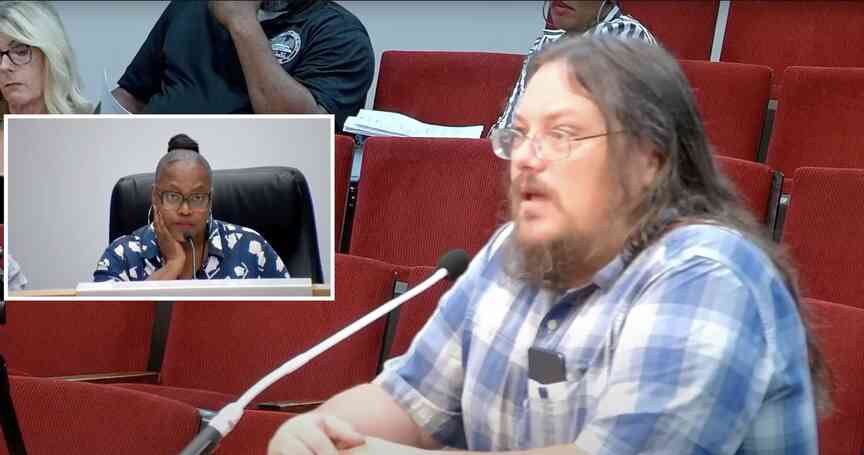
On Monday, the Pine Bluff City Council held a meeting that included public comments regarding code enforcement liens on properties.
The meeting began with public comments, where John Fenley addressed the council regarding code enforcement practices, particularly concerning property liens for unmaintained lots. Fenley, who stated he owns over 240 properties, many of them empty lots, expressed strong opposition to the city’s current code enforcement strategy.
He argued that placing liens on properties prevents owners from paying taxes and discourages maintenance, ultimately leading to derelict properties that eventually go to tax auction.
Fenley specifically challenged the process.
“Now, when I fight the lien that you’re going to put on my properties in court and the judge looks at the paperwork, I want you all to be very aware that they’re going to look at everything and if the paperwork is not done correctly, they will find in my favor,” he said.
Independent reporting for Pine Bluff & Jefferson County since 1879.
He claimed that after initial notices, there’s a second notice, but “at that point it’s too late” as the property is already going to the city council for a lien. Fenley stated that once a lien is filed, it prevents property owners from paying taxes and the only recourse is to go to court.
Mayor Vivian Flowers acknowledged Fenley’s concerns.
“I am listening, and I’m sure that the members of the council are listening to you,” she said. “I just want to say that to you and let you know that I am perfectly willing to hear and figure out what we can do so that we can find some balance in that process and with those issues.”
Fenley mentioned he won’t be managing properties with liens on them.
Council member Steven Mays directly challenged Fenley’s stance.
“You can’t own that much property and not take care of it,” says Mays.
Mays asked Fenley if all his properties are cut and clean, to which Fenley replied, “No.” He explained that paying $50 a week to mow properties would cost “a hundred times more over five years than it even cost me to buy the property.”
When asked about his purpose for buying so many properties, Fenley said he believes the city can thrive, but said maintaining a property does nothing to increase the economy of this town. “It does nothing to advance the town in a direction that is actually progress,” he said.
Fenley argued that placing liens on properties removes any incentive for him to maintain them. “The properties that have liens on them are just going to get ignored,” he said. “There’s no incentive for me to do anything about a property that has a lien on it.” He also claimed that liens prevent property owners from paying taxes and ultimately lead to the properties going to tax auction.
Flowers recognized Fenley’s concerns but also highlighted the city’s difficulty in managing properties where there’s no incentive, without a lien, for owners to maintain their yards, prevent debris accumulation, and generally care for their property to facilitate potential sale or development. She also expressed worry about “people squatting and doing all manner of illegal activity in those places.”
Another resident, Daphne Thompson, also spoke during public comments regarding code enforcement. She presented a case where her deceased parents’ property received a lien letter despite being regularly mowed by a city contractor.
“How can someone come and cut your grass on June 13th when it was already cut on June 11th? You see what I’m saying,” she said. She stated that the lien was ultimately pulled.
On ordinances and resolutions, an ordinance to amend the 2025 municipal budget for the Police Department passed unanimously.
This resolution was brought forth to adjust the 2025 municipal budget by transferring and reallocating funds specifically for the Police Department. The stated reason for this adjustment was to “cover increased costs as detailed in the request.” This resolution ensures that the police department has the necessary financial resources to operate effectively within the current fiscal year.
This resolution, providing for the placement of costs of correcting nuisance on the tax book, passed unanimously. This resolution is directly tied to the city’s efforts to ensure property maintenance.
During the discussion, Council Member Glen Brown Jr. moved to amend the resolution by removing “page 14, lines 13 and 15” from the document, “because that account has been settled and paid for.”
The resolution, as amended, was then approved.