

LITTLE ROCK – The punitive measures in a state Senate bill that would require cities and counties to either approve a current-year budget by Jan. 1 or enact the previous year’s budget could be unconstitutional, Jefferson County Judge Gerald Robinson said Wednesday.
Visiting the state Capitol, Robinson said he met with local lawmakers and addressed concerns about Senate Bill 182 sponsored by Ben Gilmore, R-Crossett, which calls for both the county judge and justices of the peace not to be paid until a current-year budget is passed. Section 14-14-1204(c) of the Arkansas Code provides a salary schedule for the county judge based on county population, and Section 14-14-1205(a) calls for per-diem compensation for JPs, both of which are to be enacted by county ordinance.
Robinson said he spoke with state Reps. Ken Ferguson and Glenn Barnes, both D-Pine Bluff, and hopes both will make headway regarding his concerns. Barnes is a primary sponsor, with Ferguson a co-sponsor.
Senate Bill 182 was passed without opposition and will move to the House, where the City, County & Local Affairs Committee is scheduled to review it following the House session on Thursday.
Robinson believes neither he nor the justices should suffer any financial penalty due to a lack of a current-year budget. The lack of an active budget has kept hundreds of employees from receiving their paychecks since the start of 2025.
Independent reporting for Pine Bluff & Jefferson County since 1879.
“The only thing I can do is hope that (JPs) will see that with a simple ‘yes’ vote to the budget, we can always work on or amend later, as we do every meeting,” Robinson said. “The people need to know there are outside forces like Lloyd Franklin (II, a former District 5 JP) in the crowd such as those antagonizing to create a smokescreen as to what the real issue is. The real issue is, this is not about the budget, and I think people can see that because I’ve had people call me and tell me this is not about the budget.”
Franklin, who was defeated in Democratic primary last year, rejected any claims he was behind the Quorum Court majority’s staunch position against Robinson’s suggested budget.
“I’m just a regular citizen,” Franklin said via phone Wednesday. “I support the movements of the Quorum Court. You have over 400 employees who support the Quorum Court as well as several elected officials. It’s a bad budget. The Quorum Court is in a situation where they can’t pass the budget because they passed a procedure ordinance that gave too much power to the judge.”
The temporary procedure ordinance is soon to expire, Franklin said, but it allows the Quorum Court to try and work out a budget. A proposed budget has to be recommended out of the Budget & Finance Committee before it’s presented to the full Quorum Court.
Franklin claims Robinson names each JP to a committee and names chairpersons for each committee. The seven JPs who have voted down Robinson’s budget — Reginald Adams, Alfred Carroll, Melanie Johnson Dumas, Brenda Bishop Gaddy, Cedric Jackson, Reginald Johnson and Margarette Williams — make up the majority on the 13-member Quorum Court. Currently, there are 12 members following the resignation of JP Danny Holcomb on Jan. 26.
“While they’re the majority, they’re held hostage because Gerald Robinson, under this temporary ordinance, he names the committee, he appoints the committee persons, and he names the chairs,” Franklin said. “He names the same five people. He doesn’t allow them to amend anything.”
JPs Roy Agee, Dr. Conley F. Byrd Jr., Jimmy Fisher, Ted Harden and Patricia Royal Johnson voted for Robinson’s proposed budget. Danny Holcomb resigned from the District 11 seat on Jan. 26.
District 1 JP Carroll said in an email responding to the budget agenda: “As long as the budget committee is set up the way it is, the majority budget has a very small chance of making it out of committee. … The budget committee is stacked with JPs that are opposed to the majority budget.”
Franklin accused Robinson of wanting to control the Quorum Court. The Commercial reported District 3 JP Reginald Johnson attempted to make a motion to replace Robinson’s proposal with the amended 2024 budget, but Robinson argued the 2024 budget was not on the agenda and focus needed to be on a budget for 2025.
“They were trying to do the very thing the bill is going to tell them to do, and he wouldn’t allow them,” Franklin said. “While he’s advocating the bill, he’s trying to get things pulled out of the bill.
“(The majority) can’t do their job because he won’t allow them. He spins the narrative on me.”
While Franklin acknowledges supporting the Quorum Court – “Anything they ask me to do, I’ll do it,” he said – there are about 400 employees also in the ears of the JPs, he suggested. Some employees including first responders have been paid via executive order.
“Four hundred employees are saying, ‘We will wait,'” Franklin said. “They don’t want Gerald to wait. They don’t want the Quorum Court to vote for a bad budget because they know people will lose their jobs or take a pay cut.”
But the jobs that members of the sheriff’s department said during a news conference last month were in jeopardy have been restored in Robinson’s proposed budget.
That budget highlighted funding for offices of the sheriff ($2,462,556), county clerk ($711,718), tax collector ($477,066) and assessor ($644,385), as well as the Juvenile Justice Center ($2,074,351), adult jail ($4,903,476), school lunch program ($180,000), emergency vehicles ($46,726) and Category 4 opioid program ($354,581) as part of a $37,053,870 budget.
The budget the Quorum Court majority is presenting, Robinson said, is the one he vetoed in early January.
“Employees are saying, ‘We want to be paid, but we don’t want a bad budget,'” Franklin said. “Four hundred employees are supporting the Quorum Court. I’m just a regular face in the crowd.”
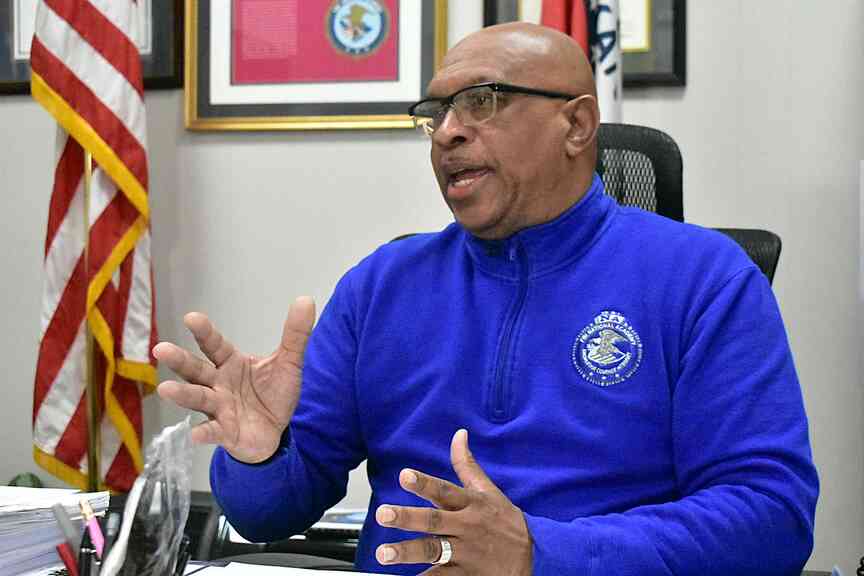 Jefferson County Judge Gerald Robinson addresses concerns about budgeting matters within the Quorum Court in his office Wednesday, Jan. 15, 2025. (Pine Bluff Commercial/I.C. Murrell)