
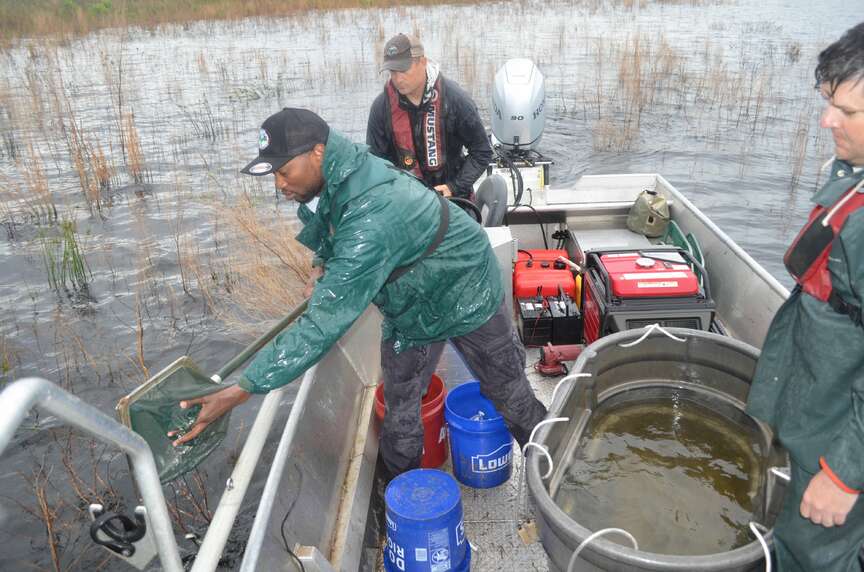
At 10 a.m. May 3, the newly refilled Lake Monticello received the first 9,250 of a total 22,000 genetically identified Florida bass that are to be stocked in the 1,500-acre body of water.
Arkansas Game & Fish Commission Director Austin Booth was on hand for a brief ceremony to introduce those present to the unique idea being put into action at the lake’s Hunger Run access.
The AGFC’s Fisheries Division is working closely with the city of Monticello and a Boston, Ga., based company, Red Hills Fishery, to stock the Titan Maxx Florida bass into an ideal environment to grow state record trophies over the next few years.
“With these particular fish we’re releasing in the lake today, we’re looking for eight-pounders and up over the next three or four years,” said Josh Salmar, a Red Hills technician.
He explained how the fish are not genetically modified, but rather genetically identified.
Independent reporting for Pine Bluff & Jefferson County since 1879.
“We’ve taken samples of Florida bass from all over the southeastern United States and looked at their genetics. We’ve been able to identify 12 different markers in their genome unique to trophy fish. Statistically, these markers indicate fish that produce in size eight pounds and larger. (Eight pounds is the lower end of what are considered trophy bass.) The parents of the fish we are releasing have all those markers,” Salmar said.
He went on to explain how to prove their hypothesis and to ensure the traits are passed along, Red Hills spawned and grew offspring of the parent fish to maturity and when genetically tested, they showed to carry the same genetic traits.
“We believe in a normal lake under natural conditions, only one to three percent of the Florida bass have these same markers as our Titan Maxx line,” he said.
“We are very excited to be working with AGFC and to be doing this first public stocking of our fish. They have a fantastic program here, and we are happy to be part of it,” Salmar said.
AGFC Chief of Fisheries Tommy Laird was on hand for the fish stocking event.
“We stocked tons of forage fish in Lake Monticello two years ago and let them grow to size,” Laird said. “That included one million blue gill and one million red ear bream along with 500,000 shad and a million fat head minnows. We gave them time to spawn and grow a good food source before introducing the top predator fish.”
As a result of their effort at providing plentiful forage for big fish to eat, it should prevent high predation of the tiny hatchlings currently being introduced. In addition, the hatchlings were placed in a part of the lake with good cover to protect them from larger fish.
“After two years allowing the forage fish to grow and spawn, we then introduced 35,000 Florida largemouth last June,” he said.
An example of the lake’s potential for growing trophy fish is the one-year old, 5.3 pound bass recently caught from the lake by AGFC District 5 Fisheries Supervisor Kris Nault, who works out of the Monticello office.
Laird went on to explain how a body of water no larger than Lake Monticello provides an ideal environment for a controlled study of how well these new fish thrive because they can be recaptured and studied more readily in the smaller pool.
“We expect to see a two to two-and-a-half pound annual growth rate in these fish given their genetic traits along with the rich habitat and environment of Monticello and high nutrient level of the refurbished lake,” he said.
The lake was drawn down in October 2019, and what small pools remained were treated with rotenone to eliminate any surviving fish. It took until July of 2020 for the bottom to dry sufficiently to move in heavy equipment and begin the work required to bring the fishery back to its original state of high productivity.
During the draw down, 15 AGFC employees from across the state constructed 41 brush piles, 117 double and triple pallet structures and 32 porcupine fish cribs as future fish habitat.
The lake is still closed to public fishing and will remain so until reaching full pool at 40 feet. It is approximately eight feet shy of that level now.
All these actions gave the lake a complete reset as a fish habitat, creating what is hoped to be an ideal test bed for fish production. It is a perfect situation for the controlled introduction of some very special hatchlings to what promises to be a state champion trophy bass producing public body of water, according to spokesmen.
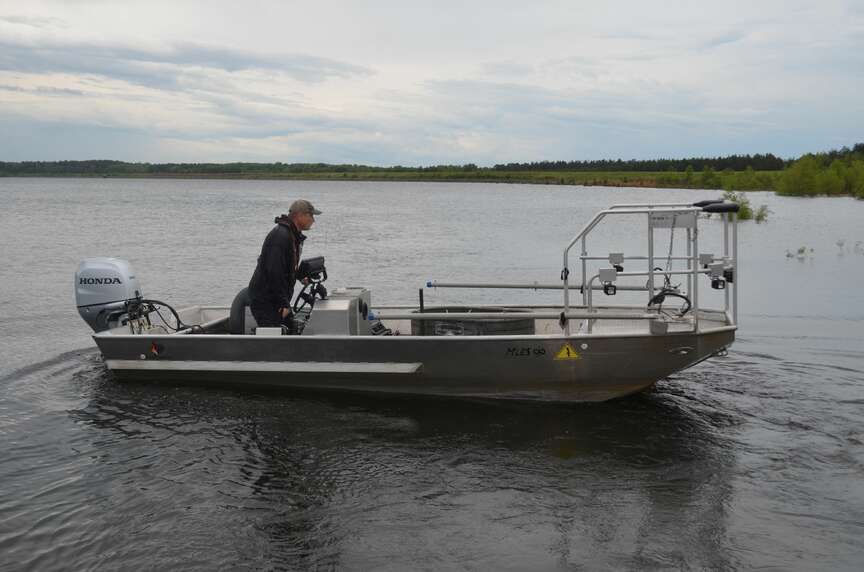 District 5 Fisheries Supervisor Kris Nault drove the AGFC boat on Lake Monticello for the stocking of 9,250 Titan Maxx Florida bass hatchlings. A total 22,000 of the genetically identified spawn are set to be introduced to the local fishery. (Special to The Commercial/Richard Ledbetter)