
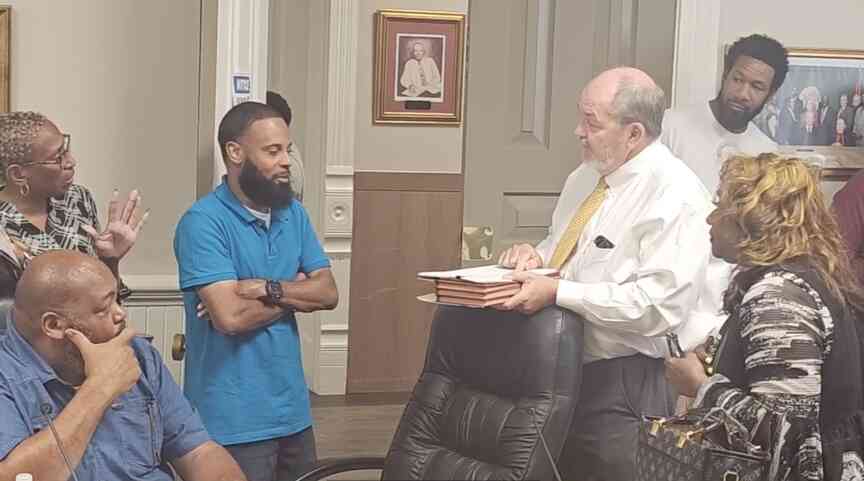
The Jefferson County Quorum Court met Monday for a contentious session marked by debates over financial appropriations, the handling of the judge’s veto and the very procedural ordinance governing their meetings.
A significant portion of the meeting focused on the approval of minutes from the previous special and regular meetings in June. A point of contention arose regarding the classification of a June 9 meeting, with County Judge Gerald Robinson stating that the meeting was not special-called but, instead, a regularly scheduled meeting. It was also discussed whether the agenda should originate from the county judge and then be sent to the clerk’s office, or if the clerk’s office has an independent role in its creation and distribution.
It was stated Robinson was supposed to call the agenda, and then he would send it to the clerk’s office, which several justices of the peace disagreed with.
The Quorum Court then moved to new business, which included several appropriation ordinances and a vote to override the judge’s veto of Ordinance 2025-12. This ordinance concerned employee bonuses coming out of emergency funds versus regular appropriation.
This particular override sparked a heated discussion about the use of emergency funds versus regular appropriations for employee bonuses. Justice of the Peace Dr. Conley F. Byrd argued against using emergency funds. The concern was that depleting emergency funds could be detrimental if actual emergencies (like natural disasters requiring FEMA aid) occurred.
Independent reporting for Pine Bluff & Jefferson County since 1879.
Justice of the Peace Alfred Carroll Sr., however, supported the override, acknowledging President Donald Trump’s efforts to reorganize Federal Emergency Management Agency and expressing confidence in future federal aid.
Robinson clarified that “normal bonuses” under his administration normally come “within the budgets of the elected officials,” implying that using emergency funds for this purpose was a deviation from the norm and one reason for the veto.
The motion to override the veto passed with a roll call vote.
Appropriation ordinances for the Road Department, County General, Metropolitan Emergency Communication Association, and the Public Defender fund, as well as a resolution to approve an appointment of one member to the Port Authority Board, all failed.
Justice of the Peace Reginald Adams told Robinson that his agenda items would continue to fail until he abides by the procedural rules and follows the agenda that comes out of the county clerk’s office.
Robinson said he would entertain a motion to add the agenda items for a combined agenda. Byrd questioned if they had been through the proper committees. The discussion around these items implied that they were not processed in a way that adhered to the procedural ordinance or committee review.
Robinson acknowledged Byrd’s point about the items not going through committees and then proceeded to list the committees and their members, effectively arguing that they do exist and are valid according to the procedural ordinance. The underlying concern remained the disagreement about whether these committees were legally established and functional.
Further appropriations for transfers within various funds were then brought forward. These items also led to discussions about whether they had followed the proper committee review process. The debate over the procedural ordinance intensified when a justice requested clarification from the prosecuting attorney, Kyle Hunter.
Hunter explained that the Quorum Court is supposed to establish its rules for procedural ordinance, which the court attempted and eventually passed. However, he acknowledged that “some in the room think it did not properly pass,” and he didn’t know why they believed it hadn’t passed correctly.
He stated that a reason could be given, and the court would have had the opportunity to pass it correctly. His suggestion was: “We come together and figure out a way to pass one that everybody agrees has been done correctly, rather than playing gotcha all the time.”
According to a procedural ordinance explained by Hunter, “items of legislation have got to go through the committee unless they have a super sponsorship.” This means that for a piece of legislation to bypass the committee stage, it requires the backing of “five justices who are sponsoring it.” If this condition is met, the legislation “can avoid committee restraint to the court.”
Hunter further explained that the primary goal for those introducing legislation is to “either go through committee or have a super sponsorship.” A critical point raised was the necessity for this designation to be clearly indicated on the agenda. It was noted that while some might believe they have a super sponsorship, if it’s “just wasn’t designated on the agenda,” it could lead to procedural issues.
The ordinance, as explained, “requires establishing who the sponsors are of each piece of legislation and that should be on the agenda that goes out.”