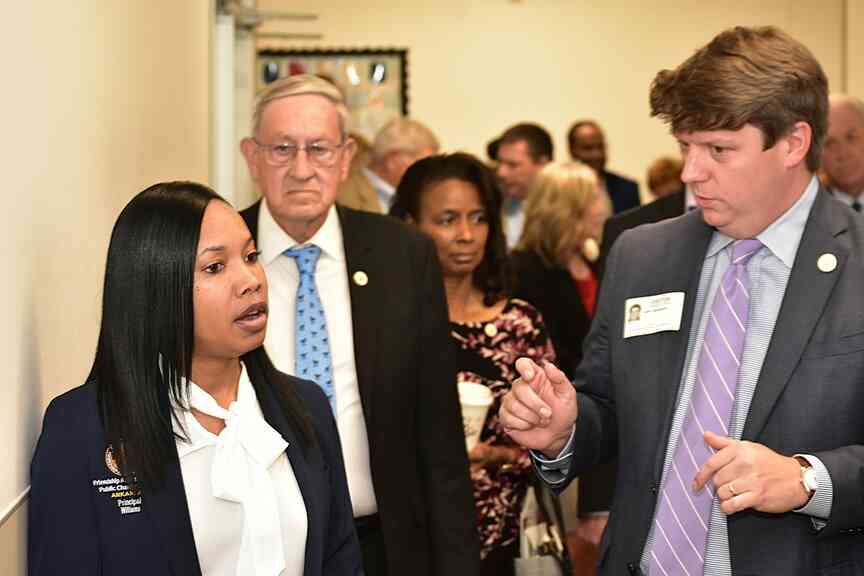
Members of the Arkansas House and Senate education committees heard from Friendship Aspire Academy Arkansas campus leaders Wednesday on a visit to Pine Bluff.
The committees met at the Main Library and walked next door to Friendship’s Downtown campus, taking a closer look at a system that was honored earlier this year by the University of Arkansas, Fayetteville, for its growth on the Arkansas Teaching and Learning Assessment System tests. The visit is one of many to schools across Arkansas as the joint committees work to prepare an Education Adequacy Study, due to the Senate president pro tempore and House speaker in November 2026. The study is used to make recommendations for legislation during the 2027 General Assembly.
No action was taken during the mid-morning meeting, but lawmakers including Sen. Stephanie Flowers, D-Pine Bluff, asked Friendship Arkansas Superintendent Phong Tran about the operations of his campuses.
“One of the things we’re going to do is visit different school districts because we spend a lot of time on adequacy school funding, so it’s important for us to go in and see what the schools look like from around the state,” said State Sen. Jane English, R-North Little Rock, the Senate committee chair who presided over the meeting. “This charter school has a good reputation for doing great things, so we wanted to come down and see that.”
Tran is pushing for state funding to help with maintenance of facilities and special education. Funding for charter schools is different from that for traditional public schools in that charter schools do not receive funding from property taxes.
Independent reporting for Pine Bluff & Jefferson County since 1879.
“We have a school for dyslexia, and it requires a lot of funds to go in and educate those kids because of where they’re at with the deficits,” Tran said, referring to a campus in Maumelle. Services to address dyslexia are also available at Friendship’s Pine Bluff campuses.
State Education Secretary Jacob Oliva said he likes the education committees’ initiative to visit campuses, calling the idea “wonderful.” The relationship between Oliva’s agency, the Arkansas Department of Education, and Friendship schools, he added, has been collaborative.
“We’re coming to the table, both of us, with the same goal in mind, and that’s with, ‘What can we do best for our students?’ What’s going to be best for the students is what’s going to be best for the school and best for the community,” Oliva said.
The end goal of the requests from Friendship, Oliva added, is to make sure students are performing at grade level. Friendship indicated in a brochure given to each lawmaker how each of its campuses grew in mathematics and English/language arts, based on the data from the UA’s Office for Education Policy.
“When you see some of our networks achieving that, we want to garner from that best practices and share that in a public forum and be able to see what works in some parts of the state and see if we can replicate that in other parts of the state as well,” Oliva said.