
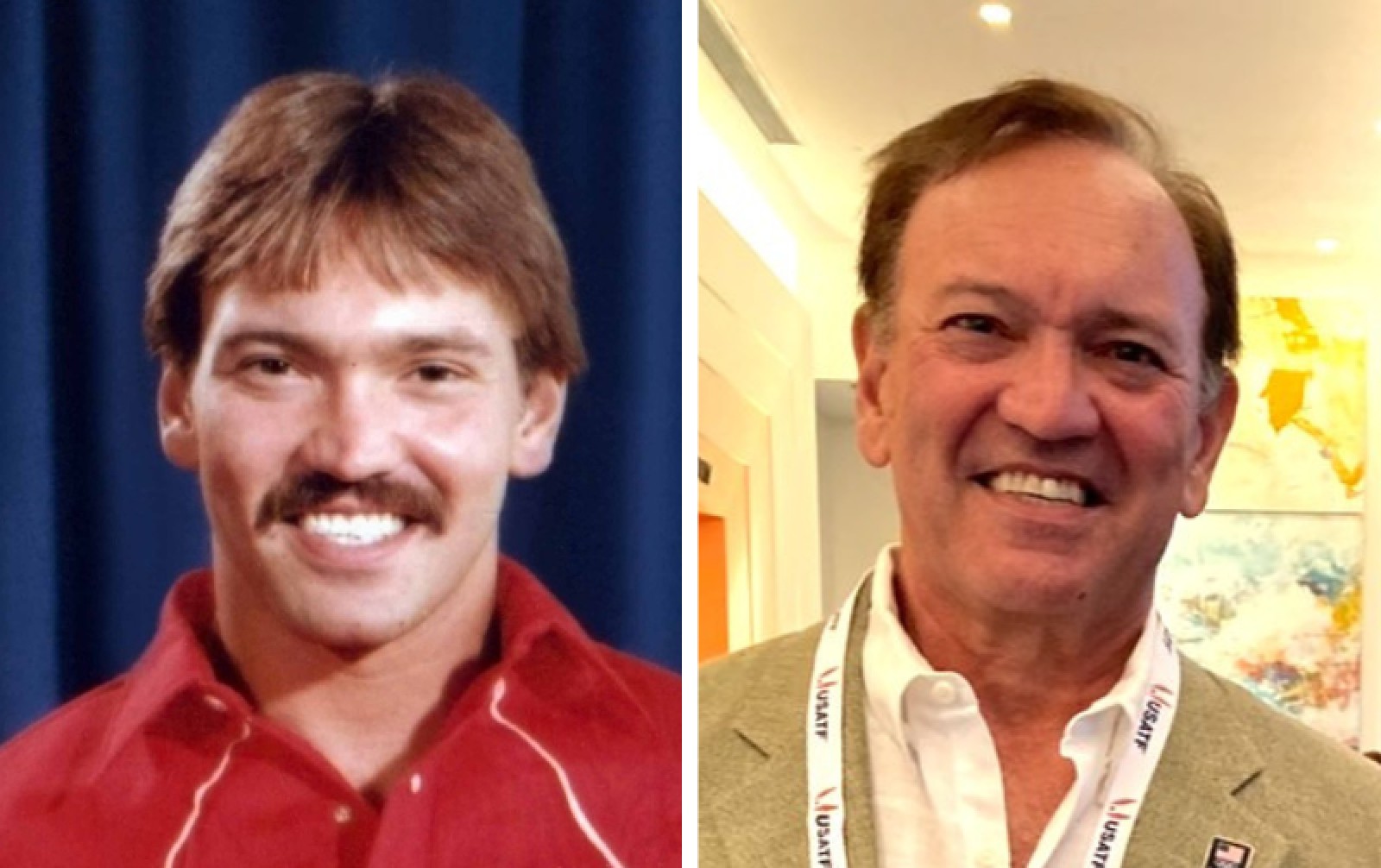
With three high school state championships and an All-America collegiate career on his resume, the next step for Lee Palles was, naturally, to make Team USA.
He achieved that and qualified for the 1980 Summer Olympics, but there was one problem. The U.S. Olympic Committee, at the behest of then-President Jimmy Carter, pulled out of the Olympic Games in protest of the Soviet invasion of Afghanistan. (The Soviets and other countries returned the favor four years later when Los Angeles hosted the Olympics.)
“My goal was to make the U.S. Olympic team. That was achieved,” Palles said. “I had no control over the politics of the day, so I could only do what God had given me the right and capabilities to do.”
Palles finished second to Bob Coffman in the Olympic trials at the University of Oregon. Coffman scored 8,184 points; Palles had 8,159.
Had politics not gotten in the way, Palles would have been the fourth of five men with Pine Bluff ties to compete in the Olympics and one of nine from southeast Arkansas to date. The former All-American at Mississippi State University will be one of 82 with ties to either Jefferson County or the University of Arkansas at Pine Bluff who will be inducted into the Jefferson County Sports Hall of Fame at 6 p.m. Saturday at the Pine Bluff Convention Center.
Independent reporting for Pine Bluff & Jefferson County since 1879.
Sunday is the final day for ticket sales, which are available at myevent.com/jcshof.
Born in South Carolina, Palles’ name is shortened from Panteleakis. His family is of Greek origin, and his first name in Greek is Leonidas.
“They changed it at Ellis Island when they came over here and it became ‘PAL-ay’. It sounds French. It looks Hispanic. It’s really Greek, so I got it all confused,” he said.
When he travels to Miami, Palles said, he becomes “Senor PAL-les.”
Palles’ father, a paper mill engineer, moved the family to Camden and Mobile, Ala., before arriving in Pine Bluff in the summer of 1972.
“You remember the movie ‘Remember the Titans’? I was on that class in Mobile and Pine Bluff, and to this day some of my best friends are the athletes we combined with,” Palles said. “We wound up having some of the most exciting, best times as teammates. I was on a state championship team in Alabama in track and I was on two state championship teams in Arkansas. So for three years of high school — sophomore, junior and senior — I was on state championship track teams in two states. That was a real, wonderful learning experience.”
Palles played defensive end and center on the Zebras’ football team. At 6-foot-3, 185 pounds, he was the lightest offensive lineman by 40 pounds, he recalled. One of his teammates was Dennis Swilley, a defensive tackle who converted to offensive lineman at Texas A&M and went on to an 11-year career with the Minnesota Vikings.
Palles was outstanding enough to compete in the state decathlon by his senior year at Pine Bluff but faced a dilemma — either go to the decathlon or the prom.
“I never held a pole vault pole in my hand,” Palles said. “I thought I could go out there and probably go 8 to 10 feet back in those days with the metal poles and everything. I said, ‘You know what? This just isn’t working.'”
Palles chose the prom.
Recruited by mostly Southeastern Conference schools and the University of Arkansas (which moved from the Southwest Conference to SEC in 1992), Palles chose Mississippi State to further his track career.
“Back then, Arkansas’ track program was not like anything it is today,” Palles said. “I really wanted to play football for Frank Broyles, but I never got that opportunity. Mississippi State had just hired a high jump coach who was a 7-foot high jumper. He told me he would get me there. At that time it was the closest school to Pine Bluff because they hadn’t built the four lanes to Fayetteville yet. Now, Fayetteville’s a hop, step and a jump.”
Palles competed in the high jump for two seasons and switched to decathlon as a junior. As he took part in more events for the decathlon, he was asked to run in some outside of the decathlon to help Mississippi State gain extra points.
While working with fellow Olympian Earl Bell to improve his pole vaulting, Palles sustained a stress fracture in his foot in 1977. During a 100-meter race, the injured foot snapped about 80 miles down the track, leading to a medical redshirt for the indoor season.
But Palles recovered, won the SEC outdoor decathlon in 1978 and qualified for the NCAA championship meet, where he finished second to Mauricio Bardales of the University of California, Irvine. He also earned All-America status in the 400-meter hurdles.
Palles earned an accounting degree from Mississippi State in 1979 after switching from pre-medicine. He’s a certified public accountant in the Raleigh, N.C., area, beginning at Deloitte after graduation and going into different sectors such as software, medical research, alternative energy and agriculture technology to work as a chief financial officer.
“Everything I studied there, I’ve used in my career,” he said.
But his track career wasn’t over.
The Americans who qualified were sent to East and West Berlin just in case they received the green light to compete in Moscow for about a month, Palles said. The score he attained during the trials would have been good enough to earn him the bronze medal in Moscow, he said.
Having not been sent to Moscow, athletes from boycotting countries were invited to the Liberty Bell Classic for two days in June at the University of Pennsylvania. Palles again finished second to Coffman, 8,058-8,009, with China’s Wang Kangqiang third at 7,015.
While competing, he took a shower under the bleachers just to cool off from the stifling Philadelphia heat. A group of Chinese athletes called him over to the bench where they were sitting and one of them — Kangqiang — reached down a cardboard box to offer him a Coca-Cola.
“You could have made a Coca-Cola ad out of that,” Palles said, considering the offer a gesture of friendship. “It’s one of those stories out of the whole boycott I’ve never forgotten. The staging of it, how it worked, the pressures and politics and all that other stuff, and at the end of the day, two athletes helping each other out.”
Palles raised three daughters and is a grandfather of five with a sixth on the way. He began a competitive volleyball program for his daughters when they were younger and the youngest now plays at Appalachian State University.
“I have no regrets and I enjoyed every aspect of my life, my sports career and business career,” said Palles, 69, a longtime certified public accountant. “I’ve been blessed the whole way.”