
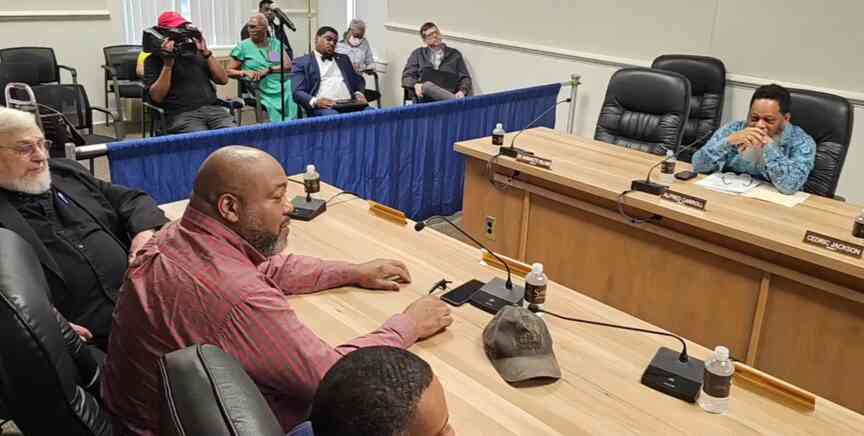
A Jefferson County Quorum Court committee meeting Wednesday addressed several pressing budget and procedural issues.
One primary topic of discussion was the transfer of funds. The Human Resource Committee, chaired by Justice of the Peace Conley Byrd, presented two appropriation ordinances aimed at transferring funds within the county’s budget. The first ordinance proposed a transfer of $445,186 within Fund 2000 Road, reallocating money from salaries to maintenance and operations. The second ordinance sought to transfer $7,000 within Fund 1000 County General for the assessor/reappraisal budget.
The request, detailed in a memorandum from Roads Director Rickey Bullard and Road Department office manager Sandra Graves, outlined the need to reallocate $445,186 from various salary and benefits lines to essential operational expenses, including vehicles, lease principal and lease interest.
These transfers were met with questions and concerns. Procedural issues were also a significant point of contention as justices of the peace pointed out, “We legally cannot have committees.”
Other justices of the peace raised questions about the operating procedures.
Independent reporting for Pine Bluff & Jefferson County since 1879.
County Judge Gerald Robinson attempted to clarify the budget situation, saying they are to operate on the previous year’s budget. “We still have to pass a 2025 budget,” he said.
Discussions also revolved around employee salaries and budget allocations. Justice of the Peace Reginald Adams raised concerns about how the fund transfers would affect employee salaries.
Justice of the Peace Alfred Carroll added to the salary discussion, saying: “We’re talking about transfer, almost half a million dollars. Those salaries and personnel are not working.”
Carroll was referring to the Road Department employees who were fired. “Why do we need to move the money if they’re not working? They weren’t called back.”
The worry from the justices was about the impact of these transfers on Road Department employees. Some employees were previously laid off, and there were discussions about whether they would be called back.
A major issue from some justices of the peace was where the money for salaries would come from if funds are moved out of the salary budget line. They questioned how employees will be paid if their salary funds are reallocated.
Justice of the Peace Ted Harden explained the employees would be called back to work with the 2025 budget in effect to restore the salaries of previously cut positions.
Robinson attempted to clarify, “Since we’re operating on a continued 2024 budget, we still need the money. We were short last year. It was short this year.”
Robinson tried explaining the need to transfer money from salaries to other operational needs due to budget constraints.
Carroll’s concern was that the county might be in default because a significant amount of money is needed to pay for vehicles and personnel, along with another amount needed to pay interest, suggesting possible overdue lease payments or financial obligations related to vehicles.
The ordinances were passed to be sent to the full Quorum Court. Failing, however, was the budget presented by the Quorum Court.
Robinson requested the court’s Finance Committee send both his and the Quorum Court’s proposed budgets to the full court.
The committee ended with a vote in favor of the judge’s proposed budget. Justices of the Peace Roy Agee, Jimmy Fisher, Patricia Royal Johnson, Byrd and committee chair Harden all voted for the judge’s budget and against the alternative proposal.
In a detailed and urgent letter sent to the justices of the peace, Robinson addressed the ongoing budgetary and procedural violations within the Quorum Court. The letter outlined a series of actions taken by the majority of Quorum Court members that have led to significant governance issues and legal challenges.
Robinson highlighted the persistent reintroduction of a proposed 2025 budget by seven justices of the peace, despite his veto and the subsequent failure to override it. In his letter, he states the majority of Quorum Court members have continued to push for the passage of the same budget, which includes unauthorized salary increases for select employees across multiple departments, ranging from approximately $7,000 to $20,000 per employee, affecting more than 43 individuals and totaling approximately $410,000. Robinson’s letter also details violations of Arkansas Annotated Code 14-14-904 and the Freedom of Information Act due to improperly called special committee meetings.
The letter also addresses the addition of positions to the tax collector’s and assessor’s offices, which violated a hiring freeze established by Ordinance 2020-164. Furthermore, the employment of Morgan Tillman, daughter of elected Assessor Gloria Tillman, was ruled to violate Jefferson County’s Nepotism Ordinance (2003-53) by Judge Randy Wright. Robinson said despite this ruling, the majority of Quorum Court members continued to allow Assessor Tillman to disregard the law.
Due to the Quorum Court’s failure to pass a legally compliant 2025 budget, state legislators intervened with Senate Bill 182, now Act 24. This measure allowed for employee payroll but withholding of the county judge’s salary and per diem payments for all Quorum Court members. As a result, Jefferson County became the only county in Arkansas to fail to pass a 2025 budget, according to the letter.
Robinson expressed his frustration with the ongoing violations and the detrimental impact on county operations. He announced his intention to seek legal relief for Jefferson County residents through the courts.
In his letter, Robinson cited embarrassment and hindrance caused by the majority of the Quorum Court’s actions. He said these justices of the peace used county employees to enforce their agendas with no regard for the detrimental impact on county operations.