
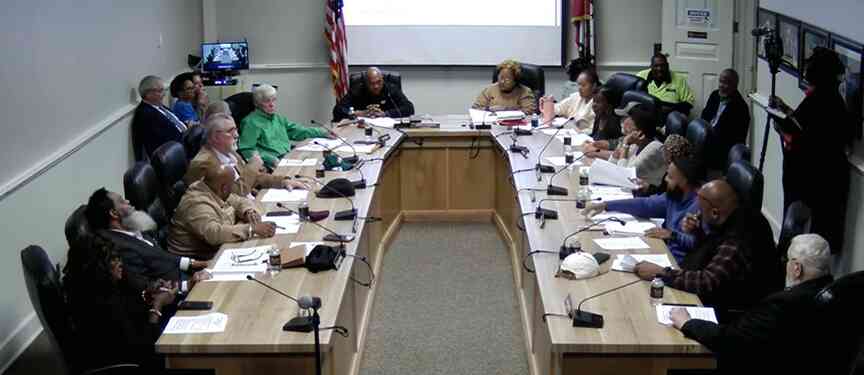
Tensions flared at the Jefferson County Quorum Court last week as a long-standing dispute over budgetary authority and unpaid services came to a head, with public outcry from two contractors and an eventual vote to override a series of the county judge’s vetoes.
The most emotional moments of the meeting came during the public comments section, where two individuals pleaded with the Quorum Court for long-overdue payments.
Demarius Mims, who provides janitorial services for the Health Department, expressed her frustration over months of unpaid invoices. “I am here again, asking the Quorum Court about my money for my janitorial service for cleaning the Health Department. I have not gotten paid,” she stated, noting she continues to work to prevent the department from going “without it being clean.”
The issue quickly devolved into an exchange between County Judge Gerald Robinson and Justice of the Peace Reginald Johnson. Robinson defended his office by stating that the Quorum Court was repeatedly asked for the necessary appropriations. “We have come … at least five months asking for these appropriations to be done so that we could make these payments,” Robinson argued.
Johnson pushed back, accusing Robinson of being the source of the problem, insisting Robinson had a full budget and chose to do other things with the money.
Independent reporting for Pine Bluff & Jefferson County since 1879.
In a follow-up with The Pine Bluff Commercial, Johnson criticized Robinson for what he called “mismanagement” and a lack of transparency regarding county spending. The tension centers on a request from Robinson for an additional $575,000 in supplemental appropriations, which Johnson insists the Quorum Court cannot approve without a detailed explanation.
In a series of pointed statements, Johnson accused Robinson of repeatedly operating outside his approved budget. “There wouldn’t be an issue to discuss if Judge Robinson weren’t requesting an additional $575,000 and expecting us to approve it blindly, which is unacceptable,” Johnson stated, adding that Robinson “expects the Quorum Court to cover it up through supplemental appropriations.”
Johnson highlighted a specific point of contention: the potential repossession of county dump trucks. He claimed the Quorum Court had “no prior knowledge of these vehicles or any purchase agreements.” According to Johnson, this demonstrates a pattern of Robinson “entering into contracts without prior authorization, then turning around and demanding funding after the fact.”
Johnson defended the legislative body’s role, arguing that their questions are reasonable and necessary for responsible governance. He pushed back against Robinson’s previous accusation of saying the Quorum Court is “micromanaging” him, asking, “I would ask any tax-paying citizen: Would you approve half a million dollars without asking ‘what for’ and ‘why’?”
The second public grievance during the meeting concerned Beatrice Goodloe, a veterans service officer who has not been paid a state-mandated incentive. Her colleague, Leotis Reagans, argued forcefully on her behalf, clarifying the nature of the funds.
“All she wants is what she has earned. These incentives are not reimbursements,” he said, citing state law that designates the $500 payment as an “incentive” for VSOs who achieve accreditation to use federal VA systems.
Justice of the Peace Alfred Carroll acknowledged Goodloe’s service and eligibility but raised procedural questions, noting the documents presented sought retroactive payments dating back several years. “The letter clearly says, use this form to indicate your expenses for 2025 going forward. It does not say anything about retroactive,” he said. He further criticized the lack of communication from the county judge’s office, stating that information about the VSO’s eligibility was never passed on to the Quorum Court, leading to the current crisis.
Justice of the Peace Jimmy Fischer offered a call for unity, urging the court to put aside political infighting: “We need to come to some kind of consensus, and get these people paid and recognize that everybody needs their money, especially if you worked for it … It’s time for us to come together. Reconcile and make decisions that the people have elected us to do.”
During the meeting, a key procedural flaw, according to Carroll, was highlighted regarding a motion to “suspend the rules” to move to the third reading and read certain ordinances by title only.
Despite the rancor, the court moved to the third reading and read by title only; however, after realizing several of the appropriation ordinances were to pay outstanding bills and balances, members of the Quorum Court went back to those items to revote.
Those appropriation ordinances include the $16,000 payment to Goodloe.
Amidst the conflict, an extensive list of other appropriations and transfers was approved, including an appropriation ordinance for the County General Cooperative Extension.
Multiple ordinances to Transfer and Appropriate Funds within the Solid Waste, Recycling, and Recycling Resource Grant funds were approved.
The acceptance of various grants, including the Simmons Grant and Jack Grant, and the Juvenile Officer’s Supplemental Grant, was also approved.
The Quorum Court successfully voted to override Robinson’s vetoes of multiple ordinances, passing with an 8-to-5 margin.