
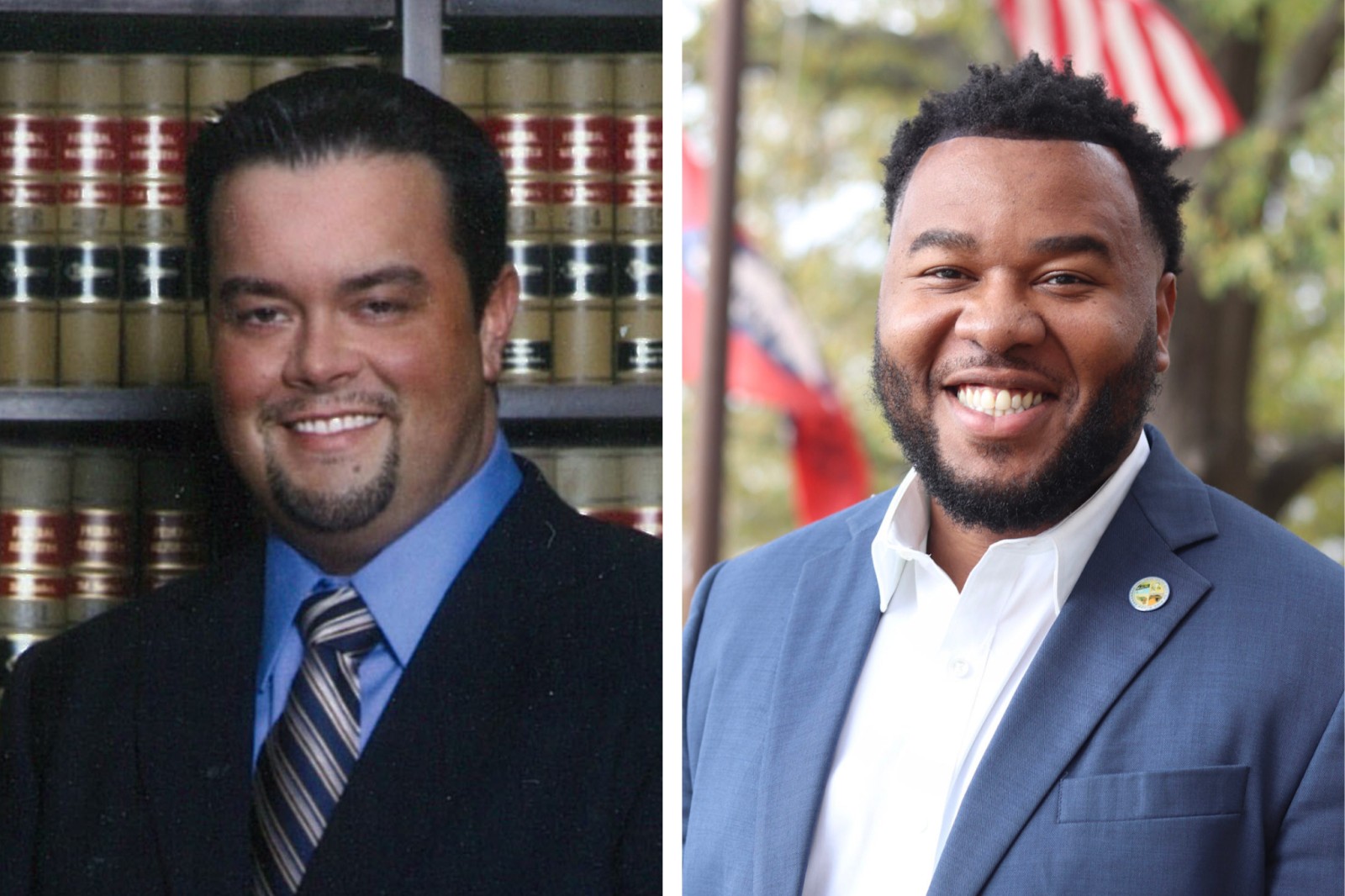
Chad Kelley is completing his seventh term — second four-year span — as Jefferson County coroner, and he faces opposition from Jamal Gordon, a chief operating officer in the funeral industry.
The two have taken part in this question-and-answer format about their credentials and plans for the position. Election day is Tuesday.
Kelley and Gordon were asked:
1. Why run for (re)election as coroner?
Independent reporting for Pine Bluff & Jefferson County since 1879.
2. What specific forensic, investigative or medical experience do you have that prepares you for this role?
3. What is your procedure for securing a scene and documenting evidence?
4. How would you handle a complex, high-profile or challenging death investigation?
5. What are the biggest challenges facing this office, and how will you address them?
6. How do you plan to improve the efficiency and modernization of the office?
Many of their responses have been shortened for brevity:
CHAD KELLEY
1. I am running for reelection because for the last 26 years, I have taken care of thousands of the families and deceased individuals of Jefferson County. Each of these families is like an extension of my own family, and I want to continue doing what I feel is not only a purpose but a calling.
During these 26 years, when meeting with families I treat the families as I would want my very own family treated during what has to be one of the absolute worst times of their life. I am always trying to find ways to improve the training that I have received along with the training that my deputies, who are all certified via the state of Arkansas as well as outlying states. Not a year goes by that I am not researching to find more advanced training for myself and my deputies.
2. The following is a list of my accomplishments and certifications:
• Two-hour training program in Vital Records Registration for Death Certificates
• Training in Child Injury Investigation
• Training in Domestic Related Homicides
• Training on the Chemical Stockpile Emergency Preparedness Program/CSEPP Chemical Awareness
• Completion of “The Medicolegal Death Investigator Training Course” at Saint Louis University School of Medicine
• Completion of the Arkansas State Crime Laboratory Coroner Training Program
• Certificate from ARORA and Arkansas Coroner’s Association for Arkansas Coroner’s Symposium
• Training by the Arkansas State Crime Lab for Death Investigations.
• Completion of “The Masters: Medicolegal Death Investigator Training Course” at Saint Louis University School of Medicine
• Certification as an Arkansas Certified Medicolegal Death Investigator conducted by the Arkansas Law Enforcement Training Academy
• Certification of completing training in Forensic Toxicology
3. There is a Mass Casualty Protocol Manual that is in place that directs my office along with first responders and funeral homes for cases of this nature and includes the Arkansas State Medical Examiner’s Office.
While most of the actual evidence is handled by law enforcement, my deputies and I assist law enforcement when needed in collecting and documenting evidence. The information that the coroner’s office provides is crucial in assisting law enforcement and the Arkansas State Medical Examiner’s Office in their investigation that helps to determine cause and manner of death.
4. Each case that is handled by the coroner’s office has its own set of challenges due to the fact that no two cases are ever the same and have their own complexities. One that some might consider to be of “high-profile” is not treated any differently than any other case that is handled by the coroner’s office.
5. One of the biggest challenges that we have faced during my tenure as coroner was the covid-19 pandemic and the excessive number of lives that were lost during this pandemic. Also, absolutely the rising number of drug overdoses are a challenge as well as the number of homicides that we in Jefferson County face yearly.
The way we addressed the covid-19 pandemic was, we kept working as a lot of health care workers did daily, while some were quarantining at home.
As for the growing number of drug overdoses and homicides, we go to churches and schools to speak of the dangers of drugs as well as combining information about gun responsibility.
6. Some of the ways the coroner’s office has been improved during my tenure are:
We worked closely with Jefferson County administration in the construction of the U.S. Brown Jefferson County Coroner’s Office, which is a state-of-the-art facility for the deceased, families and staff of the coroner’s office.
We have developed close working relationships with local law enforcement agencies, state law enforcement agencies, the medical examiner’s office, funeral homes and emergency management services.
Implemented the use of a Medicolegal Death Investigation Program for deaths reported to the Medical Examiner’s Office and Jefferson County, as well as ERave via the Arkansas Health Department for certification of death.
Consistently stayed within budget guidelines and appropriations yearly.
Currently we are in the process of digitizing cases from the last 30-50 years.
JAMAL GORDON
1. I am running because Jefferson County deserves a coroner’s office that shows up, operates professionally and earns public trust. This position is not ceremonial, political or symbolic. It is a critical public safety role that directly affects families, investigations and the integrity of the justice system. I have seen firsthand where the system breaks down: delayed communication, outdated operations, inconsistent procedures and a lack of accessibility for families and partner agencies. These are not minor issues. They create confusion, prolong grief and weaken confidence in an office that people depend on during their most vulnerable moments. I am running to raise the standard of how this office operates.
2. I bring direct, hands-on exposure within the death care and medicolegal system gained through professional work and close collaboration with coroners, medical examiners, funeral directors, embalmers, law enforcement, hospitals and state agencies. Through this experience, I have observed and developed a working knowledge of investigative procedures, including scene protocols, evidence documentation, chain-of-custody requirements and cause-and-manner determinations.
While the state allows up to one year after taking office to complete required training, I am already registered for the Medicolegal Death Investigation course in St. Louis, March 9-12, and I am committed to completing the required 40-hour certification course by Jan. 1, 2027, entering office fully prepared and ready to serve from day one.
3. Scene security begins with clear command structure and coordination. I would immediately work with law enforcement to secure the scene, establish perimeters and ensure safety. Each decedent would be treated as an individual investigation, with proper identification, documentation, photography and evidence tracking. Chain-of-custody protocols would be strictly followed, and all actions would be logged in real time. In multiple-victim cases, communication and organization are critical, and my leadership experience managing complex operations ensures nothing is rushed, overlooked or mishandled.
4. High-profile cases demand calm leadership, transparency and professionalism. I would rely on evidence, expert consultation and established protocols, not speculation or pressure. Communication would be controlled and factual, protecting the integrity of the investigation while respecting families and the public. I understand that these cases can impact court proceedings, media coverage and community trust, and my approach would always prioritize accuracy, accountability and dignity.
5. Drug-related deaths, particularly from fentanyl overdose, is a challenge not just in Jefferson County, but across the United States. In September of last year, the Arkansas Opioid Recovery Partnership participated in an Opioid Conference here in Pine Bluff to address preventative strategies caused by this crisis. I would like to connect the Jefferson County coroner’s office with that agency to empower our community about the dangers of opioid misuse. Another big challenge I would like to address is the loss of our youth to senseless gun violence. My plan is for the coroner’s office to build a supportive partnership with the Group Violence Intervention Program.
6. Improving efficiency and modernization starts with leadership, structure and accountability. One of my priorities is establishing a dedicated coroner’s office website that serves as a reliable, public-facing resource for Jefferson County residents. This website would clearly list the correct office address, contact information and procedures, eliminating confusion and improving accessibility for families, partner agencies and the public. A key modernization step is digitizing all case files and records, which improves efficiency, security and long-term accessibility. Digitization reduces delays, prevents lost records, improves reporting accuracy and ensures proper records retention and compliance.
In addition, I plan to introduce routine public reporting through a Quarterly and Annual Public Impact Report, providing aggregated, nonsensitive data on case volume, trends and operational improvements.