
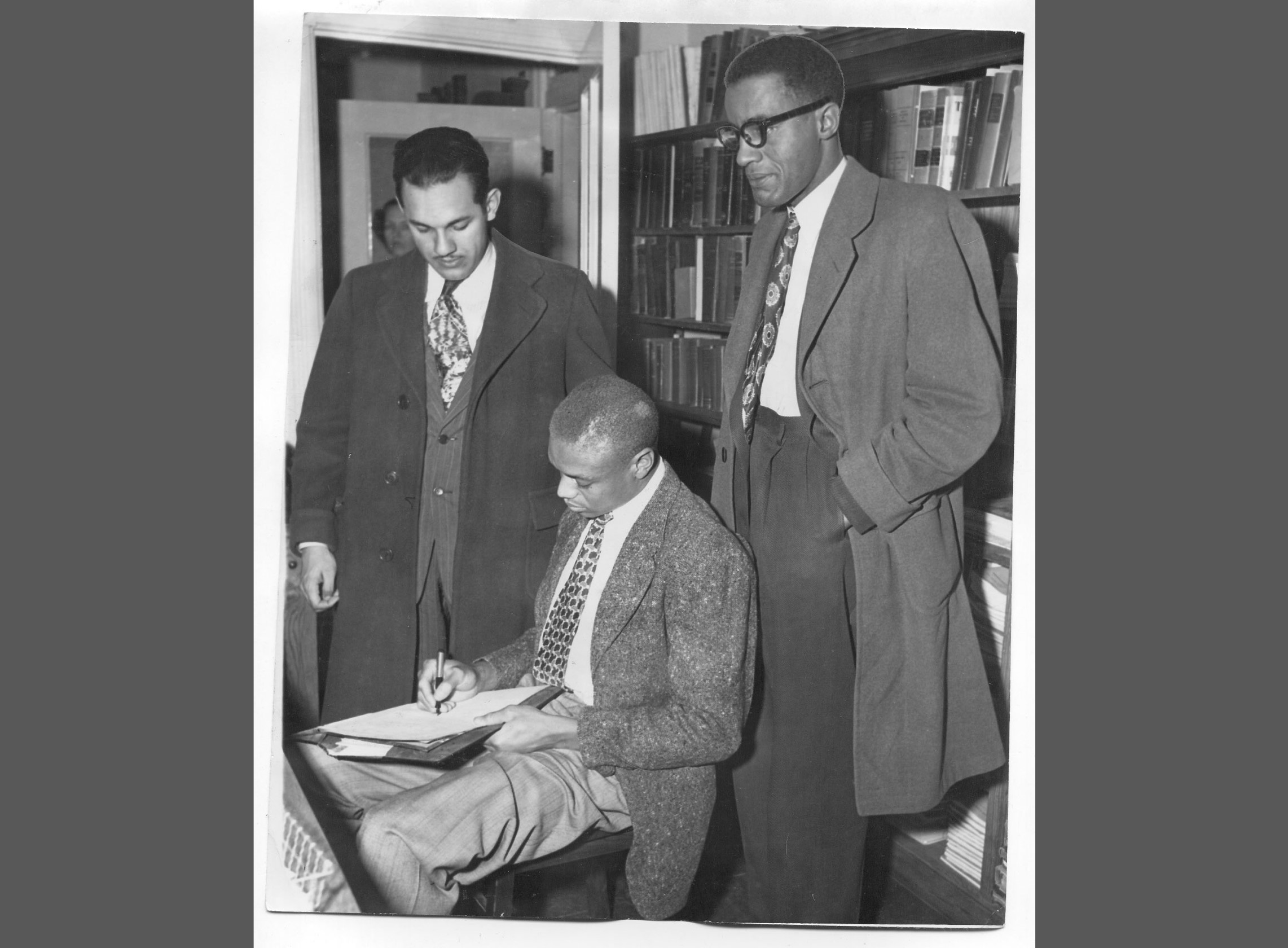
On Feb. 2, 1948, Silas Herbert Hunt was admitted to the all-white University of Arkansas School of Law, becoming the first Black student admitted to a white Southern university since Reconstruction for any program. Hunt was also the first of six Black students, known as the “Six Pioneers,” who desegregated the UA Law School.
Hunt was born on March 1, 1922, in Ashdown to Jessie Gulley Moton and R.D. Hunt. In 1936, his family moved to Texarkana, where he attended Booker T. Washington High School. He was a distinguished member of the high school’s debate team and president of the student council. In 1941, he graduated salutatorian of his class.
Upon graduation, he attended the Arkansas Agricultural, Mechanical, and Normal College at Pine Bluff (now known as the University of Arkansas at Pine Bluff). During his first year, Hunt worked various jobs to pay his college tuition, including a construction job at the Pine Bluff Arsenal. Despite his numerous jobs, Hunt excelled academically and earned scholarships that helped pay for his undergraduate tuition.
In 1942, he was drafted into the U.S. Army after America entered World War II, putting his education on hold. During the war, Hunt served as a construction engineer for 23 months until he was wounded in the Battle of the Bulge. In 1946, he was honorably discharged from the Army. While recovering from his war injuries, Hunt returned to Arkansas AM&N College to finish his degree. In 1947, he graduated with a bachelor’s degree in English.
Hunt was accepted by the University of Indiana School of Law but decided not to attend after learning AM&N classmate Ada Sipuel Fisher was waging a legal battle to overturn the University of Oklahoma College of Law’s policy against admitting Black students. Though Fisher initially lost her court case, like many other Black students vying for equal rights in education across the South, Hunt was inspired to take action. So, Hunt applied to the University of Arkansas School of Law with the support of classmate and civil rights activist Wiley Branton and AM&N President Lawrence Davis.
Independent reporting for Pine Bluff & Jefferson County since 1879.
University of Arkansas officials decided to admit Hunt after witnessing the negative publicity that integration court battles had brought to other universities in the South. On Jan. 30, 1948, University of Arkansas became the first white Southern university since Reconstruction to admit Black graduate students.
Three days later Hunt, Branton, Pine Bluff attorney Harold Flowers and AM&N newspaper photographer Geleve Grice traveled to the UA campus in Fayetteville to apply for admission to the law school. Once there, they met with the dean of the law school, Robert A. Leflar. After a brief review of Hunt’s academic record, Leflar admitted Hunt to the law school. That day, Hunt became the first Black student officially admitted to a white Southern university.
That spring, Hunt began taking separate classes from the university’s students, meeting with his professors in the law school’s basement office. Three to five white classmates began attending classes alongside him to show solidarity and take advantage of the smaller class sizes.
Historians have stated that Hunt was the ideal candidate to begin integrating the University of Arkansas. Along with having a strong support system, Hunt was a serious student whose confident, humble demeanor allowed him to handle the pressure and publicity of integrating an all-white Southern university.
In late July 1948, he suffered a hemorrhage. Hunt withdrew from UA and traveled to the Veteran’s Hospital in Springfield, Mo. On April 22, 1949, he died from pulmonary tuberculosis, a possible complication from his war injuries. He is buried in the Stateline Cemetery in Texarkana.
Hunt’s enrollment started the slow desegregation of the university. In the mid-1950s, UA began accepting Black undergraduate students. In the 1960s, the dining facilities were integrated. Housing and athletics soon followed. In 1993, Silas Hunt Hall, across from the law school, was dedicated in his honor as the student admissions center. A historical marker is located along Maple Avenue, in front of Silas Hunt Hall.
In 2003, the University of Arkansas began awarding the Silas Hunt Distinguished Scholar Awards to deserving African American students in honor of Hunt’s achievements. In 2006, the university awarded its first Silas Hunt Legacy Award. The Silas Hunt Legacy Award Celebration pays tribute to Hunt by honoring African American students who have made a significant impact on the University of Arkansas, the state of Arkansas, the nation and the world.
In 2007, the Arkansas state Legislature made Feb. 2 Silas Hunt Day to memorialize the day Hunt enrolled in classes. In 2008, the University of Arkansas School of Law awarded Hunt a posthumous law degree on the 60th anniversary of his enrollment. In 2012, the university dedicated a sculpture in honor of Hunt created by University of Central Arkansas professor Bryan Massey Sr. More than 75 years after his historic enrollment, Hunt’s courageous legacy lives on.
This article is from ExplorePineBluff.com, a program of the Pine Bluff Advertising and Promotion Commission. Sources: https://encyclopediaofarkansas.net/entries/silas-herbert-hunt-1676/; University of Arkansas (uark.edu); Original Trailblazer: Silas Hunt (arkansasrazorbacks.com).
Ninfa O. Barnard wrote this article for ExplorePineBluff.com.