
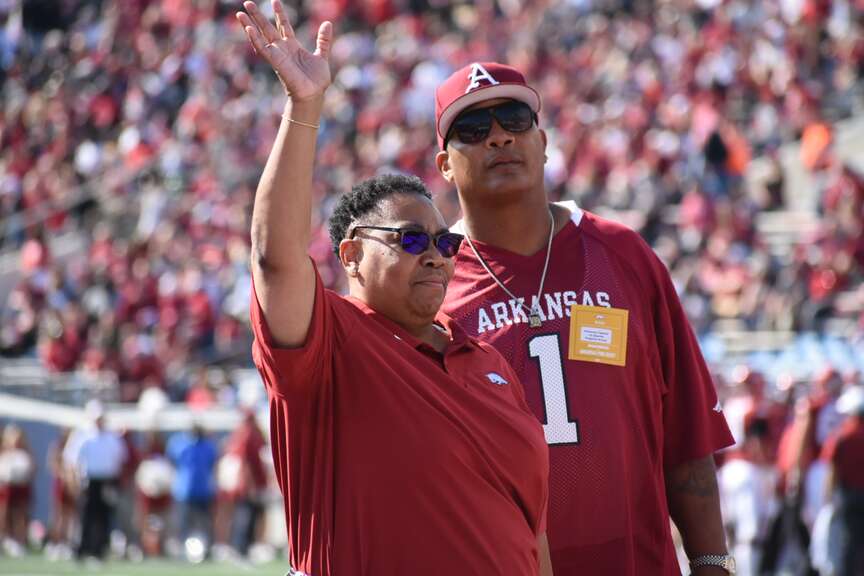
The Jefferson County Sports Hall of Fame on Thursday announced its second sub-class of initial inductees.
Fifteen athletes will be honored as the Legends of the Hall, following six All-Time Greats who were named in December. The remainder of the class is expected to be named in February, with a banquet honoring the entire class April 26.
The Legends include Jim Benton, Joe Barry Carroll, Willie Davis, Jackie Harris, Juliet Jackson, Mike Jeffcoat, Carl Kidd, Andrew Lang, Lafayette “Fat” Lever, Cleo Miller, Ben Pearson, Ulysses “U.S.” Reed, Jackie Ridgle, Freddie Scott and Dante Wesley.
JIM BENTON
The National Football League in its infancy was literally turned on its ear by two athletes who grew up about a half-hour from each other and just three years apart in age. James Warren “Big Jim” Benton wasn’t raised in Jefferson County — he was born in Carthage and played through high school at Fordyce — but after a record-setting career in the NFL, he would spend the rest of his adult life in Pine Bluff.
Independent reporting for Pine Bluff & Jefferson County since 1879.
Benton, who starred at the University of Arkansas, followed Pine Bluff’s Don Hutson into the NFL in the 1930s. Hutson would be the prototype for a pass catcher in the NFL, and Benton rivaled him, showing just how important passing and catching could be in a run-dominated game, becoming the first NFL receiver to gain more than 300 yards in a game. The record 10 catches for 303 yards in 1945, which coincidentally broke the previous high set by Hutson, stood for 40 years.
JOE BARRY CARROLL
While some of his siblings stayed in Pine Bluff and had jobs here, Joe and the rest of the family moved to Denver in the early 1970s. He played seventh-grade basketball here before moving to Colorado, where he grew to 7 feet and became a talented basketball star at Denver East High School. That led him to Purdue University, where he led the 1980 Boilermakers to their first appearance in the NCAA Final Four since 1969, being named a consensus first-team All-America player.
But even more historic is that Joe Barry Carroll is the only Arkansas-born basketball player drafted first in an NBA Draft. The Golden State Warriors moved up to the top of the draft by trading another 7-footer, Robert Parish, and another high draft pick to the Boston Celtics and chose Carroll. While the Celtics would parlay that wheeling and dealing into three NBA titles in six years, Carroll was in no way a “bust” as the top pick. Carroll would average 18.9 points and 9.3 rebounds per game and 121 blocks as a rookie, with a game high of 46 points. Two years later, he pushed that scoring average to a career-high 24.1 points per game, and he scored a career-best 52 points that season.
With five teams (plus a brief stint winning a championship for an Italian pro team), he finished with 12,455 points in the NBA (17.7 per game), and 5,404 rebounds (7.7 rpg), plus 1,121 blocked shots.
WILLIE DAVIS
The Altheimer High graduate would walk-on at University of Central Arkansas as a wide receiver with a collegiate career that consisted of 63 receptions, 1,292 yards and 10 touchdowns for the Bears.
Davis played eight seasons in the National Football League (NFL) with the Kansas City Chiefs and Houston/Tennessee Oilers. During his NFL career, Davis spent five seasons (1991-95) with the Chiefs, playing in 63 games (58 starts), recording 172 receptions for 3,014 yards (17.5 yards per catch) with 20 touchdowns. He also started six postseason contests, catching 16 passes for 239 yards (14.9 avg.) with a touchdown.
David totaled 286 receptions for 4,503 yards for an average of 15.7 per catch and 33 touchdowns, including his famous game-winning TD catch against the Denver Broncos on “Monday Night Football” in 1994. Since rejoining the Chiefs organization as a scout in 2006, Davis has been named AFC Scout of the year (2014) and was promoted to the position of senior personnel executive in the 2021 NFL offseason. He has won three Super Bowl championships with the Chiefs.
JACKIE HARRIS
Harris led Dollarway High to its first of 10 state football championship appearances in 1985 as a senior. His standout play earned him a scholarship to Northeast Louisiana University, now the University of Louisiana Monroe, where as a sophomore he started at tight end and helped the team win the NCAA Division I football championship. Harris made All-Southland Conference twice at ULM.
Harris played 12 seasons in the NFL with four teams — the Packers, Buccaneers, Titans and Cowboys – and played in Super Bowl 34 with the Titans in the 1999 season at the height of his career. He caught 393 career passes for 4,410 yards and 25 touchdowns. Today he is a judge in the Fourth Division of the 11th West Circuit.
JULIET JACKSON
Jackson jumped from a ninth-grade basketball standout all the way up to the varsity team at Pine Bluff High School in 1983.
On the basketball court, she went on to be named the Gatorade player of the year for Arkansas, a Parade Magazine All-American, and an All-American by the National High School Athletic Coaches Association. In track and field, she earned all-America honors as a sophomore (1984) running the 4×100 meter relay with teammates Inetta Lee, Gaye Bearden and Lisa Mayes. Five decades later, their 47.24-second time is still the best in Arkansas high school history.
Playing at the University of Arkansas from 1986-90, Jackson sits in the top 20 in school history in both points (1,213) and assists (313).
MIKE JEFFCOAT
Jeffcoat, a 1977 graduate of Pine Bluff High, is the most successful pitcher to ever come out of Jefferson County.
Jeffcoat was first selected in the 1977 Major League Baseball Draft by the St. Louis Cardinals but did not sign. He signed a scholarship instead to play college baseball at Louisiana Tech. He was selected in the 1980 MLB draft by the Cleveland Indians, whom he signed with.
On Aug. 21, 1983, Jeffcoat made his major league debut against the Seattle Mariners, and on Sept. 18 he out dueled the Yankees’ Dave Righetti for his first major league victory. Jeffcoat also played with the San Francisco Giants (1985), Texas Rangers (1987-92) and Florida Marlins (1993-94).
CARL KIDD
Kidd was a state champion his entire high school football career (1988-90) at Dollarway. The running back was a key contributor to the Cardinals’ run of 51 straight victories, a streak that lasted until 1991.
Kidd first played college ball at Northeastern Oklahoma A&M College and then transferred to the University of Arkansas, starring as a cornerback and safety under Danny Ford in the 1993 and 1994 seasons. The Oakland Raiders signed him as a free agent, and he spent 5 seasons with 4 different teams before finding a home with the BC Lions in the Canadian Football League, where he returned 5 of his 10 interceptions for touchdowns. Kidd earned All-Star status in the 2002 and 2006 seasons and helped the Lions win Grey Cups in 2000 and 2006.
ANDREW LANG
Andrew Lang achieved McDonald’s All-American status, the highest honor for a high school basketball athlete, as a center at Dollarway in 1984. That helped introduce the 6-foot-11 Lang to University of Arkansas fans, who saw him star on The Hill for four seasons before the Phoenix Suns drafted him 28th overall in 1988.
Lang spent 12 years in the NBA and was a part of a 3-man trade to Philadelphia for Charles Barkley in 1992. In a career that also saw him play in Atlanta, Minnesota, Milwaukee, Chicago and New York, Lang averaged 6 points and 4.8 rebounds per game.
FAT LEVER
Lever lived in Pine Bluff from birth (1960) until he was 11, eventually leaving his grandparents’ home to live with his mom in Tucson, Ariz. That’s where he played basketball in his teens before ending up at Arizona State University.
He was picked 11th in the talent-rich 1982 NBA Draft, going to the Portland Trail Blazers. It was with the Denver Nuggets in 1984-90, however, that the 6-foot-3 and 170-pound “Fat” became one of the best guards of that era. His first double-double (24 points, 18 assists) came against the Los Angeles Lakers’ burgeoning dynasty in 1984. That same season came his first triple-double, also against the Lakers (13 points, 15 assists, 10 steals).
Before finishing his NBA career in 1994 with the Dallas Mavericks, Lever was a two-time NBA All-Star (1988, 1990), All-NBA Second Team (1987), NBA All-Defensive Second Team (1988). His No. 12 jersey was retired by the Nuggets, as well as by Arizona State, where he was a two-time first-team All-Pac 10 player (1981, 1982). His career NBA averages are 13.9 points per game, 6 rebounds per game, and 6.2 assists per game.
CLEO MILLER
Without a doubt, Cleo Miller is perhaps one of the most talented running backs in the University of Arkansas at Pine Bluff’s storied football history.
Cleo, a 1974 UAPB alumnus, also has the distinction of being the only local athlete who prepped in the Pine Bluff public schools (Merrill High), played four years at UAPB and joined the National Football League.
After earning a starting spot at running back as a freshman in 1970, he turned in a stellar collegiate tenure by rushing for over 1,500 yards during his first three years with the Golden Lions. In the spring of 1974, Cleo signed as a free agent with the Kansas City Chiefs and played under legendary coach Hank Stram. In his rookie season, he was used mostly as a kickoff returner and Stram often referred to him as his secret weapon.
The Chiefs, however, traded him to the Cleveland Browns in 1975 and his career sky-rocketed over the next eight seasons. His best season rushing was in 1977 when he compiled 756 yards, a figure surpassed at that time by only Pruitt and Leroy Kelly in Cleveland’s post-Jim Brown era. He ended his pro career after playing a brief stint with the upstart United States Football League (USFL).
BEN PEARSON
“The Father of Modern Archery” was born in Paron, west of Little Rock, but he made his name and built his company in Pine Bluff, and would be known the world over. Pearson, born in 1898, was a master hunter, skilled with his hands to perform the intricate work required, and a tireless crusader for archery, which he took up in 1925. His efforts would influence people around the globe for much of the 20th century.
Pearson was an original inductee of the Archery Hall of Fame in 1972, a year after his passing, became interested in archery after reading a Boy Scout magazine article describing how to make bows and tackle. He moved to Pine Bluff in 1927 and began making bows and crafting arrows part-time in his backyard workshop. Even with the Great Depression, his sales continued to increase through that era.
Ben Pearson Inc. was formed in 1938 and Pearson was the first to design and build much of the machinery needed for mass production of bows, arrows and related tackle. By 1943, his company employed 365 workers; this would grow to between 800 to 1,000 workers by the mid-1960s with a facility near White Hall on old U.S. 65 and manufacturing facilities in Canada.
U.S. REED
Reed led Pine Bluff High to the state and overall basketball championship in 1977 and finished 30-1, considered the greatest team ever at the school. He joined the University of Arkansas men’s basketball team later that year at the height of the success of the “Triplets” — Sidney Moncrief, Ron Brewer and Marvin Delph — and was a key part of the team that made it to the 1978 NCAA Final Four, finishing third after losing to eventual champion Kentucky Wildcats in the semifinal game.
Reed played as a member of the gold medal-winning American team at the 1979 World University Games, joining such teammates as Kevin McHale, Jeff Ruland and Andrew Toney.
A halfcourt shot turned Reed into a star of the 1981 NCAA tournament. The Southwest Conference champion Razorbacks were playing the defending NCAA tournament champion Louisville Cardinals in Austin, Texas. Trailing by one with 5 seconds remaining in the contest, the Razorbacks threw the ball to Reed after a timeout. He was unable to get the ball to any of his teammates, including future NBA players Darrell Walker and Scott Hastings, and took a desperation shot from just beyond the mid-court line as the clock expired. The ball ripped through the net, giving Arkansas a 74–73 victory (this game was prior to the advent of the 3-point shot in the college game). Some credit this shot and the hysteria that accompanied it as what cradled the phrase “March Madness.”
JACKIE RIDGLE
Ridgle, who grew up in Altheimer, was a phenomenal basketball standout for the Martin High School Wildcats. He achieved something that no other basketball player in the school’s history accomplished during his senior season in 1967.
The 6-foot-4 guard averaged 30.4 points and 13 rebounds per game, earning him All-American honors. He also turned in a productive junior season while leading Martin High to its first state championship in the Arkansas State Athletics Association tournament.
Ridgle made an immediate impact with the University of California Golden Bears as a guard on the freshman team, averaging a school record 30.5 points per game. For his career, Jackie averaged 17.9 points per game, shot 47.6 percent from the floor, and had a 73.9 percentage at the free throw line over three years. In addition, he was a three-time second team All-Pac 8 performer.
The Cleveland Cavaliers selected Ridgle in the third round of the 1971 National Basketball Association Draft. He spent only one season with the Cavaliers before returning to California where he coached high school and college basketball. In 1998, he died of lung cancer at age 50.
FREDDIE SCOTT
The valedictorian of Southeast High School’s final class in 1970 was a tremendous four-sport athlete for the Panthers as he starred in football, basketball, track and field and baseball.
However, it was Scott’s football talents that landed him a scholarship at Amherst College in Massachusetts, where he posted record-setting numbers as a wide receiver and caught the eyes of professional scouts. He finished his collegiate career with school records of 143 receptions for 2,336 yards and 27 touchdowns, including a single season record of 12 in 1972.
Freddie was selected in the seventh round of the 1974 National Football League Draft by the Baltimore Colts (now Indianapolis Colts). He spent 10 seasons in the NFL, playing for the Colts, Detroit Lions and Atlanta Falcons. He also played one season in the United States Football League (USFL).
DANTE WESLEY
A member of Watson Chapel High’s 1996 AAA state championship team, Wesley played three seasons at UAPB (1999-2001), made All-SWAC three times and was named All-American in 2001. He also intercepted a pass in the Hula Bowl before being drafted in the fourth round by the Carolina Panthers.
Wesley played in two Super Bowls in three seasons, first with the Carolina Panthers in the 2003 season and secondly with the Chicago Bears in the 2006 season. For his NFL career, Wesley totaled 104 solo tackles, 94 assisted tackles, two sacks, five forced fumbles, five fumble recoveries, one defensive touchdown and 18 pass deflections.
Information for this article was provided by Jefferson County Sports Hall of Fame committee members Jeff Gross, Jim Harris, I.C. Murrell and Carl Whimper.
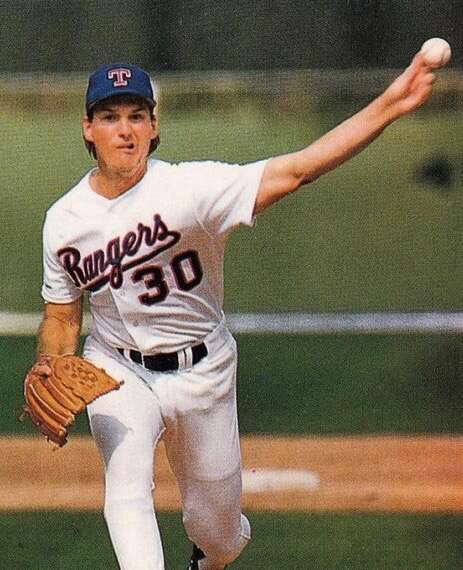 Mike Jeffcoat throws a pitch for the Texas Rangers in this undated photo. (Special to The Commercial)
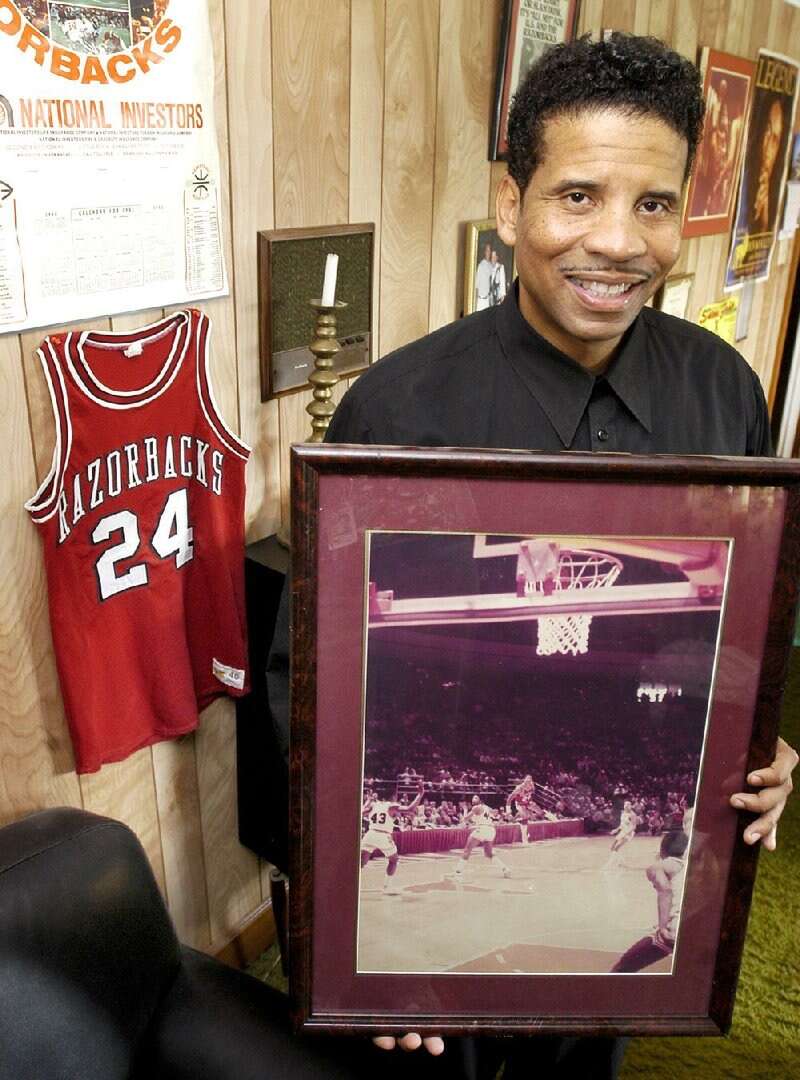 U.S. Reed holds up a framed photo of his halfcourt shot that gave Arkansas a 74-73 win over Louisville in the second round of the 1981 NCAA tournament. (Special to The Commercial)