
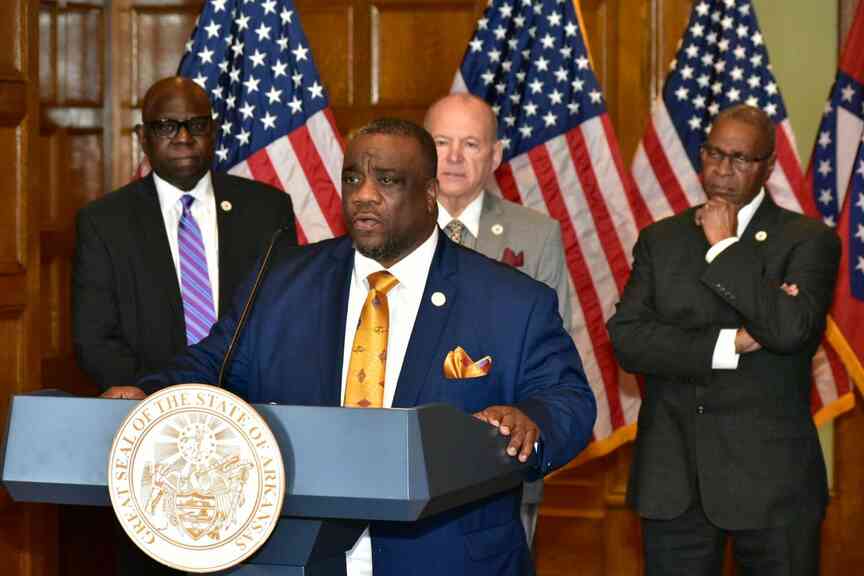
LITTLE ROCK — Eric Walden Jr. said he didn’t learn until Sunday evening that Gov. Sarah Huckabee Sanders would announce potential action to help him and other Jefferson County employees be paid.
Walden, the assistant chief of staff for the 11th West Circuit Court Sixth Division, talked five coworkers into joining him at the state Capitol to listen firsthand to Sanders on how she and lawmakers planned to rectify the budget crisis now a month old that has cost workers two paychecks. Sanders announced Sen. Ben Gilmore, R-Crossett and Rep. Glenn Barnes, D-Pine Bluff, would introduce a bill requiring cities and counties that have not established a budget by Jan. 1 each year to work under the previously passed budget until one is adopted.
Senate Bill 182 was introduced to the Senate floor Monday afternoon, read twice and referred to the City, County & Local Affairs Committee, which will consider the possible law Thursday, Gilmore said. The earliest it would make it out of the Senate and to the House floor would be Monday, Gilmore estimated, meaning it would be later next week than Sanders hoped before she could possibly sign it into law.
“We would like to see it happen as quickly as possible,” Sanders said.
Independent reporting for Pine Bluff & Jefferson County since 1879.
Sen. Stephanie Flowers, D-Pine Bluff, and Reps. Jeff Wardlaw, R-Hermitage, Ken Ferguson, D-Pine Bluff and Mike Holcomb, R-Pine Bluff, are co-sponsoring the bill.
“I am very grateful that the state representatives from our area and also the governor (have) stepped up to put this piece of legislation together and get it signed,” Walden said. “It’s a great step forward to helping us out because we’re already down two pay periods. Matter of fact, next Friday is payday again, and we’re not sure if we’re getting a check or not. It’s been hard on a lot of us people who have mortgages to pay, closing our houses. Business is slow and we’re not able to operate our offices like we should because of what’s gone on.”
If the Jefferson County Quorum Court is able, however, to approve a budget at its Tuesday meeting, payday may come a little sooner.
Quorum courts typically approve a budget by the first meeting of the year, but disputes over raises and job positions and the legality of some meetings between a majority of the 13 justices of the peace who comprise the Quorum Court and County Judge Gerald Robinson have led to an ongoing stalemate.
The ultimate goal of county leadership, Sanders said, is to have employees paid retroactive to Jan. 1, a move that would satisfy District 1 Justice of the Peace Alfred Carroll.
“I also would like to see this new legislation added as a section to our newly proposed procedural ordinance that is being studied by (County) Attorney Terry Wynne,” Carroll said. “Our current procedural ordinance expires at the end of this month. I am glad and proud that our legislative team and the governor are taking action.
“I think their actions will serve as an example for other states that have to address county and city budget problems, and other counties in Arkansas whose budget problems have not drawn statewide attention.”
Robinson did not respond to a text message seeking comment, but Sanders said she has been in back-and-forth communication with him.
“I’ve asked him to figure out a solution. Unfortunately, they haven’t come to one, which is why we’re all standing up here today,” Sanders said.
Robinson and the justices of the peace will have punitive reasons to agree to a budget should SB182 become law.
Neither per diem compensation for the justices of the peace nor the county judge’s salary will be part of the expenditures or the previous year’s budget if enacted in the current year, under the bill. Salaries to employees at the rate as of Dec. 31 and other expenditures will be paid under the previous year’s budget.
For municipalities, under SB182:
If the governing body has not adopted a budget by Jan. 1, any expenditure is to be paid under the previous year’s budget as of Dec. 31 until a new budget is passed.
Expenditures will be limited to “necessary operational expenses” including “regular and usual government services,” payroll and benefits of employees as of Dec. 31 and contracts for commodities or services.
Barnes had met with the Quorum Court majority and the public following a Jan. 23 meeting in which a quorum was not even established to conduct a vote. Nine of the 13 justices must be present for that to happen, and Robinson said that meeting was conducted without his consent.
“When I met with them, I told them they didn’t have the right to do the budget,” Barnes said he told the majority. “The budget comes from the judge, and it’s their job to vote the budget up and make amendments. There seemed to be a big argument of two budgets. They were saying, ‘We’ve got our budget and he’s got his.’ That’s not the way it works. They can vote up the budget or amend the budget.”
Barnes, a first-year representative, felt there was no middle ground between the majority of the justices of the peace and Robinson.
Holcomb said he and the other local representatives had waited as long as they could to allow Robinson and the Quorum Court to try and come up with a solution.
“Quorum Court is so divided,” he said. “I think we all tried our best to try to get everybody together and compromise (in) some way, but we’re not making any headway.”
Mike Holcomb’s brother Danny resigned from the Quorum Court on Jan. 26, citing threats to him and his family.
While Mike Holcomb did not address the resignation Monday when asked, he added there are married couples who work for the county and are being impacted.
“My main concern is not only the pay but their health insurance,” Mike Holcomb said.
“I’ve been advised by the (county) judge that he’s extended that for a couple of weeks. Hopefully with this bill we can move forward and we can get all of this behind us. (The county workers) can get their back pay and we get them back on the right track.”
Utilities such as Entergy for electricity and Liberty for water have joined food banks and churches in helping affected county workers with their bills.
“Everyone in Jefferson County has pitched in to help them out, so I’m thankful for that,” Mike Holcomb said.
The county workers’ visit, Walden said, helped to lift their spirits as they saw state leaders try to solve the problem and help the county return to normalcy. Walden is among those not being paid, but he’s helping his fellow workers through a tough time.
“I don’t like to disrupt routine,” Walden said, “so even though I’m not getting paid, I still show up to work each and every single day, coming to work every day and keeping the staff in prayer every day, showing support to the staff and helping them out as best I can and also offer an encouraging word to them every day — ‘Hey, we are going to get paid. Let’s keep positive.'”
“In our job we don’t necessarily get paid because we get the best money. We do it because it’s for an outcome. This really grounds us in that sense of purpose.”
 Eric Walden Jr., assistant chief of staff for the 11th West Circuit Court Sixth Division, talks with a television reporter about the possible impacts of state legislation on unpaid Jefferson County workers at the state Capitol on Monday, Feb. 3, 2025. (Pine Bluff Commercial/I.C. Murrell)