
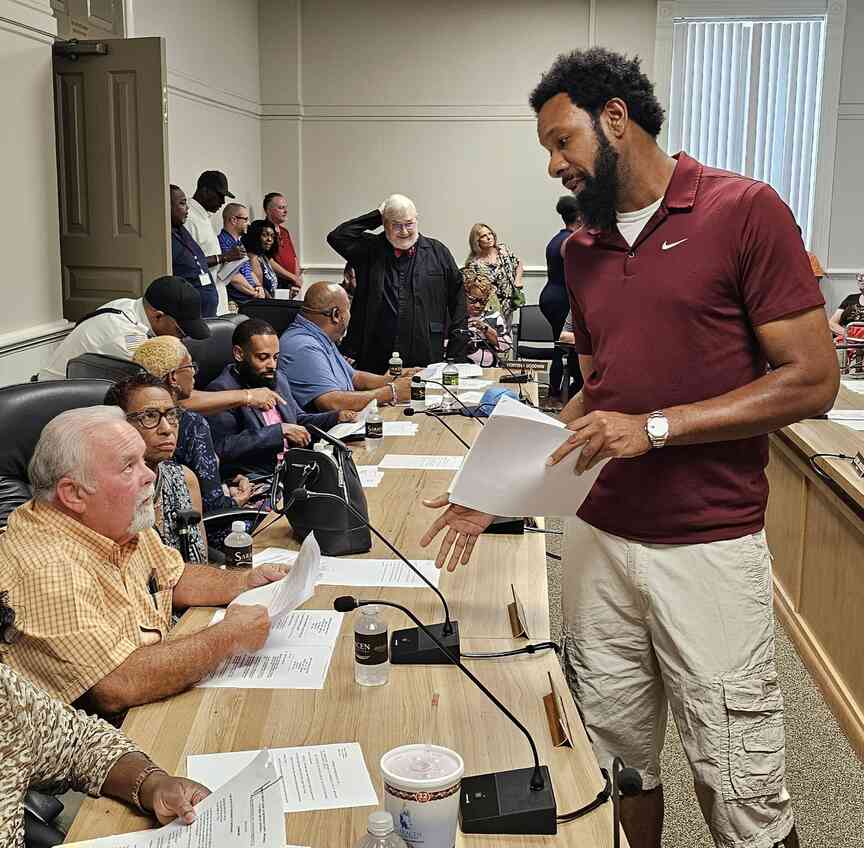
Former Justice of the Peace Lloyd A. Franklin II has filed an amended petition seeking the removal of Roy Agee from his position as Justice of the Peace for District 8.
The petition, filed on March 12, in the Jefferson County Circuit Court, alleges that Agee no longer meets the residency requirements necessary to hold the office.
Franklin, acting pro se, asserts that Agee has not resided in District 8 for over three years, following his separation and subsequent divorce from his wife in September 2021.
The petition details that Agee abandoned his residence at 6803 Oxford Road in Pine Bluff and has since used multiple addresses in an attempt to validate his residency in District 8.
According to the petition, Agee has listed addresses throughout Pine Bluff on various official documents, including campaign contribution reports and voter registration cards.
Independent reporting for Pine Bluff & Jefferson County since 1879.
However, Franklin contends that Agee’s actual residence is a mobile home on Old Star City Road, which falls within Justice of the Peace District 13, not District 8.
The petition references several exhibits, including information from the United States Postal Service and Jefferson County Assessor’s Office data, to support the claim that Agee has not maintained a residency in District 8.
Additionally, Franklin highlights a police report filed by Agee on Jan. 29, 2024, which lists his residence on Old Star City Road, further indicating his residency outside District 8.
Franklin’s petition calls for the court to issue an order removing Agee from his position and declaring the seat vacant.
The original case, filed in October of 2024, named John Thurston, Arkansas secretary of state, and the State Board of Elections Commissioners as defendants alongside Agee. They were dropped from the lawsuit in November after a response challenging Franklin.
The response motion filed by Thurston and the State Board of Election Commissioners, represented by Attorney General Tim Griffin and Senior Assistant Attorney General Sharnae Diggs, argues that Franklin’s petition and motion are moot and should be dismissed. The respondents assert that Franklin failed to file his action against the appropriate party before the Nov. 5, 2024, general election, causing undue hardship for the respondents who are not responsible for certifying local candidates’ eligibility.
The response motion highlights that the proper governmental entity responsible for determining and certifying a candidate’s eligibility was not included in Franklin’s lawsuit.
Consequently, Thurston and the State Board of Election Commissioners contend that they should not be forced to litigate a matter that falls outside their jurisdiction.
The brief argues that Franklin’s petition fails to allege sufficient facts to warrant the relief sought. According to Arkansas Rule of Civil Procedure 12(b)(6), a complaint must state facts upon which relief can be granted, and Franklin’s petition does not meet this standard. The brief emphasizes that the local county clerk was required to certify the list of candidates by Aug. 22, 2024, 75 days before the general election on Nov. 5, 2024. Since Franklin’s petition was filed after this deadline, the case is deemed moot and untimely.
Furthermore, the brief highlights that the Jefferson County Clerk of Court, who is responsible for certifying candidates, is not a party to the case.
The Separate Respondents argue that without the involvement of the local county clerk, complete relief cannot be accorded, making the petition procedurally flawed.
A motion, filed electronically on Dec. 31, 2024, by Agee’s attorney, R. Victor Harper, outlines several key objections to Franklin’s discovery process.
According to the document, Franklin served interrogatories on Agee’s counsel on Dec. 2, 2024, which included 176 questions and requests for documents.
These requests sought information spanning the past five years, despite the case’s focus on Agee’s residence at the time of the election.
Agee’s motion argues that the interrogatories delved into irrelevant aspects of his personal life, including details about his divorce and other private matters, which have no bearing on the case at hand.
The defendant contends that these questions are designed to embarrass him and expose his personal life to the public unnecessarily.
The motion requests a hearing to limit the scope of the plaintiff’s discovery, questioning the reasonableness of the number of questions and seeking to restrict inquiries into Agee’s personal life.
Until such a hearing is conducted, Agee’s attorneys have asked for the current interrogatories to be held in abeyance and ultimately quashed. In addition to the relief requested, Agee seeks attorney’s fees and costs associated with the motion.
Franklin filed a response to Agee’s objection to interrogatories and motions to quash and dismiss.
The dispute centers around Franklin’s interrogatories, which Agee claims are excessive, irrelevant and intended to embarrass him by probing into personal matters.
Franklin counters these claims, asserting that the interrogatories are crucial for establishing Agee’s residency at the time of the election, a key issue in the litigation.
Franklin argues that the interrogatories are pertinent to the case and fall within the permissible scope of discovery under the Arkansas Rules of Civil Procedure.
He emphasizes that the information sought is essential for determining Agee’s legal residence, which impacts his qualifications under election laws.
Franklin references this rule, noting that while evidence of a person’s character or past actions cannot be used to prove conduct on a specific occasion, it can be admissible for other purposes such as proving motive, opportunity, intent, and identity.
He contends that inquiries into Agee’s previous residences, financial records, and personal relationships are relevant for establishing patterns of behavior and living arrangements.
Franklin asserts that Agee has not demonstrated that the number of interrogatories is unduly burdensome given the complexity of the case.
He maintains that the interrogatories are narrowly tailored to determine Agee’s legal residence.
Franklin dismisses Agee’s claim that the interrogatories are designed solely to embarrass him, arguing that any potentially prejudicial information is outweighed by its probative value in determining Agee’s residency.
Franklin concludes his response by requesting the court deny Agee’s motion to quash, compel responses to the interrogatories, dismiss Agee’s objections, or alternatively, schedule a hearing on the merits of the motion to quash.
Getting Agee removed from the Quorum Court could strengthen the hand of those on the court who are, like Franklin, opposed to County Judge Gerald Robinson.
Agee has been supportive of Robinson, but his replacement might be less inclined to vote the way Robinson wishes.
Danny Holcomb, who cast mostly supportive votes for Robinson, resigned as a justice of the peace earlier this year and was replaced by Richard Victorino, who has been less supportive of Robinson, further eroding Robinson’s influence over the Quorum Court members.