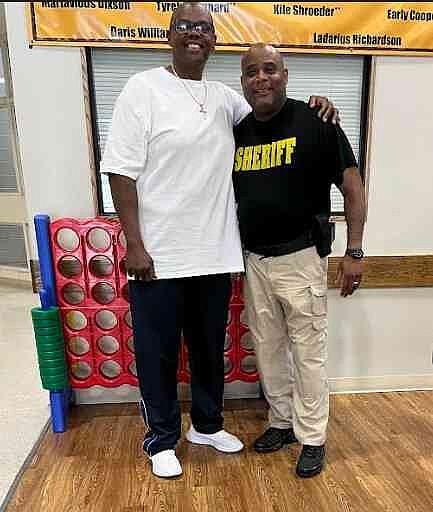
In a powerful and emotional address, Davis Spicer, who served 33 years in prison, shared his transformative journey with juveniles at the Jack Jones Juvenile Justice Detention Center in Pine Bluff last month. Spicer’s compelling narrative centered around regret, redemption and faith.
Jefferson County Chief Deputy Santrice Kearney revealed that she personally funded Spicer’s recent visit to speak to juveniles in the area. Spicer, whose powerful testimony on YouTube caught Kearney’s attention, was invited to share his extraordinary journey with the young people.
This personal investment stemmed from her own extensive experience working with the Department of Corrections, including time at a supermax prison.
“I wanted these youth to understand that no matter their past, they still have a chance to change their path,” Kearney explained, highlighting her motivation for arranging the visit.
Independent reporting for Pine Bluff & Jefferson County since 1879.
Spicer’s story is indeed remarkable. In 1987, at the age of 17, he was incarcerated. He served 11 years at the Mississippi State Penitentiary in Parchman before being released at 28. Facing difficulties finding employment, Spicer later turned to robbing banks and was sentenced in 2000, at age 29, to six life sentences plus 30 years. In a turn of events, he was released on Aug. 10, 2022.
Spicer spoke candidly about his troubled past, acknowledging his mistakes and the negative influences that led him down a destructive path.
“I was a fool,” he admitted, reflecting on his time as a gang member. “I thought (the streets) showed me the kind of love that I was aching to feel from a father figure … but that’s not life, that’s only illusion.”
Spicer stated he was considered one of the worst prisoners because he had been deemed “one of the worst prisoners, dangerous prisoners in the feds.” He also said he was “never going to another compound” because of it and described his restricted conditions at the ADX Supermax facility in Florence, Colo., where he could only walk four steps to his bars and four steps back to his shower.
ADX, often referred to as the “Alcatraz of the Rockies,” is a highly secure federal prison known for housing dangerous and high-risk inmates.
Spicer didn’t shy away from the harsh realities of prison life, describing the violence and the internal battles he faced. He shared stories of stabbing others and the constant struggle for survival within the prison system. However, Spicer emphasized that even in the darkest of times, a transformation was possible.
“God had a purpose for me,” he affirmed, attributing his survival and eventual release to a divine intervention. “It’s the best thing that ever happened to me in my entire life.”
Spicer spoke about stabbing others while in prison. He mentioned, “Going into prison, I’m steady getting in trouble in prison, I’m gang banging, I’m stabbing people.” He also recounted stabbing the last guy and killing him. “God brought him back, thank the Lord, because see one thing about the feds if you got life and you kill somebody, it’s automatic death penalty, but I didn’t know none of this,” he said. “But God had a purpose for me, so God brought the guy back to life.”
A pivotal moment in Spicer’s story came when he was at his lowest point, contemplating suicide. “What a wasted life,” he recalled thinking. It was then, he said, that he turned to prayer and began a journey of faith. “I gave my life to God. I got saved.” This spiritual awakening led to a profound change in Spicer’s perspective and ultimately paved the way for his release.
Spicer’s message wasn’t just about his personal journey but also a call to action for those present. Addressing the juveniles directly, he urged them to take responsibility for their choices.
“You are here because of your choices that you have made,” he stated. “When I was in prison, I blamed everybody but myself.” He also challenged the notion of victimhood, particularly within the community. “For you that are Black, you cannot blame the white man. Ain’t nobody white coming in our neighborhood selling no dope, killing nobody. We killing each other,” he said.
Spicer emphasized that change needs to start in the present moment, not at some future point. “Change, don’t wait to start on Monday,” he said. He clarified that when people say they will change later, like “I’m going to stop … I’m going to quit smoking Monday,” and then it’s Thursday and they haven’t, it means they are not truly serious.
Spicer explained that genuine change happens the instant someone gets serious about it. He warned against waiting for a symbolic start date, such as Monday, because it suggests a lack of real commitment to change.
He further emphasized personal responsibility in bringing about change, stating that one makes their own time and life hard, and that change starts with taking accountability for one’s actions and mindset. He urged the audience to be respectful and that it does not make one weak.
Toward the end of his talk, Spicer invited anyone who wanted to give their life to God to stand. Several individuals stood, signaling a moment of collective acknowledgment of faith and the potential for change.
The event was organized thanks to the efforts of Kearney, who recognized the impact Spicer’s story could have.
“Mrs. Kearney called me,” Spicer shared, “and she was like, ‘Listen, what’s it going to take to get you down here. … I can talk to the kids, but you can talk to them.’ And I have a passion for this because God didn’t release me to sit on the sidelines.”
Deeply moved and passionate about his powerful testimony, Spicer concluded his message that redemption remains possible even when facing great challenges.
“Give your life to God,” Spicer passionately urged. “Because everything they got on the street, man, they got in prison … but none of it’s going to work, man, but to dull your real pain. But the blood of Jesus Christ, man, God came and died for your sins so you may have life and have it more abundantly.”