
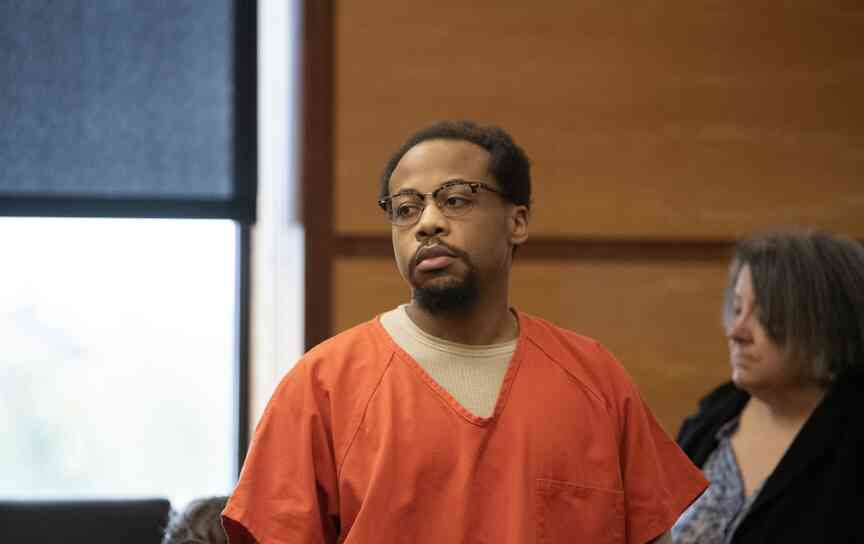
A signed plea deal is left to be completed in Jefferson County prosecutors’ case against a Washington state murder convict originally from Pine Bluff accused of killing a man in 2017.
Kirkland C. Warren, now 29, was sentenced to life in prison in October in Clark County, Wash., Superior Court for second-degree murder of Meshay Melendez, 27, and aggravated first-degree murder of Layla Stewart, 7, on or about March 12, 2023. Warren pleaded guilty in September to killing them, more than a year after their bodies were found. They had been reported missing in a rural area near Washougal, Wash., 17 miles east of Vancouver, a suburb of Portland, Ore. Warren also accepted an Alford plea, or guilt while maintaining innocence without going to trial, to first-degree child molestation of Layla.
The Columbian newspaper of Vancouver, Wash., which first reported the developments in the case, added the local medical examiner’s office determined the victims died from gunshot wounds to the head.
Warren took a joint offer from both Washington and Arkansas to plead guilty to first-degree murder and abuse of a corpse in Curtis Urquhart’s Nov. 27, 2017, death to have his sentence run concurrently with his time in Washington, 11th West Circuit deputy prosecutor Cymber Tadlock said. As part of the deal, Tadlock clarified, prosecutors in Arkansas would not seek the death penalty. Tadlock added prosecutors received new information from Warren’s cellphone in relation to the murder in Arkansas after they offered him the plea deal.
A special judge in the 11th West Circuit Court revoked a $250,000 bail for Warren in connection to Urquhart’s death. Warren reportedly told police he pulled out a .22-caliber handgun and shot Urquhart in the head while driving from a Pine Bluff notary office. Warren reportedly told police Urquhart asked him for money then dumped Urquhart’s body in a ditch near Stuttgart, where three men discovered the body two weeks later.
Independent reporting for Pine Bluff & Jefferson County since 1879.
Warren was formally charged Feb. 7, 2018.
“There was information there that, based on what was on his phone, I figure would have satisfied charging him with capital murder,” Tadlock said. “But that was not information we had at the time we made the decision. Had he wanted to come back here and go to trial, we would have asked the court’s permission, based on that evidence, to increase the charge to capital murder, so that ran a bigger risk for him.”
But the terms of a plea negotiation have yet to be properly finalized, she explained, and one of Warren’s attorneys in Washington is to meet with him to complete the forms.
“What happened, once he was sentenced up there, they moved him up there to their Department of Corrections,” Tadlock said. “He wasn’t in jail long after he was sentenced.”
Warren needed to sign three forms, which Tadlock said she sent to his attorney in Washington in two different emails.
“What I think happened, because they got sent two separate emails, the public defender only took one set of the forms to him to sign, and the other one didn’t get taken to him to sign,” Tadlock said.
By the time Tadlock said she realized the missing form, Warren was already taken to a maximum-security prison. He is held at the state penitentiary in Olympia, according to online records.
“He’s in a maximum unit, so I’ve got to get the paperwork over to him and agree to let him enter his plea by video,” said Mark F. Hampton, Warren’s lawyer in Arkansas. “It’s just the logistics of where he is. There’s another lawyer up there who will assist him in getting his stuff.
“It’s a done deal. He’s agreed to a concurrent life sentence.”
Hampton thinks the paperwork will be completed in the next 30-60 days.
“There’s no real rush because he’s already doing life up there, he said.
But Tadlock said the public prosecutors have not forgotten about the case. The ongoing budget crisis has not helped to speed up casework in Jefferson County.
“We’re certainly not wanting to ask any extra of anyone we don’t have to,” Tadlock said. “All of the county employees are already doing their jobs without getting paid. To ask for extra on any of the cases, we’re trying not to. It doesn’t mean we’re not still working cases. Things are still happening.”
Attorneys in the judicial circuit are paid as state employees, however. But Tadlock said they feel some of the emotional and mental impacts the county employees have been dealt with.
“It doesn’t impact us paycheck-wise, but it makes a huge impact on our office,” Tadlock said. “The majority of (our county employees) have been good about coming in and staying on top of what has to be done, but some of those extra things that normally you wouldn’t think twice about, now you’ve got to think, ‘I really need to make sure the essential stuff gets done.’ We’ve been trying not to make it any harder on our employees because they’ve been generous to come in and help while they’re not getting paid. We let them know as much as we can how much we appreciate them doing that.”
” … Some of them have worked there 20 years. They’re good employees and they’re good people. It’s really hard to watch them hurt and go through all of this.”