
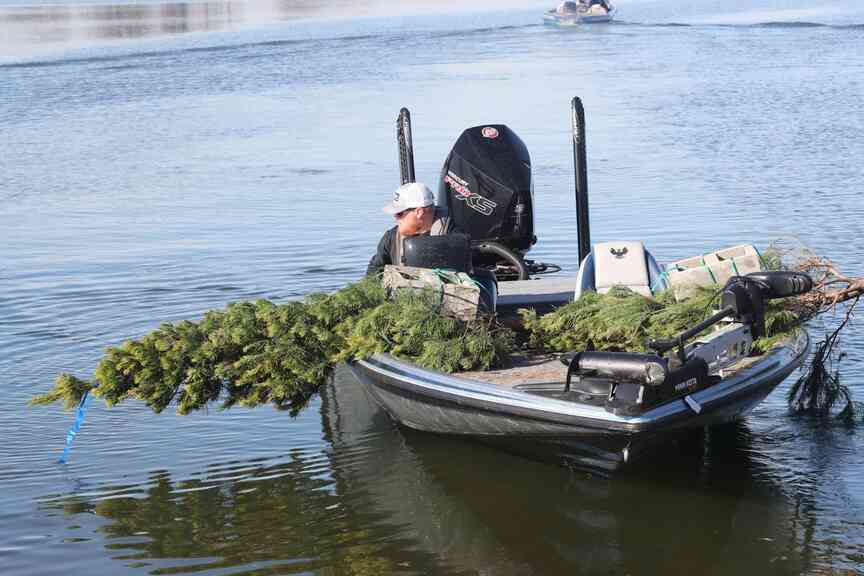
Habitat in fishponds involves pieces of natural or artificial cover where fish can seek refuge around or within, according to Scott Jones, small impoundment Extension specialist at the University of Arkansas at Pine Bluff.
Balancing the type, abundance and location of habitat in a fishing pond can be beneficial to fish production and angling efficiency.
Small and young fish need refuge until they are large enough to effectively evade predators or at least become more difficult to eat, he said. Refuge habitat tends to include densely packed objects with small spaces that only small fish can enter. Refuge sites made of plant and woody materials can also provide food for resident fish, as nutritious microbes, periphyton and invertebrates often grow on the surface of these structures. Synthetic structures, PVC for example, develop some surface growth but usually not as much as wooden structures.
“Predators can use the outsides of refuge sites to ambush small fish that venture too far from the inner confines,” Jones said. “Sites utilizing larger objects with larger openings between branches or frames tend to attract larger predators. They can use these sites to rest in shade or to use as concealment waiting for prey to swim close enough to attack.”
In ponds with little or no refuge habitat, predators may consume so many young that there are very few intermediate-sized fish and a limited number of large adults. This may create an entertaining angling experience for large-fish enthusiasts, but it may also result in catch rates so low that casual or novice anglers may lose interest from infrequent bites.
Independent reporting for Pine Bluff & Jefferson County since 1879.
“There are tangible angling benefits to good habitat construction and placement. Even if the number or size of fish in a pond does not increase following installation of good habitat sites, it can congregate fish into predictable and consistent locations,” he said. “This provides the owner with specific high-probability spots to target for their own satisfaction or the pleasure of their guests. Access to quick and consistent bites can be exceedingly satisfying, especially when introducing novices or children to fishing.”
EXAMPLES OF FISH HABITAT
Piles of brush, either tossed into the pond or bundled together and anchored by affixed cinderblocks or concrete tends to be the most common artificial habitat installed in ponds. Any shrub or tree can be used for this purpose, though you will find it easier to sink hardwoods than softwoods, Jones said. Used natural Christmas trees are a very common material for fish habitat projects.
“Piles of large crisscrossing untrimmed tree trunks and logs can make for spectacular habitat sites. These include both dense cover for small fish and large open spaces for large predators in the same site,” he said. “The major downside to this option is that it must be assembled during pond construction with heavy machinery before the pond begins filling with water.”
Assembled wooden structures, such as shipping pallets stacked into towers or arranged into A-frames with tree limbs pushed through the slats, can make good, complex fish attractors that can be installed before or after the pond fills, Jones said. Another option is to fill buckets partially with wet concrete, then insert limbs, bamboo, plastic piping or other branching materials into the concrete and wait for the concrete to harden before deploying the structure into the pond.
“Aquatic plants can provide excellent fish habitat but come with potential problems. Most ponds, especially small ones, have a large ratio of shallow and shoreline areas compared to deep open water,” he said. “This can result in even beneficial aquatic plant species growing excessively, interfering with fish production, angling, aesthetics and other pond uses. For this reason, aquatic plants are generally discouraged for small ponds, and only certain species are recommended for larger ones.”
Some state agencies have built and deployed what has become referred to as “Georgia Cubes,” made of PVC, in public reservoirs with good success, Jones said.
“Internet image searches for this term will generate numerous examples of designs and ideas to inspire your project,” he said. “There are also several synthetic commercially made fish attractors you can purchase and assemble on site.”
Benefits to natural materials like shrubs, trees and lumber include increased organic growth on their surfaces and potentially no financial cost if the materials come from the owner’s property, Jones said. However, these materials are not permanent, especially thin limbs and branches, because they will break down over time.
“Christmas trees, for example, usually do not last more than about one year before their limbs have withered down to the trunk. Exposing these materials to air, from water levels dropping during summer, for example, will increase the rate of breakdown,” he said. “Also, don’t overload the pond with woody materials. The natural breakdown of plants and wood consumes oxygen and some plants, like oak, can stain the water with tannins.”
Synthetic structures can last the lifetime of the pond with little to no breakdown. They may also be lighter than natural materials and more easily transported by boat to favorable deployment locations, Jones said. While the smoother surfaces do not grow periphyton as well as natural materials, they also do not snag line and lures as frequently.
HOW MUCH HABITAT IS NEEDED?
It makes sense that too little habitat is a problem, but you can also have too much. A general guideline is to occupy 20% to 40% of the total pond area with habitat. Too little habitat can result in excessive predation on small fish, leading to reduced abundance of intermediate-sized fish and poor recruitment, Jones said. Too much habitat can inhibit predators from reaching their prey, resulting in overpopulation of small fish, slow growth throughout the fishery and skinny adult predators.
“Place habitat near points, within pockets, on the edges of depth changes, around docks or within comfortable casting distance from your most likely fishing locations. Most habitat should be located between the depths of about four feet and about 10 feet. As shallow as three feet is acceptable, but habitat at this depth and shallower is more likely to become exposed during dry periods,” he said. “Habitat located deeper than 10 feet may not always be available to fish as dissolved oxygen levels in deep parts of poorly mixed ponds can become quite low during summer.”
For more information about fishpond habitat, contact Jones at (870) 575-8185 or joness@uapb.edu.
Debbie Archer is an Extension associate of communications at the University of Arkansas at Pine Bluff School of Agriculture, Fisheries and Human Sciences.