
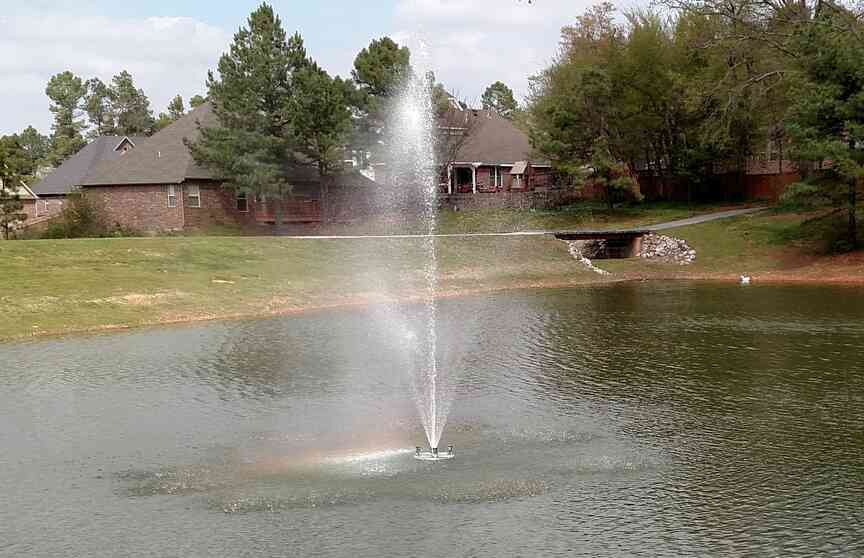
Supplemental aeration can be beneficial for fishponds, says Scott Jones, small impoundment extension specialist at the University of Arkansas at Pine Bluff. Improvements to the chemical and biological conditions of the pond can increase fish populations and extend the pond’s life.
“Although aeration is most often good, being too eager to set your new aeration system to full blast from the jump in summer could trigger disaster,” he said.
The most common types of aerators used in fishing ponds are diffusers, floating vertical pumps and fountains. Fountains are more about aesthetics, providing limited aeration and water circulation, Jones said.
“Vertical pumps provide good aeration and some circulation of shallow waters,” he said. “Diffused aeration is generally preferred, especially in ponds deeper than about 8 feet as they provide good aeration and good circulation. They also do more than aerate.”
In the summer, ponds develop distinct thermal layers. Usually, only the shallowest layer, the epilimnion, maintains high dissolved oxygen levels, Jones said. The deeper layers, unable to mix with the surface due to density differences between the warmer and cooler layers, gradually lose dissolved oxygen over summer.
Independent reporting for Pine Bluff & Jefferson County since 1879.
“In many ponds, the deepest, coolest layer, the hypolimnion, may run completely out of dissolved oxygen by mid to late summer,” he said. “In the fall, when surface water temperatures begin matching deeper water temperatures, ponds can again mix throughout. This period is known as the turnover.”
Ponds that are deep or highly productive (those that produce dense plankton blooms) can experience low dissolved oxygen during turnovers that can result in fish kills. Diffused aeration systems prevent these thermal layers from developing by circulating the water continuously, Jones said. So long as a properly sized diffused aerator is run continuously through the warm season, thermal layers will not develop, and the pond will not experience a turnover.
“A cruel irony experienced by some pond owners who install diffused aeration during summer is that they can accidentally trigger a turnover resulting in disastrous fish kills overnight,” he said. “The very same mechanism that prevents thermal layers from developing will break them if a diffuser is activated after the thermal layers have developed.”
Mid to late summer is the most dangerous period to activate a diffused aerator for the first time, but it is wise to boot them cautiously regardless of the time of year, Jones said. The boot-up procedure recommended by many manufacturers is intended to gradually mix the pond over a week to prevent sudden shock to the system. Start with only 30 minutes of run time day one, double the run time each day until the system is running continuously 24 hours per day.
“Arkansas ponds benefit most from operating a diffused aeration system continuously all year long,” he said. “Just remember to do annual maintenance on your compressors as recommended by the manufacturer to maintain optimal performance and life.”
If you do not want to run your aerator year-round, you can shut the system down during the cooler months of November through February with fewer negative effects than if you did so during warmer months, Jones said. If you only want to run your system during the highest periods of oxygen demand, perhaps to save slightly on electricity, wear and tear for example, run the system for 12 hours overnight each day.
“If you intend to operate aeration only overnight, it would be wise to increase the output volume of the system to ensure the whole pond’s volume is mixed at least once during your shorter aeration period,” he said.
For more information about fish pond aeration, contact Scott Jones at (870) 575-8185 or joness@uapb.edu.
Debbie Archer is an extension associate for communications at the University of Arkansas at Pine Bluff School of Agriculture, Fisheries and Human Sciences.