
Preserve Arkansas announced its 2025 Most Endangered Places list Sept. 12 during its annual Membership Meeting in El Dorado held in conjunction with the Destination Downtown conference.
The 2025 list comprises six properties, including Syrene Missionary Baptist Church (a remote African American church in Pickens) and Cemetery, an early Argenta building, a downtown Fayetteville neighborhood, a Hot Springs home believed to be the oldest of its kind, a Little Rock building important for its aviation history and a historic Fayetteville cemetery.
“We look forward to working with property owners and local advocates to chart a path forward and find solutions to save these irreplaceable community assets,” Rachel Patton, executive director of Preserve Arkansas, said in a news release.
The 2025 List of Arkansas’s Most Endangered Places features:
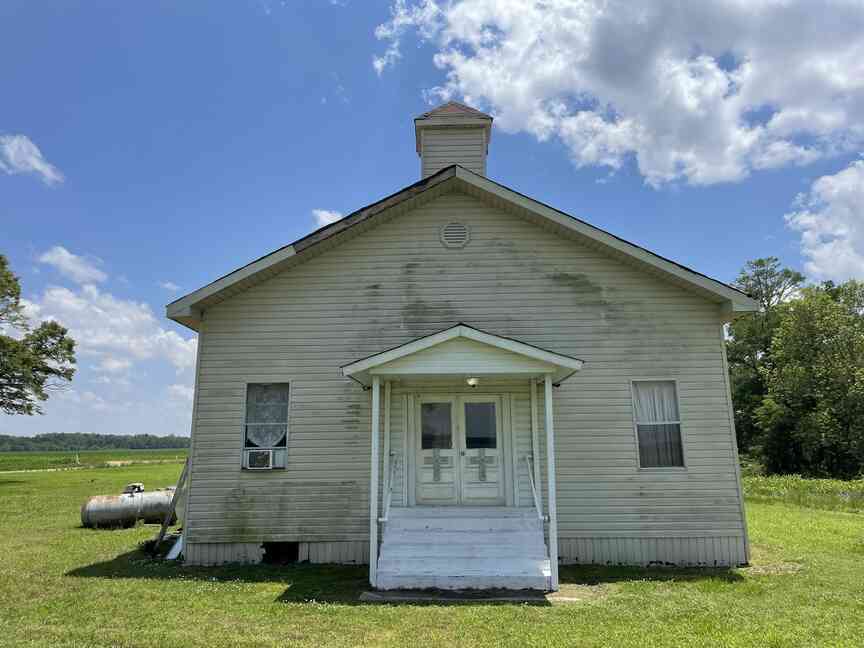
Syrene Missionary Baptist Church and Cemetery in Pickens (Desha County).
Independent reporting for Pine Bluff & Jefferson County since 1879.
Duncan/Hill Neighborhood, Fayetteville (Washington County).
East Mountain Cemetery, Fayetteville (Washington County).
Faucette Building, North Little Rock (Pulaski County).
Former 154th Observation Squadron Headquarters, Arkansas Air National Guard, Little Rock (Pulaski County).
Dr. William P. Passmore House, Hot Springs (Garland County).
PICKENS CHURCH
The 1937 Syrene Missionary Baptist Church in Pickens (Desha County) traces its roots to 1888, when property along Bayou Bartholomew was gifted to the African American congregation by local landowner R.J. Hyatt. The structural integrity of the church is threatened by age-related decline, and frequent flooding of the only access road renders the church unreliably accessible. A successful save would remedy this with road grading and improvements, assessment of the church and survey and repair of grave markers in the associated cemetery, according to the news release.
Evidence suggests that the congregation met at the location before the 1880s. According to oral tradition, an earlier church structure was destroyed by fire, and the current church was built in 1937, according to the history of the church on www.PreserveArkansas.org.
Baptisms were performed in Bayou Bartholomew, a common practice for contemporary congregations up and down the bayou. The church cemetery’s earliest surviving marker is hand-carved in concrete with a death date of 1907, and there are at least two stone markers supplied by the Mosaic Templars of America in the 1920s.
While there are 36 grave markers visible, unmarked graves are undoubtedly present, according to the website.
The primary threat is a lack of physical accessibility to the site. The church can only be reached by farm roads, including a half-mile stretch that is frequently flooded. Furthermore, the integrity of the structure itself is threatened by weather and age-related decline. A successful save would include road grading and improvements, a condition assessment of the church, a Ground Penetrating Radar survey of the cemetery, and the clearing and development of interpretive signage along the bank of Bayou Bartholomew commemorating the significance of this cultural landscape.
MOST ENDANGERED
The Most Endangered Places Program began in 1999 to raise awareness of historically and culturally significant properties facing threats such as demolition, deterioration and insensitive development.
Preserve Arkansas solicited nominations from individuals and organizations throughout the state, and a selection committee of preservation professionals, architects, historians and Preserve Arkansas members chose properties based on their level of significance, severity of the threat and level of local support. The list is updated each year to generate discussions and support for saving the places that matter to Arkansans.
Details: www.PreserveArkansas.org.