
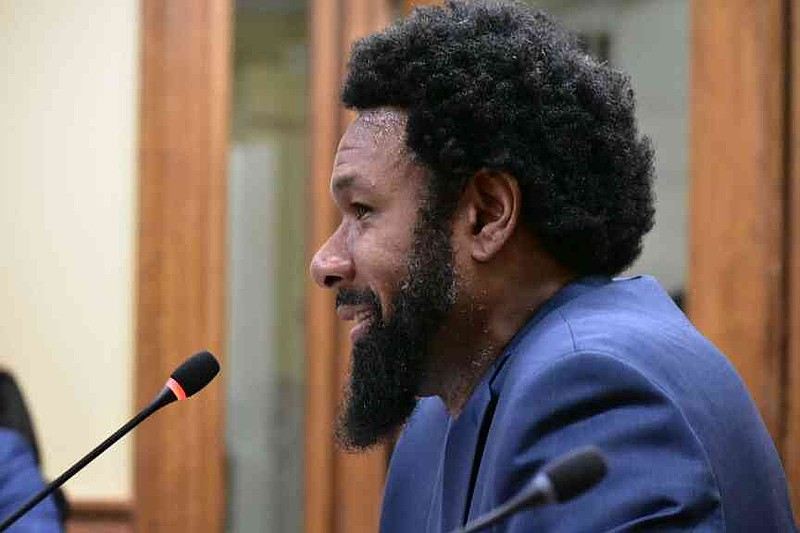
Former Jefferson County Quorum Court member Lloyd Franklin Jr. has broken his silence following a ruling in Little Rock District Court last week that found him not guilty of driving while intoxicated.
The decision, which included the dismissal of several related charges stemming from a November 2025 arrest, concludes a monthslong legal battle that Franklin described as one of the most trying times of his life.
According to court records, a judge has entered a verdict of not guilty on the primary charge, while the city dismissed several other citations. The charges leveled against Franklin included refusal to submit to a chemical test and refusal to submit to arrest, along with a first-offense violation of the Omnibus DWI Act. Additionally, he was cited for the use of a wireless telecommunications device while driving, impeding traffic and operating a vehicle with a license that was canceled, suspended or revoked.
The case concluded March 16, marking the end of a legal process that began when the Little Rock Police Department cited Franklin for DWI and several traffic-related offenses.
Independent reporting for Pine Bluff & Jefferson County since 1879.
In a statement released after the verdict, Franklin expressed the personal toll of the public scrutiny surrounding his arrest.
“Your name and your reputation are everything,” Franklin said. “Watching that be torn down in the public eye while you’re forced to remain silent is something I wouldn’t wish on anyone.”
Franklin also secured a victory in a separate administrative process. An Arkansas Driver Control hearing was decided in his favor after the state failed to meet its burden of proof, leading to the withdrawal of accusations against him.
According to documents from the Arkansas Department of Finance and Administration Driver Control Hearing Summary provided to The Commercial, a Driver Control hearing officer withdrew all administrative charges against Franklin at the Ragland Building in Little Rock on Nov. 19, 2025.
The decision comes after a contested hearing revealed stark contradictions between an officer’s sworn report and video evidence from the night of the arrest.
The case originated from a traffic stop in which the initiating officer claimed Franklin was impaired and had refused a chemical test. According to the documents, Franklin’s attorney, John Collins, challenged the very foundation of the stop, asserting that his client was merely stationary at a red light while entering an address into a GPS.
According to the defense, the officer activated emergency lights to prompt Franklin to move through a green light, only to pull him over immediately afterward — a sequence Collins argued undermined the officer’s justification for the stop.
The hearing centered on several procedural and evidentiary discrepancies.
According to the documents, while the officer’s report cited a “volatile and hostile” demeanor as the reason no chemical test was administered, the booking video showed Franklin affirmatively asking to take the test and questioning why he was being charged with refusal.
Defense counsel noted that the video showed the officer attempting to force the 6-foot-7-inch Franklin into the back of a police pickup, which he could not fit into. The documents say the video depicted Franklin as upset by the circumstances, but not “hostile” as the officer had characterized.
Although the officer documented impairment, according to the documents, the video of the one-leg stand showed that Franklin did not sway or hop. Furthermore, on the walk-and-turn test, the officer only noted one clue; standard protocols require two clues to indicate failure.
The officer’s own statement described Franklin’s speech, balance and vehicle exit as “normal,” which the defense argued was entirely inconsistent with a conclusion of impairment.
Hearing officer Cyndi Kalpac ruled that the state failed to meet the necessary burden of proof.
“Based on the totality of the evidence — including the video, audio recordings, and the sworn statement of the trooper — the state is unable to meet this burden,” the hearing summary said.
As a result, the administrative charges for first-offense driving under the influence and refusal were officially withdrawn, and all associated administrative requirements were dismissed.
In an interview with The Commercial, Franklin pointed out a significant clerical or procedural discrepancy that had emerged in an Arkansas Administrative License Suspension case, raising questions about the accuracy of official arrest records and the due process rights of the accused.
He provided evidence from his arrest that reveals a direct conflict between the physical “Pink Copy” given to him and the digital version of the same form appearing on a law enforcement computer screen that was also presented during his hearing.
The physical document handed to Franklin shows only one box checked: DWI ALC (§ 5-65-103). This indicates an arrest based on alcohol intoxication or a blood alcohol content of 0.08% or higher. Notably, the “DWI REFUSAL” box remains blank on this version.
A photograph of the computer-based version of the same form — signed by the same driver and dated the same day — shows two boxes checked: both DWI ALC and DWI REFUSAL (§ 5-65-205).
Franklin noted that the inability to immediately defend himself or clear his name in the moment “changes everything.”
While expressing respect for law enforcement, he pointed to “missteps” made during the situation, whether intentional or not.
Reflecting on the experience, Franklin noted the intensity of the media coverage compared to the nature of the offense and expressed gratitude for the “overwhelming number of phone calls and messages of support” from across the state.
Franklin concluded by highlighting the importance of access to legal representation.
“I am grateful that I had that access, because in many cases, individuals do not, and the outcome may not be the same,” he said.
With the legal matters now resolved, Franklin said he remains focused on his continued service to the community.