
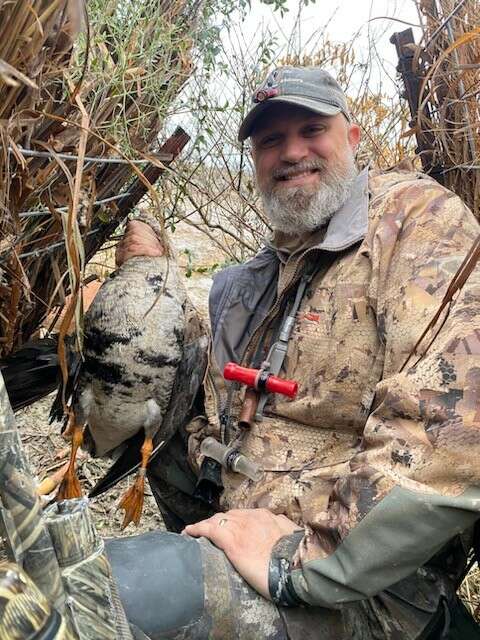
The second split of the 2024-25 Arkansas waterfowl season wrapped up Sunday. The third and final split will reopen Friday and continue through Jan. 31.
So far, harvest numbers have been spotty, with certain hunters in Jefferson County reporting good success during the first split and early in the second split while numbers dwindled as the second split wound down. Those waterfowlers taking respectable duck numbers proved the ones who pumped up water in their fields during an extra dry year.
Despite high winds leading to unfavorable flying conditions, the first Arkansas Game and Fish Commission aerial duck survey for the 2024-25 season was completed around Dec. 18 and numbers are scant. This is primarily related to a lack of surface water on the landscape and relatively warm conditions in Missouri where migrating ducks continue to linger.
According to wildlife biologist Jason “Buck” Jackson, who has been involved with Arkansas Game & Fish Commission aerial duck surveys since their inception in 2013, this may be the poorest early winter count since he has been flying.
Independent reporting for Pine Bluff & Jefferson County since 1879.
AGFC Waterfowl Program Coordinator Brett Leach said of the survey, “The observers did see some pockets holding good numbers of birds, but overall reported low counts.”
The survey, released on Christmas Eve reads in part, “Biologists conducting transect-based surveys in the Delta estimated 153,423 mallards and 529,977 total ducks, while duck population estimates in the Arkansas River Valley were 40,901 total ducks, including 19,126 mallards. Staff performing cruise surveys in southwest Arkansas reported an estimated 17,960 ducks with 3,305 mallards. Arctic goose population estimates totaled 609,561 light (lesser snow and Ross’s) geese and 326,026 greater white-fronted (speckle belly) geese in the Delta.”
The survey further states, “The Delta mallard population estimate was 74,058 mallards above the 2023 December estimate, but 379,895 mallards below the 2009-24 December long-term average. Total duck population estimates were 520,922 birds below the long-term average, but 80,117 birds above last December’s estimate. On average, mallards account for about 49% of all ducks in the Delta during December surveys. During this survey period, mallards made up only 29% of the total duck estimate …”
“The Bayou Meto-Lower Arkansas survey zone had a relatively high total duck estimate of 51,021. Most notably, the Cache River zone had 173,571 total ducks which made up 33% of the total duck estimate. Hotspot maps indicate several key duck concentration areas primarily in the southern and northeast portion of the Delta, with scattered distribution throughout the central part of the state.”
The survey concludes, “Similar to 2023, much of the Delta faced dry conditions this fall without any substantial recent rainfall, leaving majority of the Delta abnormally to moderately dry. After observers completed the survey period, portions of the state began to receive some rainfall, with more rain in the predicted forecast before the New Year. Staff are expected to fly the annual midwinter waterfowl survey the week of January 6th.”
While duck harvests are spotty, speckle belly goose hunters have experienced success in Jefferson, Lonoke, Arkansas and other surrounding counties of the Delta.
Ducks require water to land and feed in. Geese generally find their food sources in dry fields. Accordingly, there is currently more ready goose habitat available than that required to support large duck numbers.
Goose hatch numbers remain high as well while the overall duck hatch census is down. Drought in the pothole region of Canada, where ducks nest, has played havoc with duck hatches in recent years. Geese, on the other hand, nest farther north in the tundra region where drought has not had as severe an effect on the development of young birds.
Avian flu has reemerged, with a considerable number of snow and Ross’s geese being found deceased in fields across the region. This is largely the result of the thick flocks that roost together causing ready spread of the infection as well as their poor condition upon arriving this far south after the long, strenuous migration.
A limited number of speckle bellies and only a couple of ducks have thus far proved positive when tested for the disease.
AGFC’s WRICE (Waterfowl Rice Incentive Conservation Enhancement) Program is operated by the Commission’s Private Lands Habitat Division and includes 64 fields scattered throughout the state in the 2024-25 enrollment.
For a minimal $5 fee, properly licensed Arkansas hunters may apply online for the experience of hunting privately owned flooded rice fields. Names are randomly drawn from the overall pool of applicants on a weekly basis. Successful applicants may hunt all day Saturday and Sunday at their designated field, with up to four hunters allowed. The winning applicant may bring different hunters for each day.
Some major rule changes this season for WMAs (Wildlife Management Areas) like Jefferson County’s Bayou Meto now allow hunters to bring 25 shells as opposed to the previous 15-shell limit. After being banned for a number of years, motion decoys such as Mojo’s are also again legally allowed for use.
Regarding AGFC’s conservation philosophy, Buck Jackson said, “We are working in the best and safest ways we can for the future and still provide opportunities for waterfowlers today. We don’t want to get too greedy. We want everyone to still have these hunting opportunities for generations to come. Our management plan is designed with our great, great grandkids in mind.”
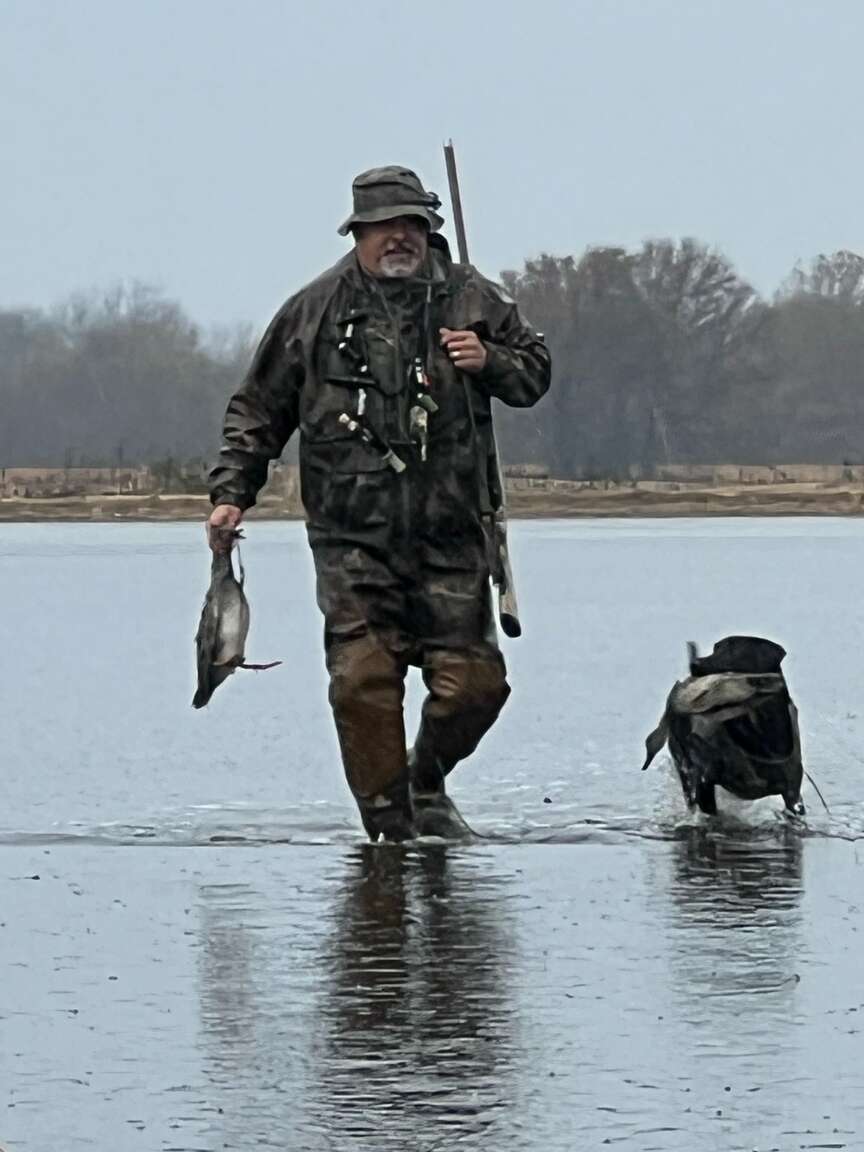 Devin Carr and his Labrador, “Lady,” retrieve a pair of gadwalls from a flooded rice field in the Delta. (Special to The Commercial/Mark Ladd)