
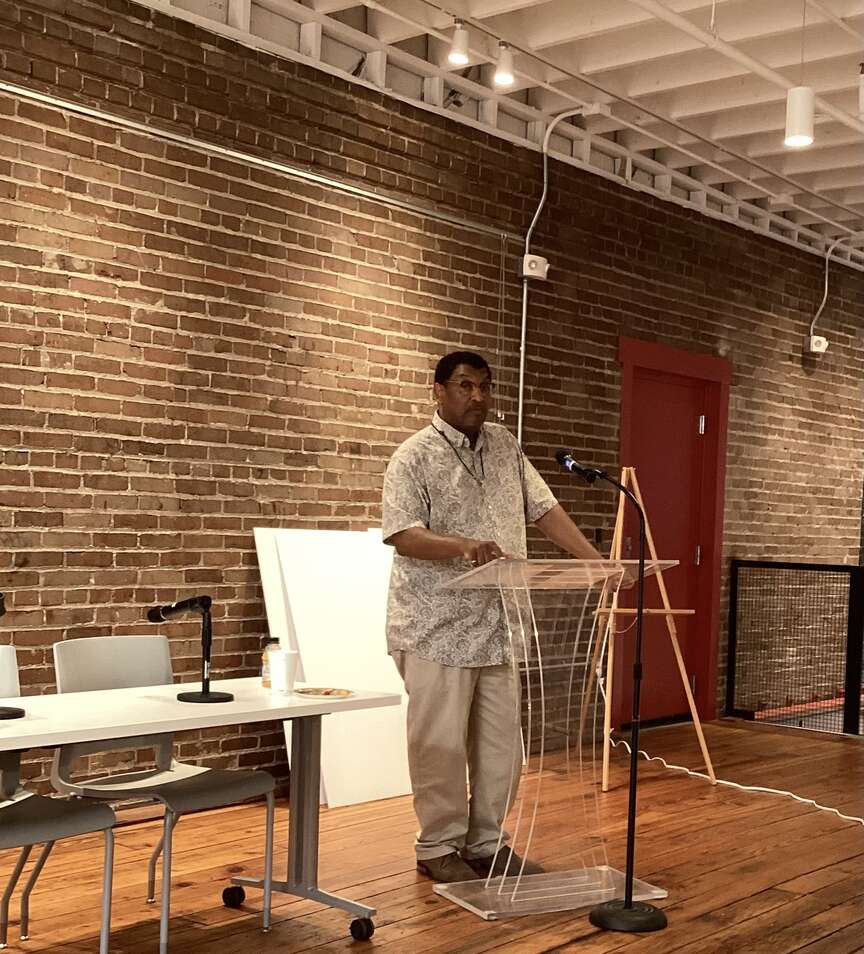
Community leaders, elected officials, entrepreneurs, pastors, singers and songwriters spent the day learning about the progress of tourism-related projects and potential opportunities during the Delta Rhythm & Bayous Highway Regional Tourism Summit.
The day-long event was held recently at the ARTSpace and gave insight into the collaborative efforts of lower Delta communities located along the DRB Highway — which is U.S. Highway 65 South from Pine Bluff to Lake Village, as designated by the Arkansas Legislature in 2017.
Participants experienced a taste of Southern culture through art, music and cuisine. Tours included the Freedom and Blues Exhibition, located inside the University of Arkansas at Pine Bluff Business Support Incubator, and Pine Bluff’s DRB Cultural District in the city’s downtown area. Live entertainment was provided by blues artist Detroit Johnny Johnson of Pine Bluff during a soul food luncheon consisting of catfish, greens, beans, macaroni and cheese and cornbread muffins. Johnson was the 2023 recipient of the Sonny Payne Award of Blues Excellence.
The summit was hosted by Winrock International, Pine Bluff Advertising and Promotion Commission and the DRB Alliance, a nonprofit organization designed to help build a travel corridor between Pine Bluff and Indianola, Miss., to facilitate increased tourism revenue and public awareness. UAPB and Mississippi Valley State University were mentioned as the two historically black colleges and universities located within the corridor.
Independent reporting for Pine Bluff & Jefferson County since 1879.
Special guests included Arkansas State Rep. Vivian Flowers, soon to be sworn in as Pine Bluff mayor, and Mississippi State Rep. John Hines.
Jimmy Cunningham Jr., tourism development director with the Pine Bluff Advertising and Promotion Commission and executive director of the DRB Alliance, said that UAPB students will be working with professionals who will install artwork, sculptures and murals in Pine Bluff’s DRB Cultural District.
“Effectively, we’re going to have an outdoor classroom…this is going to be the largest outdoor gallery dedicated to music and culture in the country,” Cunningham said.
He moved on to discuss the topic of community control.
“No project is going to work that a community does not own. A community must own a project…. Even though we’re all working together in six different sites, each site has local control of its assets,” Cunningham said.
He explained that the DRB Alliance wants to avoid confusion when working with a large foundation that is “well-endowed financially” and may have a possible interest in funding projects. They will provide portfolios and show the individual projects that various cities have embarked upon, he said. He quickly added that when potential funders and grant providers make inquiries, they will put them in touch directly with the local non-profit organization leading the project. If an award is made, it will not be made to the DRB Alliance in an effort to avoid having control over how those funds are used, he said.
“We want to make sure that communities understand from the get-go that this is your project. We are agreeing to work together collaboratively because we understand the power of bringing all of this together and being of benefit for everybody … you’re going to be the one in charge. You’re going to be the ones in control. That’s going to be on you,” said Cunningham.
Highlights of the summit included a presentation by Pastor Walter Witherspoon III, owner of Lil’ Walt Productions LLC and a member of the award-winning Gospel music group The Racy Brothers, in Dumas. In a segment entitled “Building DRB Highway Narrative Assets in Arkansas,” Witherspoon talked about the benefit of using music as a placemaking model in his community. He shared that numerous renowned Gospel as well as Rhythm and Blues artists have used his recording studio to create music. As a special treat, he and two members of The Racy Brothers — Bobby Racy Sr. and André Spinks — performed an acapella song.
“We are a national recording artist that has traveled the entire country. Out of Dumas, Ark., we have been on four major labels … and we have some songs that did well all across the country that actually put Dumas on the map,” Witherspoon said.
He added that a song he wrote called “Heal Our Land” that was on Al Bell’s label was downloaded over 250,000 times and went into the homes of over 2 million people. He said that Dumas is home to other well-known recording artists such as Jazz trumpeter Rodney Block.
Linda Henderson Austin, John Livingston, Pastor Johnnie Smith Jr. and Alice Love spoke about the benefit of highlighting a national or local narrative as a placemaking model in the community of Mitchellville. Austin shared how she once worked with Daisy Bates, an American civil rights activist, publisher, journalist and lecturer who played a leading role in the Little Rock Integration Crisis of 1957. Austin said that Bates visited Mitchellville in the 1960s, noting that the city was extremely impoverished back then and needed numerous resources.
Love said that Bates first came to Mitchellville in 1967 to speak on behalf of the NAACP.
“When she saw the conditions, it is reported that she stopped her speech, looked into the crowd and asked why they wanted a town in the first place. She was involved in civil rights, developing friendships, partnerships and networks,” said Love.
Austin said that Bates became overwhelmed with the conditions of Mitchellville.
“There were no paved streets. The homes that were in the city were in disrepair, and there was no sewage system in Mitchellville. The raw sewage was in the ditches and the stench just permeated the air. When she saw that she became overwhelmed with the poverty of that community. So she said, ‘I have found another cause that I want to fight for. And I want to fight the war on poverty,'” Austin recalled.
Love said that Bates reached out to Dr. Bob Riley at Ouachita Baptist University, shared her vision with him and asked if he would come survey Mitchellville to determine what it would cost to create infrastructure, education and employment, and help her to develop a sense of community. He decided to have his students get involved.
In October 1967, Riley’s students came to Mitchellville, interviewed residents, mapped out the geography and compiled their report. Bates used this data from the report, went to Washington, D.C., and pitched her plan to John A. Baker, who was then assistant secretary of agriculture. By January 1968, Bates had a reply from the U.S. Agriculture Department.
“He wrote a note that said, ‘You made a favorable impression and impact here on your visit to Washington. I have directed each of our agencies and their personnel to cooperate in making a success of this most worthwhile undertaking. You can be assured of their help whenever possible.’ Over the next seven years, Mrs. Bates organized and oversaw a lot of work in Mitchellville. She was awarded the grant from the Office of Economic Opportunity. It was part of the (President) Lyndon Baines Johnson’s Great Society Legislative Agenda, and once she received the grant, she began her work,” Love said.
In 1968, Bates and her husband moved to Mitchellville. Using her organizational skills and national influence to pull together residents and improve the community, Bates became an executive director for the Mitchellville Office of Economic Opportunity Self-Help Project for six years. Under her leadership, the quality of life in Mitchellville dramatically improved as residents began gaining relevant training, skills and education, Austin said.
Austin, along with John Livingston, Pastor Johnny Smith, Jr. and Alice Love, presented details about the future Daisy Lee Gaston Bates Cultural Center. An artist’s rendering described the facility as an adaptive re-use of the historic Mitchellville Community Center.
The renovated center would include a museum/genealogy research center, a multipurpose hall/music studio, a computer training center, a commercial kitchen, a new culinary arts school and rooms for workshops. A memorial garden with a fountain and statues in honor of women in the civil rights movement would be located outside of the building. Other features include an amphitheater with a covered stage for musical or cultural performances, movies and a venue for a speaker’s bureau; a covered gazebo for formal gatherings, wedding receptions, reunions and birthday parties; and a walking path for joggers, walkers and bikers.
A team from Indianola, Miss., shared details of a unique concept they have labeled as “The Three Kings” – Grammy Award Winners B.B. King and Albert King as well as Dr. Martin Luther King Jr. The team included Indianola Mayor Ken Featherstone, Malika Polk-Lee, Robert Terrell and Dr. Adrian Brown.
Currently, the city is home to the B.B. King Museum & Delta Interpretive Center where Polk-Lee serves as executive director. Blues Guitarist Albert King was born there, and Dr. King spoke on the grounds of the Sunflower County Courthouse in June 1966.
The idea of “The Three Kings” is to attract more tourists to the community through the historic relevance, connection and contribution of the three famous men.
Towards the end of the summit, several experts were featured during a panel discussion entitled “Seasoning the DRB Highway Narrative; Expanding the Lens.” They included Kody Ford, director of outreach, programs and education, Arkansas Cinema Society; Michael McCray, cultural development specialist, Pine Bluff Economic and Community Development; Orson Weems, executive director and co-founder, The Music Education Initiative; Barry Jurgenson, Underground Railroad Network to Freedom; Susie Cowan, industry relations manager, Arkansas Department of Parks, Heritage and Tourism; and Marty Ryall, director of Division of Heritage, Arkansas Department of Parks, Heritage and Tourism.
 The Rev. Johnnie Smith Jr. discusses the inside and outside aspects of the future Daisy Lee Gaston Bates Cultural Center. (Special to The Commercial/Kim Jones Sneed)
 Detroit Johnny Johnson performs during the luncheon of the Delta Rhythm & Bayous Highway Regional Tourism Summit. (Special to The Commercial/Kim Jones Sneed)
 Linda Henderson Austin worked closely with Daisy Lee Gaston Bates. (Special to The Commercial/Kim Jones Sneed)
 The Racy Brothers gospel singers make a presentation at the Delta Rhythm & Bayous Highway Regional Tourism Summit. Speakers include Bobby Racy Sr. (left), the Rev. Walter Witherspoon III, and André Spinks. (Special to The Commercial/Kim Jones Sneed)