
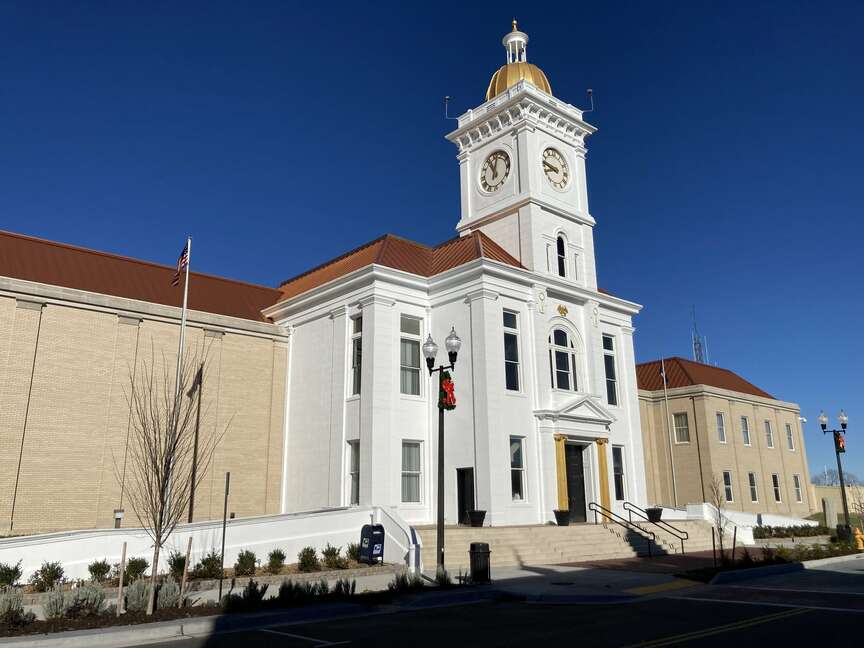
A ruling by a special county judge in Jefferson County has ordered the county clerk to collect all outstanding invoices from a northeast Arkansas law firm for payment for past representation of members of the Quorum Court.
These invoices, Special County Judge Efrem B. Neely Sr. ruled, are to be submitted to him for approval and signature for payment from of funds previously appropriated for legal services to the Quorum Court. But North Little Rock Attorney Casey Castleberry, representing County Judge Gerald Robinson, has requested a stay of Neely’s decision, stating the approval of vouchers for payment is outside of his appointment. Neely is a practicing attorney in Pine Bluff who was appointed as special county judge by Gov. Sarah Huckabee Sanders.
The order, dated Tuesday, stems from a legal dispute initiated on July 14, 2023, when Robinson filed a “Petition for Writ of Mandamus and Declaratory Judgment” against the Quorum Court and several individual justices of the peace. The petition sought to address the payment of invoices submitted on behalf of Paragould firm Kimberly Dale of Branch Thompson Warmath Dale & Butler for payments related to the representation of certain justices.
The core of the dispute revolved around the legal representation of the justices. While four justices — Ted Harden, Danny Holcomb, Roy Agee and Patricia Royal Johnson — opted not to seek legal counsel through their submitted responses to either admit or acquiesce to the allegations presented by Robinson, JP Dr. Conley F. Byrd responded to the action by using a similarly drafted response, with the key difference being that he sought legal counsel.
The remaining eight justices — Melanie Johnson Dumas, Cedric Jackson, Alfred Carroll Sr., Lloyd Franklin Jr., Reginald Adams, Margarette Williams and Brenda Bishop Gaddy — sought legal counsel in response to Robinson’s action.
Independent reporting for Pine Bluff & Jefferson County since 1879.
Neely’s order pointed out that in accordance with Arkansas Code Annotated §14-14-902(b)(1) and (2), the Quorum Court exercised its right to retain legal counsel and set aside appropriations for legal funds to hire counsel. Funding for legal counsel was appropriated in the budget for the fiscal year and appeared to be set at $35,000.
The ruling notes that with Robinson’s action, there was a conflict of interest for Prosecuting Attorney Kyle Hunter to represent either side in good faith, adding that outside counsel was then necessary. The order reiterates that Robinson should sign off on approval for payment and there must be a sufficient appropriation available. The funds must be expended for appropriate purposes, and the expenditure must comply with state purchasing laws, according to the order.
Neely concluded that Robinson created a legal conflict within county government by initiating litigation against Quorum Court members. “Consequently, the Justices, in defending themselves, were entitled to and appropriately obtained legal counsel,” according to his ruling.
According to the ruling, despite the statutory requirement to approve all payments, the county judge “may not arbitrarily withhold payment” when:
• Legal services were necessary and lawfully incurred;
• Funds were properly appropriated;
• Attorneys for both sides rendered services in good faith in the same proceeding; and
• The county judge approved payment to his own attorneys but not to those representing the Justices, which raises equitable concerns.
Castleberry appealed the ruling to Neely in a letter dated Wednesday.
According to Castleberry’s letter, Robinson’s stance is that a circuit court order pertaining to county funds should be treated as a “supersedeas and suspension of all further proceedings” in the case, suggesting the decision on payments should be held pending a final disposition without risk to “receipt, retention, or security.” A supersedeas bond is also known as an appeal bond.
Castleberry asserted that “the Governor’s appointment was limited to presiding over the above-referenced case,” and the appointment of vouchers for payment falls outside the scope of the Governor’s appointment of a Special County Judge.
“I would respectfully request that you do not approve payment of the disputed claim with county funds,” said Castleberry in the letter.