
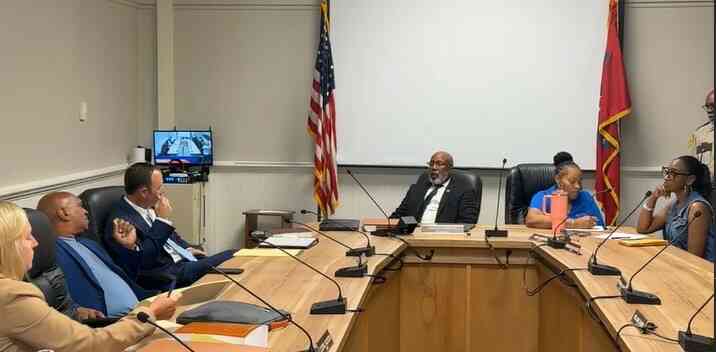
A legal battle centering on the right of the Jefferson County justices of the peace to secure independent legal representation unfolded Tuesday.
The dispute, held before special appointed judge and Pine Bluff attorney Efrem Neely in county court, involved a claim filed by Paragould attorney Kimberly Dale on behalf of her law firm for services rendered to several justices. Dale asserted that her firm represented the justices of the peace in a case against Jefferson County Judge Gerald Robinson and that the fees for these services have not been paid despite proper submission and approval by the justices of the peace.
Earlier this year, a special judge in the 11th West Circuit Court ruled in favor of Robinson in a 17-month case against all 13 justices of the peace over the validity of meetings without an active ordinance on the rules of procedure. Dale represented the justices.
Dale appealed to the court after Robinson refused to pay her fees, an attempt made by the justices of the peace in several Quorum Court meetings through legislation.
During the proceedings, Dale emphasized the statutory basis for her claim, citing Section 14-14-902 of the Arkansas Code. “The statute … says very clearly that they have (a) right … for representation that had (arisen) to safe legal services,” Dale stated.
Independent reporting for Pine Bluff & Jefferson County since 1879.
She further argued that the law is “very particular about legal counsel, how to have the ability to contract the legal counsel and what that legal counsel should or should not use for services.”
A key point of contention is the role of the county judge. Dale stated that Robinson recused himself from the matter in April, suggesting his office should no longer have input.
“When a judge recuses … you can’t then show up as a district judge and say, ‘Oh, by the way, I recused on the (case) … but I want you prosecuted,'” Dale explained. She maintained that once recused, “you do not have any rights or have any input on that particular matter.” She believes the county judge’s office has therefore been vacated.
Robinson’s attorney Casey Castleberry challenged Dale’s arguments.
“It’s proper and appropriate for him to defend his position,” he said. He also raised questions about the validity of the fee agreements, stating, “All (fee) agreements are between the JP and the law firm. There’s no ordinance that approved these fee agreements. … It’s not the court that adopts these fee agreements.”
Castleberry further argued that Section 14-14-1102 of the state code grants the county attorney “the sole authority to get it.” Regarding the budget, he noted a $32,000 appropriation for special legal counsel in the 2025 budget but highlighted that the fee agreements in question were executed in 2023, questioning the authorization.
Dale, however, rebutted these claims.
“We did not receive a $5,000 retainer,” she said, pointing to an ordinance that was passed by the justices of that time. She also stated that the county judge’s office itself has paid outside counsel in the past.
The core of Dale’s argument rests on the right of elected officials to obtain necessary legal representation. She emphasized that justices of the peace “have an absolute right to representation, they have a right to contract for services and (look) forward to engaging in legal services.”
She continued by stating, “There is not one particular county government office that has any more of that higher authority over the other.”
Neely will now consider the presented arguments, case law and supporting documentation and make a ruling later this month.