
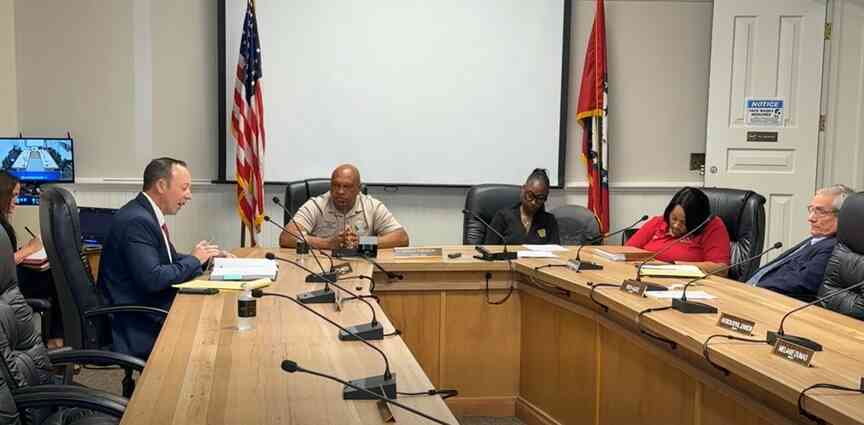
In a move sparking debate, Jefferson County Judge Gerald Robinson has approved a significant financial claim for his own payment, asserting his authority as acting judge while his attorney simultaneously represented him in an individual capacity.
The controversy centers on a recent statute that purportedly eliminates the county judge’s salary and compensation, a move Robinson contends is unconstitutional, until a budget for the current year is passed. This decision also comes amidst an ongoing budget dispute with the Quorum Court over budget appropriations, leading to a halt in payments for county services and vendors.
During a recent hearing held on Wednesday, Casey Castleberry, representing Robinson, filed a claim for payment with the county clerk on Sept. 10. Castleberry presented evidence, including pay stubs and the appropriation ordinance, which set the budget for the fiscal year beginning Jan. 1, 2024, and continued through 2025. This ordinance established the county judge’s salary at $115,750.67.
Last month, Robinson filed a formal claim in County Court seeking over $53,000 in unpaid salary for the first half of 2025. Robinson has said in past interviews that a state law preventing his payment is unconstitutional, setting the stage for a significant legal challenge in the 11th West Circuit Court.
The dispute stems from a contentious budget impasse between Robinson and the Quorum Court, an issue that had previously affected nearly 400 other county employees earlier this year. Robinson’s claim specifically targets Act 24 of 2025, a state law that withholds the county judge’s salary in the absence of an annual appropriation ordinance. He argues that this act violates Section 5 of Amendment 55 to the Arkansas Constitution, which prohibits the reduction of a county officer’s compensation during their current term.
Independent reporting for Pine Bluff & Jefferson County since 1879.
According to Robinson’s filing, he was not paid for 11 pay periods between Jan. 15 and June 15, despite his annual salary being set at $115,750.67 by Ordinance 2023-64. He states that his compensation was effectively reduced to zero during this period, directly conflicting with the constitutional amendment. The nonpayment of salaries became a critical issue earlier in the year, bringing county operations to a standstill. In response, state legislators from Jefferson County pushed for new legislation. House Bill 1331, initially authored by Rep. Glenn Barnes, D-Pine Bluff, failed to advance. Subsequently, Sen. Ben Gilmore, R-Crossett, drafted Senate Bill 182 (SB182), which was fast-tracked and signed into law by Gov. Sarah Huckabee Sanders. SB182 included an emergency clause, allowing local governments to operate under the previous year’s appropriation ordinance until a new budget was adopted, thereby enabling hundreds of county employees to receive their paychecks.
However, a key provision of SB182 specifically withheld the salaries of the county judge and the per diem of justices of the peace until the 2025 budget was officially passed. This meant Robinson was losing approximately $317 per day.
The 2025 budget was eventually passed on May 9, but Robinson vetoed the ordinance on May 16. The veto was overridden on June 9, leading Robinson to claim he is “now being paid from a budget that was improperly passed.”
In September, Robinson said Arkansas Attorney General Tim Griffin was formally notified of the constitutional question, a step required by state law. During the claim hearing on Wednesday, Castleberry argued that the statute reducing the judge’s compensation to zero directly conflicts with Section 5 of Amendment 55 of the state constitution, which stipulates that the compensation of each county officer shall be fixed by the Quorum Court and “may not be decreased during the current term.” Castleberry stated, “The statute is unconstitutional.”
According to Castleberry, correspondence with Griffin was also submitted, notifying him of the matter and confirming receipt of the letter. However, the Attorney General’s office has not intervened.
A memo from county Attorney Terry Wynne, offering an opinion on the constitutionality of the act, was also introduced as evidence. Based on the claim, the county attorney’s opinion, and Amendment 55, the claim for payment was requested to be approved. The decision allows for a 30-day appeal period to the Circuit Court.
In a follow-up interview, Robinson clarified his role in approving the claim, distinguishing it from a civil action. He explained that in a previous civil suit filed by attorney Kimberly Dale, in which he was named as a defendant, he recused himself. However, in the current claim, he acted in his executive role as county judge, responsible for signing off on claims, while his attorney spoke on his behalf in his individual capacity.
On Aug. 4, 11th West Circuit Judge Rob Wyatt issued a stay on a previous decision by special County Judge Efrem Neely Sr. This decision had ordered Robinson to approve payments for legal services to members of the Quorum Court. Neely’s July 29 ruling also directed Jefferson County Clerk Shawndra Taggart to collect all outstanding invoices from the law firm Branch Thompson Warmath Dale & Butler for Neely’s approval. However, Castleberry, representing Robinson, appealed this decision on July 30.
Castleberry successfully argued that Sanders’ appointment of Neely was limited to presiding over the case, and that ordering payment vouchers fell outside his scope as a special county judge.
According to the order, all proceedings from the July 1 county court hearing are stayed “pending further orders” of the Circuit Court. Special Judge Randy Wright had previously ruled in Robinson’s favor on Jan. 6, after Robinson challenged the validity of meetings without an active ordinance on the rules of procedure against all 13 justices. Robinson had filed a petition for mandate and declaratory judgment against the Quorum Court and eight individual justices in July 2023, addressing invoices submitted by Dale of Branch & Thompson, who claimed her firm was not being paid. Wyatt ruled that since Robinson filed a de novo appeal, any orders in the county court case are “null, void and of no effect,” meaning the case will “start anew” in circuit court.
Regarding Wednesday’s hearing, Robinson emphasized that his decision to approve the claim was based on information received from the county attorney’s opinion and the unconstitutionality of reducing his pay during his term.
The judge further elaborated on the consequences of the Quorum Court’s actions, stating that vendors have not been paid.
Last week, during the Quorum Court meeting, several justices of the peace expressed concerns that the county judge’s appropriation ordinance improperly combined all vendors and contractors. Questions also arose regarding whether a specific item was an “appropriation” or a “reimbursement,” with some members and a public commentator suggesting it was a “kickback to an employee.”
A controversy also ignited over a motion to suspend rules and read ordinances by title only, intended to expedite the meeting. Although initially declared passed with an 8-4 vote, the validity of this motion was later challenged by Quorum Court members, who asserted that nine votes were legally required for such a suspension.
The situation escalated with the rejection of two vital appropriation ordinances. One, for $575,751, aimed to fund the county general and veteran services, while another for $15,000 was for the veteran service fund. Both failed with a 7-5 vote. Ultimately, the county clerk’s office confirmed that the motion to suspend the rules had indeed failed, as only eight affirmative votes were recorded. This renders any ordinances passed under the invalid suspension of rules procedurally invalid and unprocessed.
Robinson has publicly apologized to affected vendors and service providers, acknowledging the strain on their businesses. He stated that the denied funding was intended to correct existing shortfalls and ensure uninterrupted county operations, warning that similar past denials have led to significant operational disruptions. Robinson also criticized the conduct of certain Quorum Court members, asserting they have consistently disrupted proceedings and disregarded the county’s legitimate needs.
The immediate fallout includes the inactivation of the county’s Google Workspace system and email, severely hindering communication, and a delay in payments to numerous vendors and service providers.
Regarding the Quorum Court’s argument that appropriations should not be bundled, Robinson countered. “The appropriations were separate … that is something we have done all the time,” he said. A special meeting to suspend rules and correct previous voting errors was called by Robinson earlier this week at the suggestion of Prosecuting Attorney Kyle Hunter, according to Robinson. Robinson said the majority of the justices did not show up.
“They purposely did not come to the meeting,” he said.
Robinson expressed frustration with the justices. “They are not putting the citizens first. And people are tired,” he said.
He concluded by noting his consistent success in lawsuits, implying the validity of his position: “If I were wrong, I wouldn’t continue to win lawsuits.”