
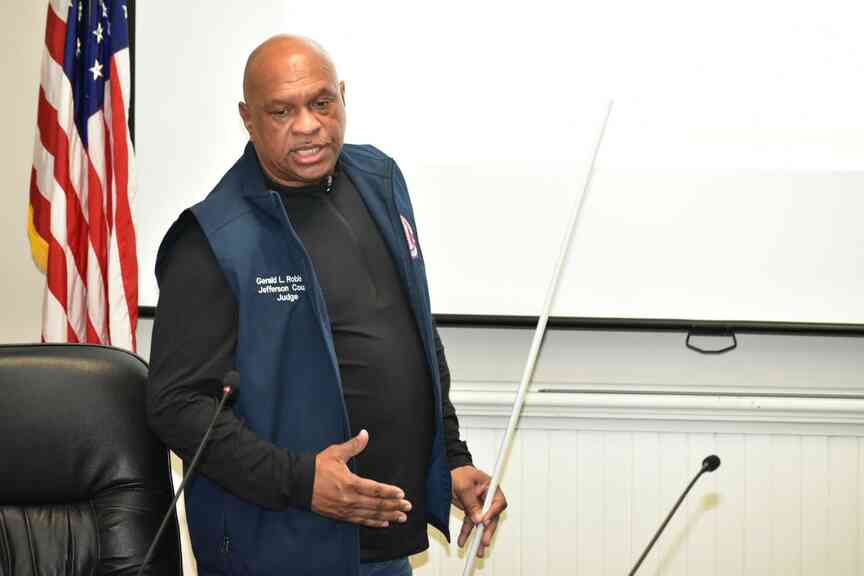
Jefferson County Judge Gerald Robinson has issued a veto on seven ordinances passed during the special-called Quorum Court meeting Thursday.
In a formal letter addressed to County Clerk Shawndra Taggart the following day, Robinson expressed concerns regarding the validity of the meeting, citing an “abundance of caution” as the reason for his decision. The ordinances addressed critical funding needs across various organizations, including the Department of Finance, Juvenile Justice Education, utilities, county clerk, District Court automation, assessor and Cooperative Extension.
The ordinances vetoed include:
Appropriation Ordinance No. 2025-31: This ordinance aimed to create Fund 3527, titled “Department of Finance Grant,” and appropriate $31,167 for various expenses, including salaries, supplies, medicines and training.
Independent reporting for Pine Bluff & Jefferson County since 1879.
Appropriation Ordinance No. 2025-32: This ordinance proposed transferring $680.43 from Fund 1809 (FINS & Truancy) to Fund 3401 (Juvenile Justice Education) to correct a payment error for an invoice intended for the 6th Division Circuit Court.
Appropriation Ordinance No. 2025-33: This ordinance sought a supplemental appropriation of $34,203.04 to Fund 1000-117 (Utilities) to cover increased phone service costs after switching from AT&T to Ritter Communications.
Appropriation Ordinance No. 2025-34: This ordinance proposed transferring $10,000 within Fund 1000 (County Clerk) to balance group totals and eliminate negative line items.
Appropriation Ordinance No. 2025-35: This ordinance aimed to create Fund 3003, titled “District Court Automation Fund,” and appropriate $15,000 for the purchase of new computers for the District Court.
Appropriation Ordinance No. 2025-36: This ordinance proposed transferring $1,000 within Fund 1000-105 (Assessor) from the telephone line item to the internet line item to balance the end-of-year budget.
Appropriation Ordinance No. 2025-37: This ordinance sought to reappropriate $20,500 within Fund 1000 (County General — Cooperative Extension) to cover outstanding invoices from fiscal ’24 that were inadvertently charged to the fiscal ’24 budget.
The Jefferson County Quorum Court also engaged in a discussion regarding a new ordinance establishing and adopting procedures within the county during their special-called meeting. The procedural ordinance, intended to govern the court’s operations for 2025 and 2026, sparked discussion, particularly because one was reportedly already in place.
Justice of the Peace Alfred Carroll chaired the meeting, with Justices of the Peace Brenda Bishop Gaddy, Melanie Johnson Dumas, Reginald Adams, Margarette Williams, Cedric Jackson, Reginald Johnson and Richard Victorino in attendance.
The Jefferson County Quorum Court passed a procedural ordinance in March 2025, which Robinson later disputed and challenged in court. Its validity was disputed because Robinson claimed the Quorum Court had been operating without a valid procedural ordinance in place, as stated in a previous court ruling.
In March, the Quorum Court passed a revised procedural ordinance, but Robinson later vetoed it. In April, the Quorum Court passed the ordinance unanimously with the required eight votes to override the veto. Carroll, who clarified his right to vote as a justice of the peace, cast one of the deciding votes.
When the question was raised about a procedural ordinance reappearing on the agenda, noting that it had already been passed, Carroll clarified the situation.
“Some issues were being raised in the public, so it was simply an action for any public concerned,” said Carroll, who said the action was at the advice of prosecuting attorney Kyle Hunter. He also clarified that the verbiage of the ordinance remained unchanged, and the repassing was for “clarity purposes” to address public concerns.
He also touched upon Robinson’s veto of several ordinances. Carroll expressed strong disagreement with Robinson’s approach to the veto.
“The judge cannot issue a blanket veto, which is illegal,” he said. “If he’s going to veto, he has to list each item and the reason for it; he cannot issue a blanket veto.”
A special-called meeting was then held on Monday as several ordinances were on their second reading. Carroll touched on the process for passing appropriation ordinances, indicating that with the rules not suspended, such ordinances could be passed with seven votes on their third reading.
The possibility of another meeting being called by a majority was also mentioned to get through the three readings before the next regular meeting next month. It will be at the next regular meeting that Carroll said they will vote to override Robinson’s veto.
Earlier this month, the Quorum Court voted against two crucial appropriation ordinances from the judge’s office. These ordinances were intended to fund the County General and Veteran Services, leaving the county judge’s office without the necessary financial resources to maintain essential services, Robinson said.
An ordinance to fund the County General County Judge account for $575,751 would have authorized Robinson to provide an appropriation within County Judge and Buildings and Grounds accounts. The ordinance failed 7-5.
The other ordinance to fund the Veteran Service fund for $15,000 failed 7-5.
Adams, Williams, Dumas, Jackson, Gaddy, Johnson and Carroll voted against the measures while Victorino abstained from both.
Several justices of the peace believed the appropriation ordinance for the county judge should not have combined all vendors and contractors.
In a statement on operational hardships by Robinson released Tuesday, he said the daily operations of the Jefferson County judge’s office have been significantly hampered by what he describes as “ongoing obstruction by eight Justices of the Peace working against the County Judge’s administration.”
“Their collective actions have made it extremely difficult for the departments under the Judge’s Office to function properly and for the Judge’s staff to perform daily duties that directly serve the public,” Robinson stated in a recent news release.
Among the most critical issues highlighted by the judge’s office are:
Email and communication disruption: Robinson’s staff has been locked out of official Gmail accounts due to an unpaid Google Workspace bill. This has severed access to vital communication tools necessary for court correspondence, departmental coordination and citizen responses.
Billing and document processing: The Adobe subscription, crucial for creating invoices, bills and financial documents, especially for the Road Department, has been suspended. This has resulted in delayed payments, interrupted project tracking and a growing backlog in accounting.
Interruption of essential services: Routine tasks such as maintenance orders, equipment requests and vendor communications have been stalled or entirely halted.
Loss of productivity: Robinson lamented the wasted time, stating, “Hours of the Judge’s staff time are being wasted attempting to work around systems that should already be functioning, diverting attention from real improvements in the county.”
Erosion of public trust: The constant appearance of conflict has, according to the judge’s office, “eroded public confidence in county leadership and raised concerns about transparency and stability.”
Employee impact: Dedicated employees within the judge’s office are reportedly “discouraged and uncertain about their ability to perform their duties amid political division.”
Stalled community progress: Projects aimed at improving roads, safety and public facilities have been delayed, significantly slowing progress throughout Jefferson County.
“Until these deliberate disruptions end, the focus of the judge’s office must remain on damage control more than development, which seems to be the goal of these JPs,” Robinson said. “The judge’s office will remain committed to protecting operations and ensuring that essential services continue for the citizens of Jefferson County.”