Even though the homicide rate in Pine Bluff in recent years is alarming — five have already taken place in this small city this year — a very small percentage of citizens are responsible for that and other violent crimes.
That’s just one nugget of information senior field advisers of the National Network for Safe Communities shared with Pine Bluff’s community leaders and law enforcers Monday at GVI University, a daylong seminar at the Pine Bluff Convention Center educating them on key components of Group Violence Intervention, a nationwide initiative that is gaining steam locally.
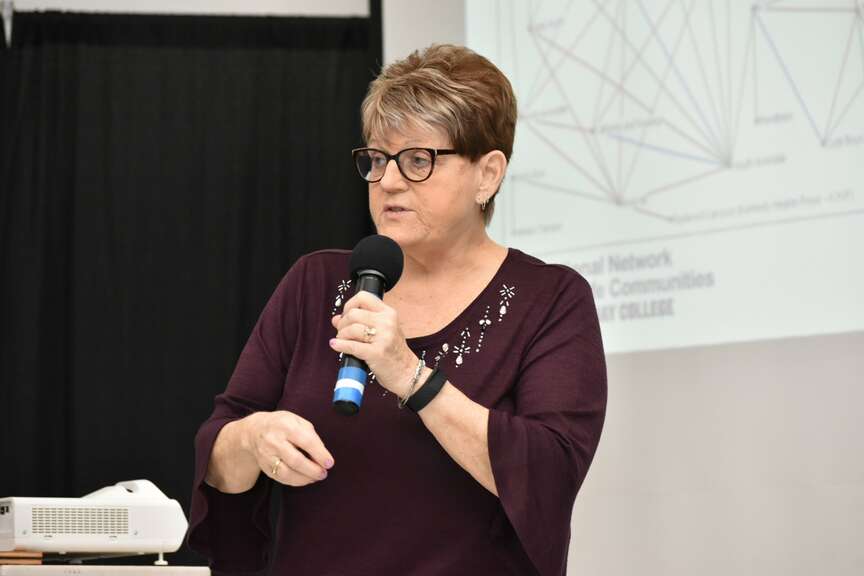
Former Cook County, Ill., deputy sheriff Debra Higens and Boston community developer Kevin Johnson are senior field advisers for the National Network, based at John Jay College in New York, and presented GVI University inside the ballroom. They discussed topics such as the GVI strategy, nature of street groups, strategic intervention, information sharing and communicating with groups.
Among statistics they revealed, 0.6% of the U.S. population are involved in violence and violent groups, and that small percentage is responsible for half of the homicides that occur.
Independent reporting for Pine Bluff & Jefferson County since 1879.
Despite Pine Bluff’s reputation as the least safe U.S. small city, as labeled by MoneyGeek.com last summer, Johnson stated there is no such thing as a dangerous neighborhood, adding neighborhoods with the highest rates of homicide at any given moment is a small fraction of the population that is at high risk.
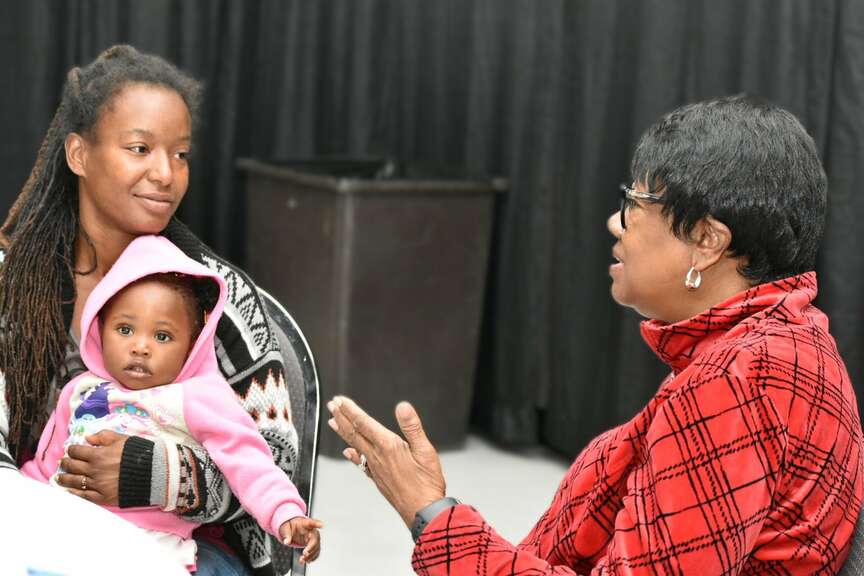
Pine Bluff, however, offers Dotiana Dawson and her family — a husband, 2-year-old son and young niece and nephew — a better quality of life, she said. The family moved from Los Angeles last August.
One ingredient Dawson named in the higher quality of life is gratefulness, adding Pine Bluff “supersedes” her past residences — Atlanta, Philadelphia and others — in that.
“I think people need to appreciate having a small community like this because you’re more able to know your neighbors, even if you’re just meeting somebody for the first time,” she said. “If you guys talk long enough, you realize that somebody knows somebody. That connection and sense of unity is a lot stronger down here. I believe it’s due to having a smaller population down here.”
Dawson and her husband are working to get their nonprofit organization, Extended Family, off the ground locally. Bridging the gap among neighbors, she explained, is crucial to fighting crime.
“If I consider you a family member, I’m less likely to end your life,” she said. “We can fight and have our disagreements, but at the end of the day, love is a unifying factor.”
The link between that and helping to reduce gang or group violence is receiving crucial information to learn more about what is happening in the community, Dawson explained.
“Sometimes there is a little disconnect between what you are seeing in the neighborhood and what is talked about in meetings, seeing if it matches up, and also seeing what people’s potential solutions are, like where people are coming from, and how to address what they believe is the problem,” she said.
The Rev. Kevin Crumpton, director of the Pine Bluff GVI, said he and other team members will go into schools on Wednesdays to talk with principals and students and then strategize a peace walk from the hotspot areas of Pine Bluff.
Some of the statistics revealed Monday, Crumpton said, have come into play in Pine Bluff.
“Since I’ve been the GVI director since November, now I’m keeping up with the homicides and stats,” he said. “I do see the groups and gangs. We identified 27 gangs that are here. That’s some information people need to know about.”
A gang, Johnson defined, implies a large national or international affiliation with a structure or hierarchy that usually conducts violence to make money. Groups are usually small, local and have no formal leadership, and most of the violence they commit isn’t about money.
Many of the homicides that have occurred are gang-related, Crumpton said. Some of the violence-related behavior is also taking place in schools, and GVI officials are taking on the challenge of reducing such problems.
“We’re seeing it at a young age at elementary schools,” he said. “There are group fights. A lot of kids got this generational thing going on, two or three generations of family members who have been in gangs, and so they just changed the name.”