
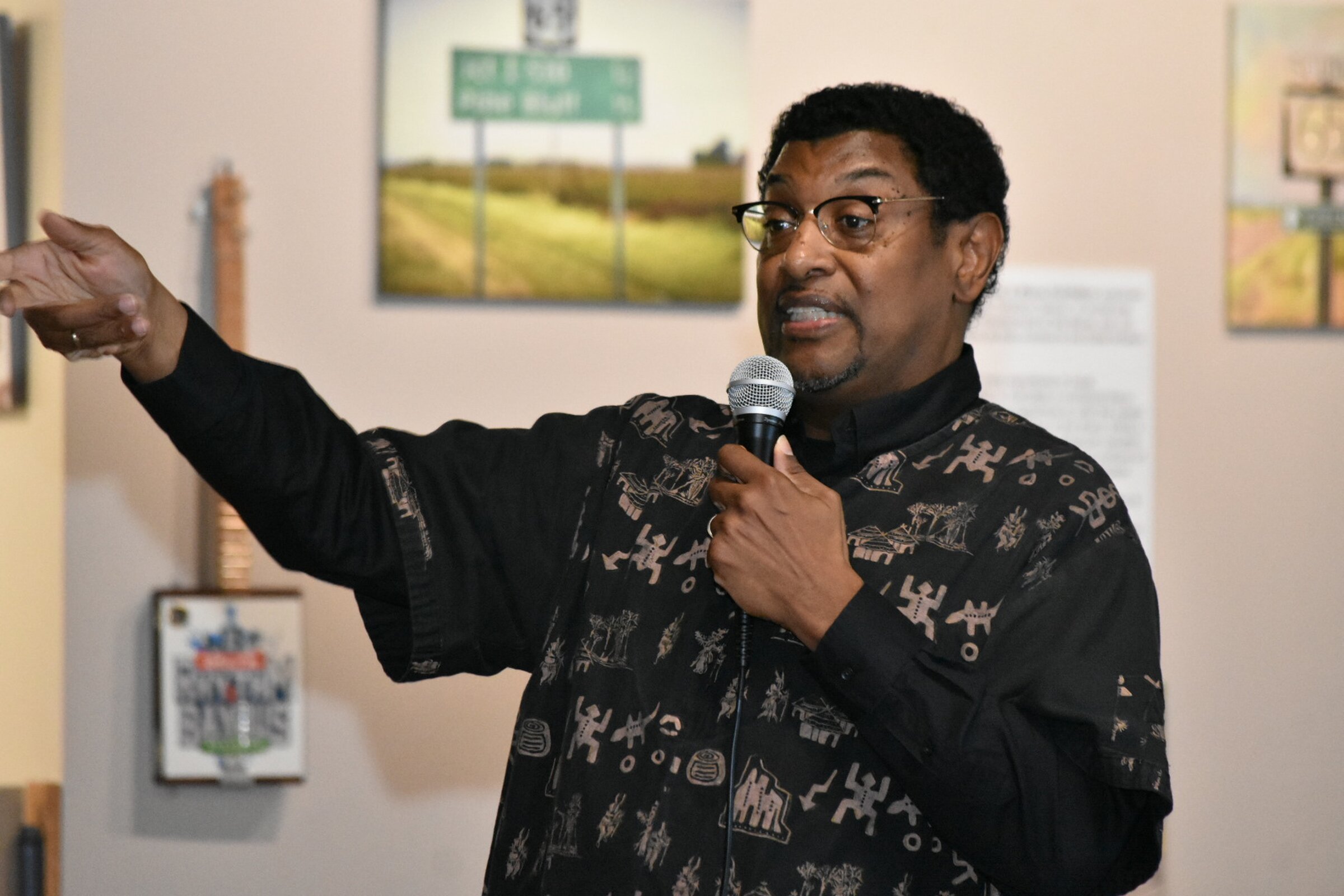
Historians and community leaders from Pine Bluff and Greenville, Miss., gathered at the UAPB Business Support Incubator on Monday to further plan the development of the Delta Rhythm & Bayous Highway, the designation for U.S. 65 South and U.S. 82 East with the two cities as principal locations along the route.
But to take plans to another level, the Delta Rhythm & Bayous Alliance — the group that helped secure designation of the highways from the Arkansas and Mississippi state legislatures in 2017 — is seeking to receive a grant from the Andrew W. Mellon Foundation, a New York-based benefactor of arts and humanities projects named after an industrialist who served as U.S. Secretary of the Treasury in the early 20th century. The foundation awarded more than $510 million to projects in 2021, according to its website.
“The Mellon Foundation is a big deal,” said Jimmy Cunningham Jr., Pine Bluff’s tourism development director who is also the visionary behind the cultural district. “We have to be invited [to apply]. We’ve tried to use this opportunity to get every ‘i’ dotted and every ‘t’ crossed. We’re going to be approaching them with all of our costs in place. We’re going to be talking with them about the fact this is a regional collaboration. We think that will strengthen our application, that this is across the region.”
How much the DRBA could receive is yet to be determined. Cunningham said the group is waiting to receive costs from an architect this month to have a better idea of what the budget will be like, adding they may solicit help from other foundations as well.
Independent reporting for Pine Bluff & Jefferson County since 1879.
The city of Pine Bluff has committed $2 million to a downtown Delta Rhythm & Bayous Cultural District that Cunningham envisions will be the epicenter of the route.
“The $2 million is largely for that one venue,” Cunningham said. “We have a $500,000 grant that’s pending. That’s the TAP [federal, refundable Transportation Alternatives Program] grant, and we’re getting costs back. We’re thinking this could be another million dollars or a million and a half, but we’ll have a better sense of what this means. This is all to give people a taste of what the big picture is, so this is the signature portion or just the epicenter, but if we show this to people and let them see what it is we’re talking about, we think we’re going to have broad support for building out even more, not only in the epicenter but other parts of the district as well.”
The project has piqued the interest of Cynthia Gray-Hines, a Pine Bluff native who presides over the advisory board for a similar alliance in Washington County, Miss., of which Greenville is the seat.
“I understand very well the story Mr. Cunningham is telling. He and I are classmates,” Gray-Hines said. “So, one of the things I think is very important is the regional concept, because often you hear people talk about the music but they don’t always understand the history of the music or the places that dot the proverbial highway as we come down.”
Gray-Hines referred to the social issues of a segregated early 20th century that shaped the music and the message of the blues, such as a public lynching of a Black person as reported by a now-defunct Pine Bluff newspaper. The clipping of that story is now framed inside the dining hall of the incubator.
Those who participated in the workshop pushed for the enlightening and difficult social stories related to the region where the blues was arguably birthed.
“Mississippi touts itself as the home of music, but in reality music came from the South and it came from pretty hard stories, some horrendous stories, if you will,” Gray-Hines said. “We don’t talk about the story. We just talk about the music, and we have to correct that.”
Telling the uncomfortable stories and showing how the blues has connected to younger generations and other genres of music are just two missions Cunningham has established for the cultural district. He made it clear his goal is not to let the district become another run-of-the-mill historical site that only highlights the bullet points of a timeline.
Community leaders agree with the idea.
“How about telling the authentic story, the real story?” said Joni Alexander Robinson, a former Pine Bluff councilwoman and 2024 candidate for mayor who participated in small-group discussions about the project.
The real story is what people are looking for in tourism, said Catherine Maxwell Gardner of the Greenville Convention and Visitors Bureau.
“They come here, and they have questions when you’re trying to cover up and you’re trying to see, like in my town which is majority African American … they come here and they want to explore the Delta and know about our history and culture,” Maxwell Gardner said. The problem is, she added, some information isn’t correctly told.
Pine Bluff Ward 4 Councilman Bruce Lockett suggested a task force be created to present the true story for tour guides to share with visitors.
Gray-Hines embraces that challenge for her side of the Delta, which she said is years behind Cunningham’s alliance in planning.
“This is an opportunity to showcase Pine Bluff, but also Washington County, Mississippi, and Greenville, Miss.,” she said, adding Nelson Street in Greenville is known as a hub of up-and-coming R&B acts such as Ike and Tina Turner in the early days of the genre.
“Even though you were performing, you were still relegated to certain parts of town,” she said. “We have to tell that story. It is the good, the bad and the ugly. We can do that with this particular project, and we can tell the story of the folks who moved into the Delta.”
Development of the highway isn’t limited to Pine Bluff and Greenville. Cunningham said he’s applied with Winrock International of North Little Rock for grants to help with placemaking and building music assets in Gould, Dumas, Dermott and McGehee.
“It’s taken us a while to get to this point, but we have a template,” Cunningham said. “Once we get our stuff moving, we know that with Greenville and what we’re continuing to build down there, not only will we generate more support in Pine Bluff but also in Greenville. And, hopefully, as momentum works, we might have other foundations who might call us up.
“We intend to do a really bang-up job, and we’re going to have something unique.”
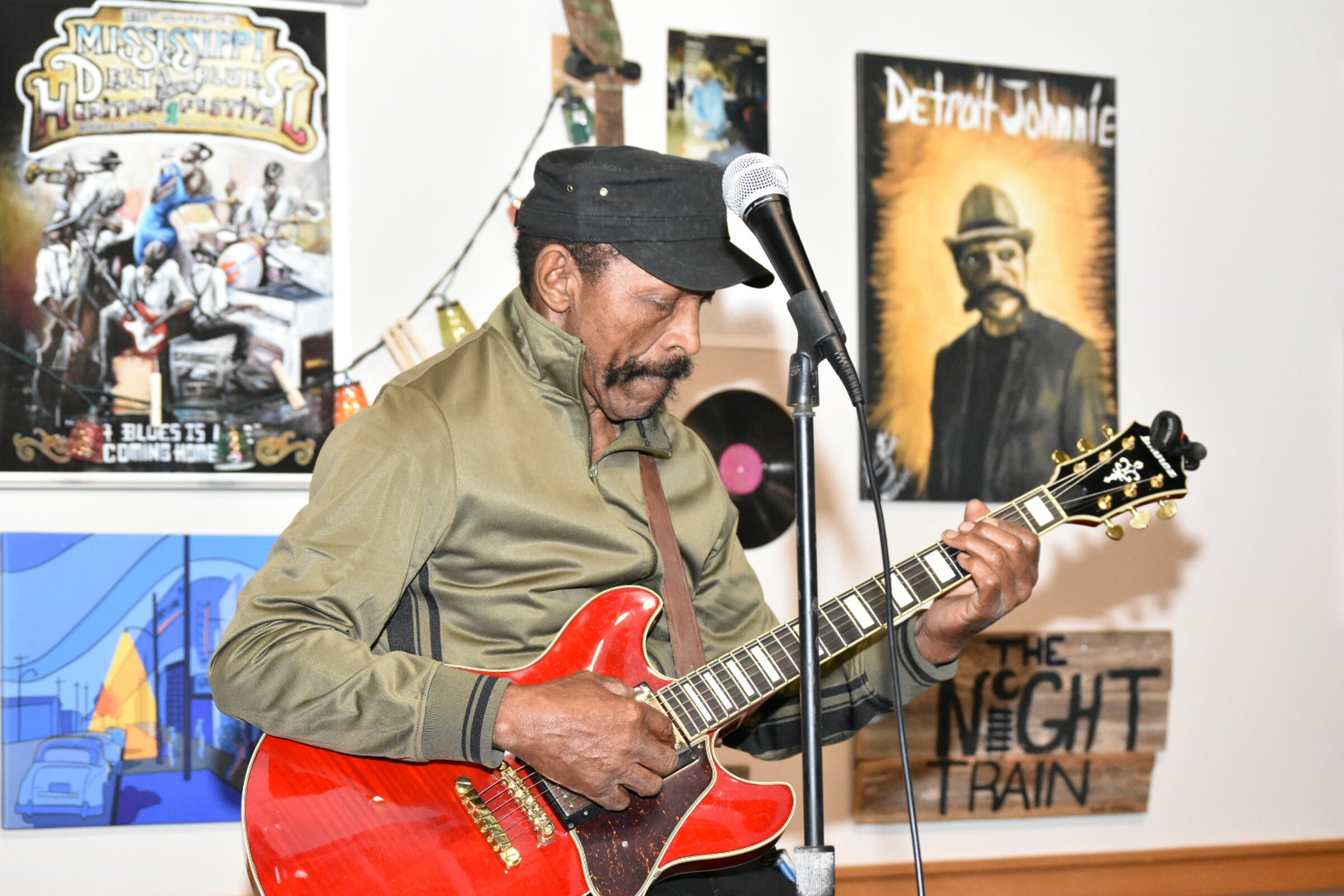 ”Detroit Johnny” Johnson plays some of his blues songs during a lunch break of a Delta Rhythm & Blues Alliance workshop. (Pine Bluff Commercial/I.C. Murrell)
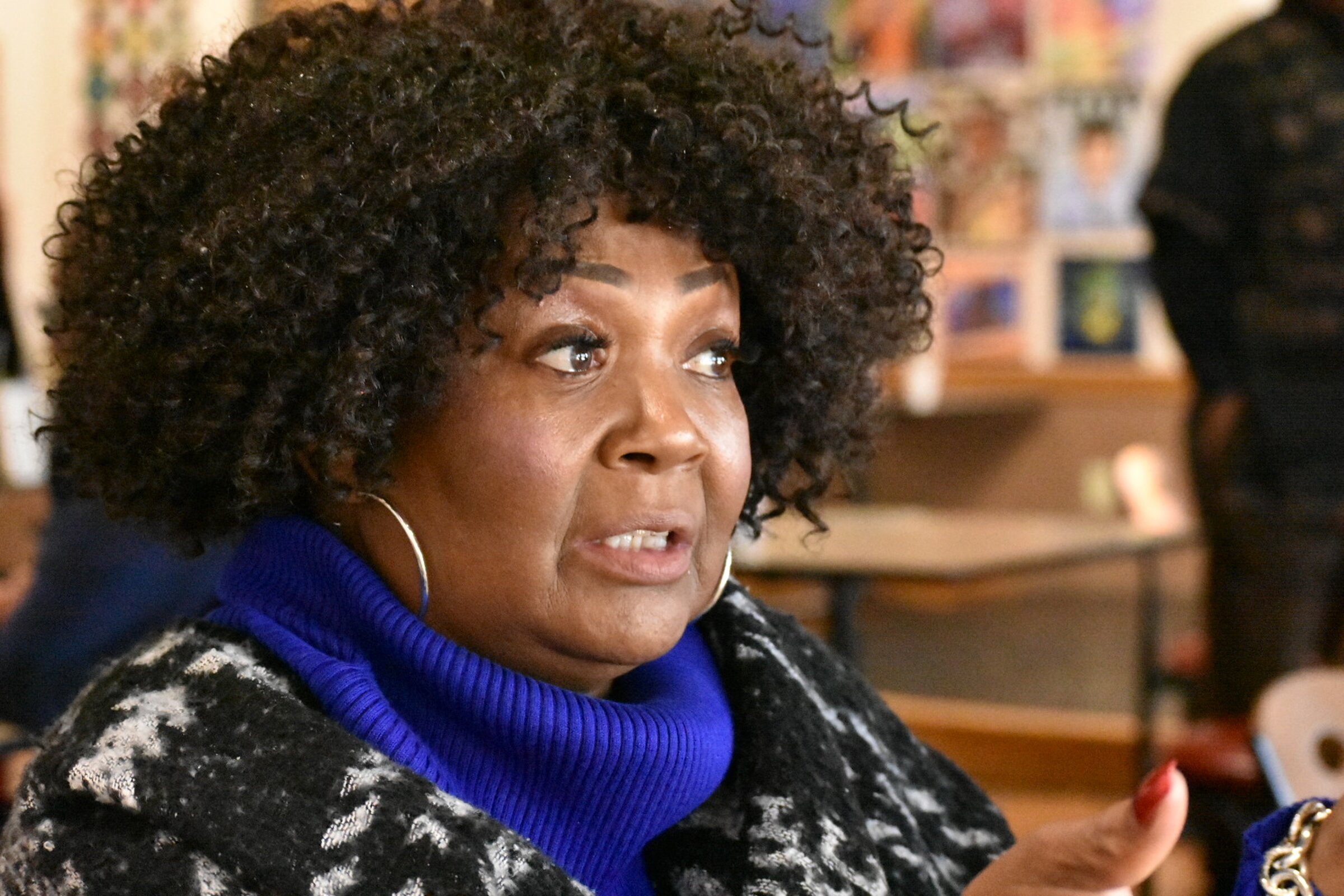 Catherine Maxwell Gardner of the Greenville, Miss., Convention and Visitors Bureau shares ideas during a small group session. (Pine Bluff Commercial/I.C. Murrell)
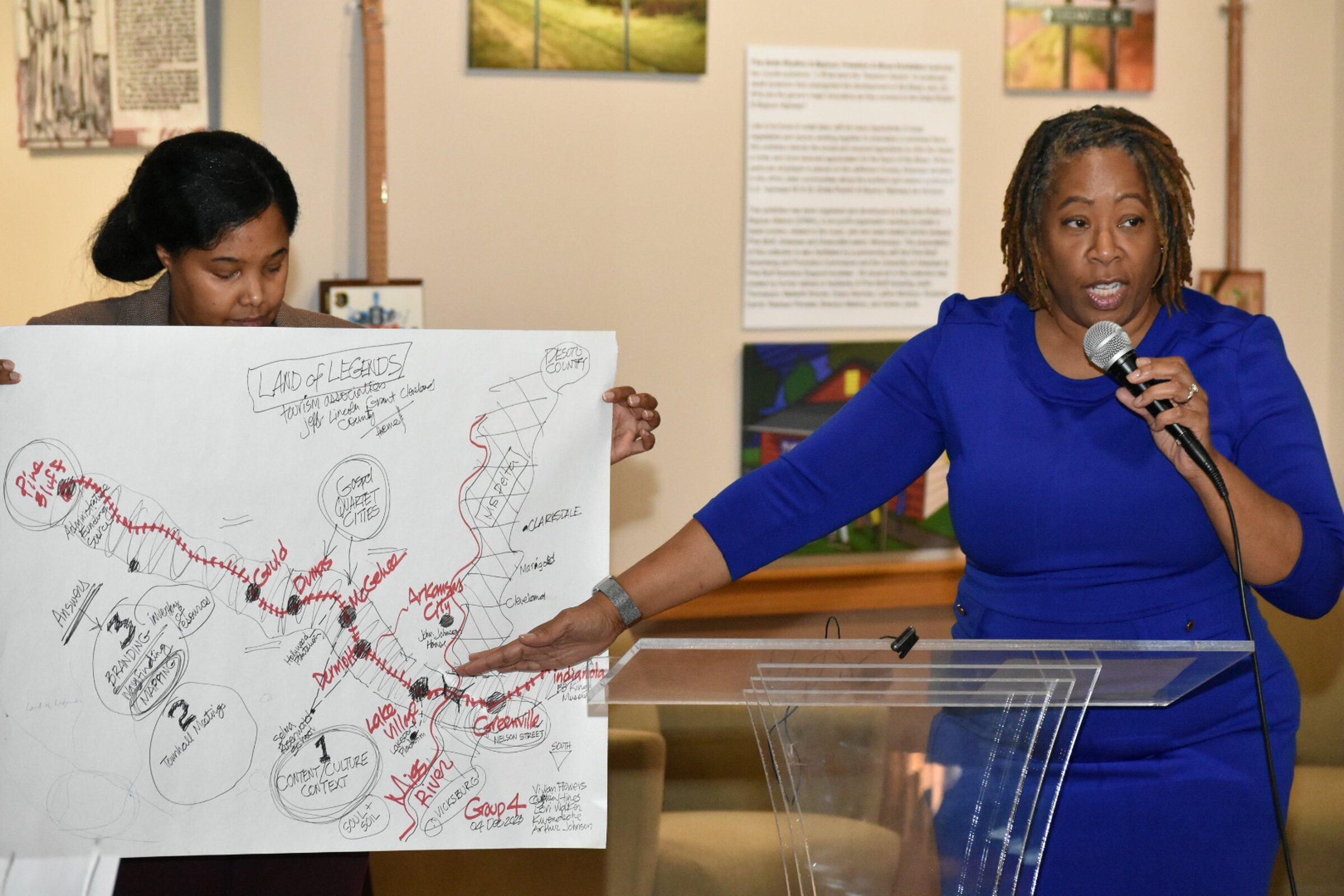 Cynthia Gray-Hines (right), a Pine Bluff native who leads a Delta Rhythm & Blues Alliance in Washington County, Miss., points out a group illustration of the Delta Rhythm & Blues Highway from Pine Bluff to Indianola, Miss. Holding the drawing is Lori Walker Guelache, director of economic and community development for Pine Bluff. (Pine Bluff Commercial/I.C. Murrell)