
Interested in getting The Pine Bluff Commercial’s newsletter delivered to your inbox every morning? Click here.
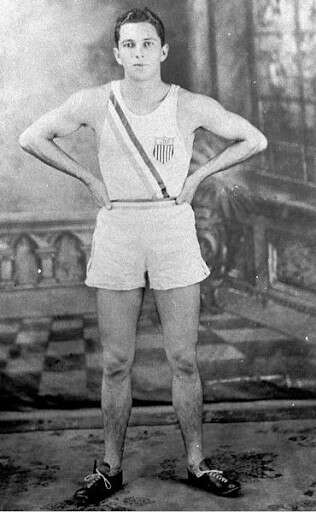
William “Bill” Arthur Carr was born in Pine Bluff on Oct. 24, 1909. He was the youngest of two sons born to William L. and Ann Holmes Carr. He became a freshman at Pine Bluff High School in the fall of 1925. Carr wanted to join a sports team, but at just 5’6” and 125 pounds, he was too small for both the basketball and football teams. However, his slight stature proved an asset when Carr joined the Pine Bluff High track and field team. Carr excelled at the jumping events. Unfortunately, he sprained both of his ankles and had to quit the team toward the end of his freshman season.
During his junior year, Carr rejoined the track and field team after being persuaded by some of his school officials. At the state championship in Arkansas that spring, his decision to rejoin the track team paid off. He garnered national attention for his high jump and long jump skills, breaking the record and winning both events by jumping 6’¾” and 21’4″, respectively. He even excelled in the running events by finishing second in both the 100-yard (100-meter) and 220-yard (200-meter) events. These athletic feats caused many sports writers to name Carr “the premier track star in the nation.”
Later that year, a Pine Bluff banker convinced him to attend Pennsylvania’s Mercersburg Preparatory Academy so he could prepare for the academic challenges of an Ivy League education. Carr did exactly what he went to Mercersburg to do, becoming the state champion in the long jump and the 100- and 200-meter races. He did so well that the University of Pennsylvania recruited him, and he became a student in the fall of 1929.
As a well-rounded student-athlete, Carr was elected president of his sophomore class and awarded the “Golden Spoon” for being the most outstanding, all-around student at Penn. While being coached by 1904 Olympian Lawson Robertson, Carr began to specialize in the 440-yard (400-meter) and 880-yard (800-meter) races as well as the long jump. As co-captain of Penn’s track and field team, Carr helped the university regain its high standing in the world’s athletic arena.
Independent reporting for Pine Bluff & Jefferson County since 1879.
In 1932, at the Intercollegiate Championships (the precursor to the National Collegiate Athletic Association or NCAA ), Carr beat world record holder Ben Eastman in the 440-yard dash, causing an upset. He secured his position on the U.S. Olympic team by beating Eastman again at the Olympic trials in Palo Alto several weeks later.
On Aug. 4, 1932, the Tenth World Olympiad began, at the newly constructed Los Angeles Coliseum. There Carr competed against the best 400-meter sprinters in the world. Carr won his 400-meter semi-final heat in 47.2 seconds, besting Eric Lidell’s 1924 Olympic record of 47.6 seconds. Eastman matched Lidell’s Olympic record in his semi-final heat. This rematch between these two great athletes was such an anticipated event that The New York Times called it the “400-meter race of the century.”
Carr proved himself to be a better competitor winning the race almost 2 meters ahead of Eastman, shattering the Olympic record he just set with a time of 46.2 seconds. Several days later, Carr anchored the US 4×400-meter relay team to an Olympic record-setting victory with a time of 3:08.2.
After the Olympics, Carr returned to Pine Bluff for a special awards ceremony, where he received a trophy in honor of his Olympic feats. On March 17 of that year, Carr broke both of his ankles and his pelvis in a car accident. Though his track and field career ended abruptly, Carr had never lost a race during his collegiate or Olympic career.
Carr graduated from Penn’s Wharton School in 1933 with a B.S. in Economics. He joined the U.S. Navy in World War II and served as a naval officer in the Pacific. He met his wife Rachel in Shanghai, China. After the war they moved to Japan, where he worked for several American insurance companies. Years after his Olympic victories, the accolades still poured in. In 1954, Sports Illustrated honored Carr as a member of their All-Time Olympic Team. In 1964, he was inducted into the Arkansas Sports Hall of Fame. His Olympic 400-meter record wasn’t contested until 1948 when it was tied.
Carr died of congestive heart failure in Japan on Jan. 14, 1966. He was buried in Pine Bluff’s Graceland Cemetery. In 2008, he was inducted into the National Track and Field Hall of Fame. Statues were also erected at Mercersburg Preparatory School and the University of Pennsylvania track and field stadium to honor his athletic and academic career.
Carr was such an impressive figure in Pine Bluff’s sports history that the Pine Bluff/Jefferson County Library System honored him with his own room at the Main Library called the Carr Memorial Room. Inside the Carr Memorial Room, there are many of Carr’s favorite books and portraits. The room also features his popular collection of insects, guns, and other memorabilia.
Recently, Jeff Gross, chairman of the committee for the Bill Carr Museum & Jefferson County Sports Hall of Fame, and Ricky Williams, director of the Pine Bluff/Jefferson County Main Library, have led the endeavor to transform the Bill Carr Room in the main library to the Bill Carr Museum and Jefferson County Sports Hall of Fame (JCSHOF).
When asked about the JCSHOF, Williams stated: “The legacy of Bill Carr and his greatness will be remembered even more now by recognizing the outstanding athletes in Jefferson County for the past 100 years. The Selection Committee is made of sports writers and historians, with nearly 200 combined years of experience, and possess knowledge that dates back more than six decades. They have been working for over a year on this project, and I feel we have a first-year class that could match any in the country.”
At a news conference at the Main Library on Dec. 11, the first six selections for the new Hall of Fame were announced. These six initial inductees to the Jefferson County Sports Hall of Fame include former NFL player and UAPB head coach Monte Coleman, NFL Hall of Fame members Don Hutson and Willie Roaf, former Major League Baseball greats Torii Hunter and Rickey Henderson and Pine Bluff legend Basil Shabazz. These Pine Bluff sports greats will formally be inducted on April 26, 2025, at the Pine Bluff Country Club.
In January, officials also named 15 athletes who will be honored as the Legends of the Hall, following six All-Time Greats who were named in December. The remainder of the class is expected to be named in February, with a banquet honoring the entire class April 26.
The Legends include Jim Benton, Joe Barry Carroll, Willie Davis, Jackie Harris, Juliet Jackson, Mike Jeffcoat, Carl Kidd, Andrew Lang, Lafayette “Fat” Lever, Cleo Miller, Ben Pearson, Ulysses “U.S.” Reed, Jackie Ridgle, Freddie Scott and Dante Wesley.
This article is from ExplorePineBluff.com, a program of the Pine Bluff Advertising and Promotion Commission. Sources: www. EncyclopediaofArkansas.net — Bill Carr (1909–1966); www.ExplorePineBluff.com — Meet Olympian Bill Carr; www.archives.upenn.edu — William Arthur Carr 1909 – 1966; www.pineblufflibrary.org — Carr Memorial Room; www.pbcommercial.com.
Ninfa O. Barnard wrote this article for ExplorePineBluff.com.