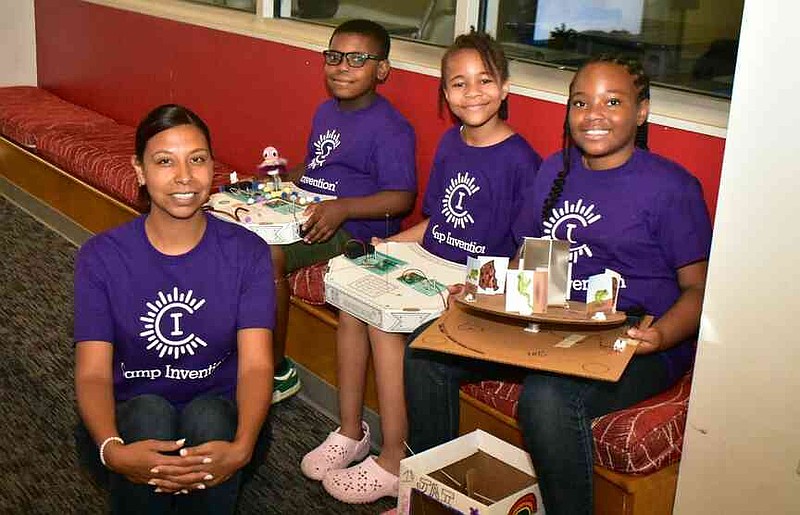
As a second-grade English/language arts teacher, Claudia Lozano challenged elementary students — and herself — to embrace the challenge of innovation.
“Out of my comfort zone, but I’m so glad I chose this,” Lozano said about leading a session where students were in control of their inventions during a weeklong Camp Invention at Friendship Aspire Academy Hazel Street Campus that concluded Friday. “I’m so glad I chose the In-Control session because it was a lot of hands-on lessons and I also learned a few things.”
Lozano’s campers learned how to build Morse Code receivers, putting to use a message system artist Samuel Morse invented in the 1830s.
“The Morse code is usually used when, like, we are at war and we need to contact somebody faster than letters,” Avery Martin, 11, said. “Who knows? People have invented the phone, but there may not be any wi-fi there, so you won’t be able to send the message. You can use Morse code, which was invented in World War I to send messages to the mainland.”
At home, Lozano said she can relay Morse codes to her son, who also built a receiver.
Independent reporting for Pine Bluff & Jefferson County since 1879.
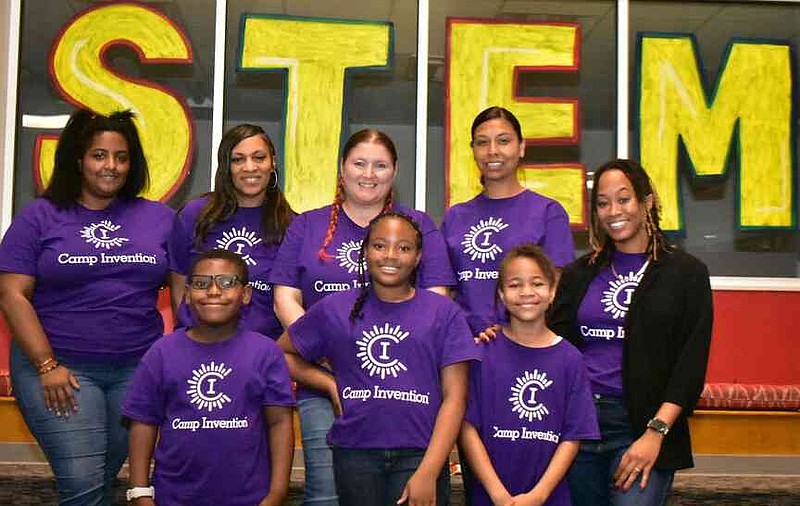
Markesha Spears, a fourth-grade science teacher, directed Camp Invention and teamed with four other teachers to aid about 65 students in their creations, including a “spin-a-scope,” Morse Code translator, and claw arcade. The students also learned about copyrighting and trademarking their work.
The camp was one of 1,500 nationwide as a project of the National Inventors Hall of Fame, open to students in grades K-6. The students attended camp free of charge thanks to a grant from the Walton Family Foundation, Spears said.
“They are in class with students they had never been in class with before and with students they had never seen before, so I wanted them to have an open mind and be able to adjust as they meet these new people,” Spears explained. “It starts now, learning how to cooperate with people and how to get along with people and learning how to take four or five initiatives.”
Student interns from local high schools also assisted by leading students in activities and games, Spears added.
Ten-year-old Jai’Yonni McDonald created a “spin-a-scope,” which creates a video illusion similar to that of a zoetrope. Jai’Yonni’s illustration shows a cookie being eaten down to vanishment.
“The pictures were pretty easy and simple, so that’s why I did a cookie,” she explained.
Kaison Thorn, 9, created his own Morse Code receiver and added an extra feature — a bobblehead toy.
The toy, Kaison said, “could keep us entertained” during the manufacturing phase.
Stephanie Akines, a kindergarten math-science teacher in kindergarten, showed students how to build a claw arcade, but not all of them were electronically powered.
“It was a lot of fun. Kids are excited about games in general, and they get to make their own to take home,” Akines said. “The inner workings were real nice to break down to them and explain it all.”
Akines said the students learned building these wasn’t as easy as it seemed, and they tried them out with pom-poms. In addition to building claw arcades, each student understood the value of entrepreneurship and coming up with ideas they could market.
Plus, Jai’Yonni embraced science even more.
“It increased my interest,” she said. “I never even liked science, but when I came here, it was fun making electronics like (a Morse Code receiver).”