
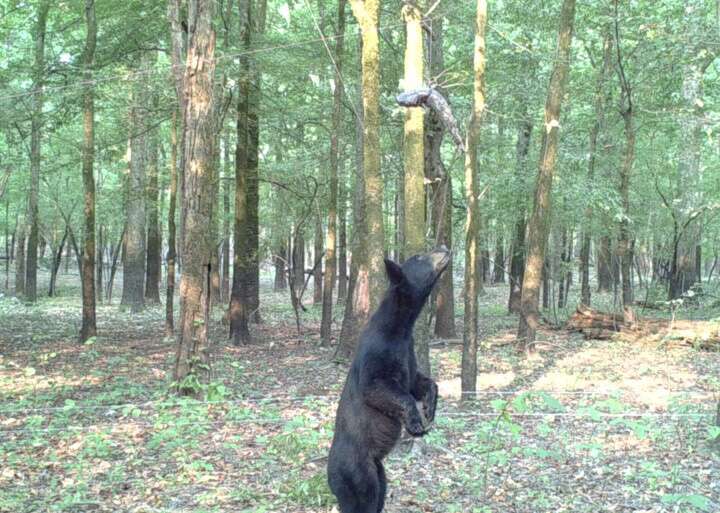
Black bear populations are slowly rising in the bottom land hardwood forests of southern and eastern Arkansas, according to wildlife expert Don White Jr.
Population modeling results from a recent study led by White indicate that the population density of black bears in the West Gulf Coastal Plain — WGCP — of southeast Arkansas is approximately one black bear for every 5 square miles. The black bear population in the area is growing at approximately 4% per year.
As the bear population has expanded in the WGCP over recent years, interest in hunting bears in the area has increased as well. However, establishing and maintaining sustainable harvest levels requires reliable information on the population status.
To assist the Arkansas Game and Fish Commission with setting harvest levels, White led a population study using hair snares across the region.
“To establish and maintain sustainable harvest levels for black bears, AGFC biologists need to know the number of bears that occur in the region and the growth rate of the population,” White said.
Independent reporting for Pine Bluff & Jefferson County since 1879.
During two summers within the past five years, White and his field crews placed 360 hair snares throughout the WGCP, including the Felsenthal and White River National Wildlife Refuges and the Trusten Holder Wildlife Management Area.
“A hair snare is nothing more than two strands of barbed wire stretched tightly around three to five trees,” said White. “Attractants such as candy flavorings and fish were then hung from a rope located at the center of each enclosure. As a bear is attracted to the scent, the bear crawls under or steps over the barbed wires. As they do, the bears get their hair snagged by the barbs. From these hair samples, DNA is extracted and used to identify each bear.”
Because the DNA of bears in southeast Arkansas is slightly different from the DNA of bears in the Ouachita and Ozark Mountains, DNA can also be used to better understand the movement of bears between different areas of the state.
“Bears from the Ouachita Mountains in western Arkansas may be dispersing and moving south and southeast. My AGFC colleagues and I are using our bear genetics data to better understand bear dispersal and map the locations of bear movement corridors. This is important work because genetically connected bear populations are healthier bear populations. Connected populations do not suffer the consequences of limited genetic variability like isolated populations do,” White said.
Throughout each nine-week collection period, field crews checked each hair snare every seven days. These crews consisted mostly of undergraduate wildlife conservation and management students in the College of Forestry, Agriculture, and Natural Resources at the University of Arkansas at Monticello.
“Opportunities to get paid to work on research projects provide students with valuable educational and professional opportunities,” White said.
White is a wildlife ecologist for the Arkansas Forest Resources Center of the University of Arkansas System Division of Agriculture, housed at UAM, and has studied black bears of Arkansas for almost 20 years. He is also a James White Endowed Professor of Wildlife with UAM.
Traci Rushing is with the University of Arkansas at Monticello’s College of Forestry, Agriculture and Natural Resources.
 Don White Jr.
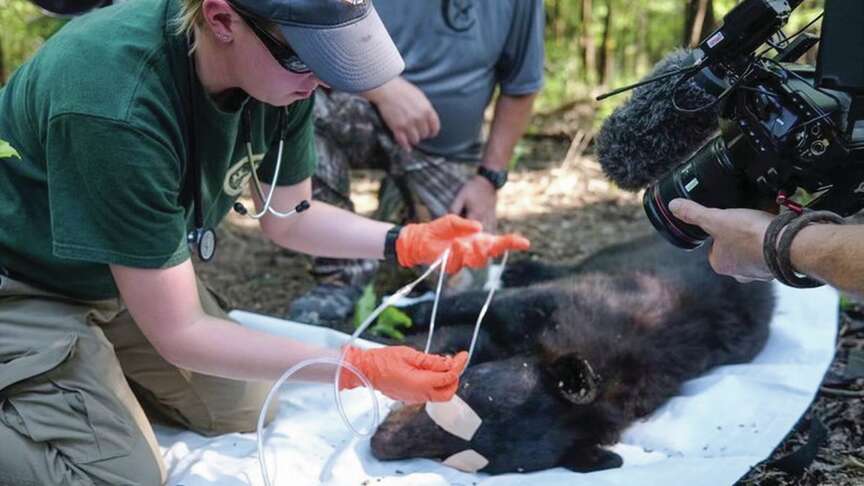 In 2022, the Arkansas Game and Fish Commission was looking for landowners willing to let them place GPS collars on female bears in Ashley, Bradley, Calhoun, Clark, Cleveland, Columbia, Drew, Nevada, Ouachita and Union counties. (Special to The Commercial/Arkansas Game and Fish Commission)